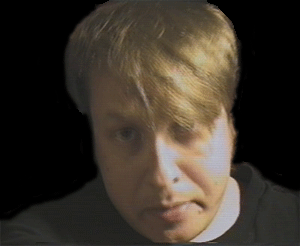
Karenlee Grant's collage art for the alternative version of A Clockwork Orange soundtrack (1972)
A Clockwork Orange -- a 1962 novel by Anthony Burgess and its 1971 film adaptation by Stanley Kubrick -- has stirred controversy and both positively and negatively influenced people in ensuing decades since the original conception. The movie was released in 1971, the same year as two other notoriety-gaining film studies on violence, Don Siegel's Dirty Harry and Sam Peckinpah's Straw Dogs, indicating that something had perhaps gone sore in the aftermath of the 60s liberal revolution.
Probably Burgess and Kubrick's intentions were not exactly ACO becoming such a pop phenomenon and starting a life of its own, inspiring countless artists in music (from David Bowie to Sigue Sigue Sputnik; punk movement being in general another reflection of the ACO ethos), fashion, and naturally other films (Oliver Stone's sensationalist Natural Born Killers lacked the philosophical depths and ironic nuances of Kubrick). My own take on ACO is as a sister work to Kubrick's 2001: A Space Odyssey (1968), perhaps depicting the sinister, seedy and violent circumstances of those unfortunate left on Earth while Dave Bowman and Discovery crew were on their more spiritually heightened, universe-embracing cosmic pursuits.
Here are some new-found interesting alternative takes on the phenomenon.
Feuilleton, the blog by British visual artist John Coulthart always worth checking, recently featured an entry on A Clockwork Orange and sounds & images connected to it.
Switched-On Bach was a 1968 album of Johann Sebastian Bach adaptations for the Moog synthesizer, painstakingly created by the electronic composer W. Carlos together with Rachel Elkind as a sort of sonic animation movie with multiple tape splices, when with early Moogs one could only generate one monophonic sound at a time. The album was a huge success in the days synthesizer was still mostly considered an expensive gimmick only good for creating spooky or funny sound effects for sci-fi movies and radio jingles, as is chronicled in Analog Days (2002) by Trevor Pinch and Frank Trocco. Or to be used in avantgarde music, allegedly with not too much commercial potential there.
Rock bands such as The Doors also had experimented with a Moog synth but the instrument was considered only good for creating weird psychedelic sounds, to spice up a bit the usual rock instrumentation, and not something one could create whole albums with. Switched-On Bach changed all that, and tons of more-or-less cheesy copycat Moog albums followed in its wake: there were some exceptions such as the works by Dick Hyman, but at this moment Moog felt like another passing craze.
Nevertheless, thanks to the album's success, Wendy Carlos was subsequently commissioned by Stanley Kubrick, planning his film version, to basically do the same thing for Ludwig van Beethoven, the favourite composer of Alex, in the book the devilish leader of his gang of "droogs".
Alongside the official film soundtrack, Wendy Carlos published in 1972 another album featuring also Carlos's compositions for the film that remained unused. On her page Carlos shares more information on her film music.
Allen Jones (b. 1937) is a British sculptor who came into prominence with his notorious "Chair, Table and Hat Stand" -- the jury is still out whether this is a misogynist work of glaring pop art verging on pornography or an ironic, even feministic comment on sexism. In a Guardian story Allen Jones tells Kubrick wanted to use his designs as props for the film but Jones refused, instead offering to design BSDM-type rubber costumes for the Korova Milk Bar waitresses (it's interesting Jones calls himself a feminist in the Guardian story). Kubrick didn't use the outfits by Jones but still emulated the artist's style for the bar's now-infamous forniphiliac furniture.
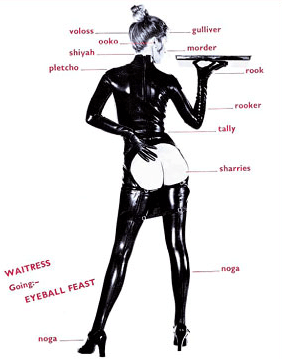

Some unused Clockwork Orange designs by Allen Jones