Showing posts with label music journalism. Show all posts
Showing posts with label music journalism. Show all posts
Sunday, July 20, 2008
Electronic Dance Music: Where Next?
Trips Festival, San Francisco, 1966 - an early "rave" with Donald Buchla sounds
Some food for thought by Philip Sherburne for electronic dance music artists, DJs, clubbers and fans:
http://www.pitchforkmedia.com/article/feature/142152-the-month-in-techno
Well, I have no answers or solutions. Personally, at the moment the past and origins seem to be more inspiring than the current state of club culture, as just finishing Analog Days (2002) on the early days of analogue synths (Moog, Buchla, ARP, EMS) proved.
Wednesday, March 19, 2008
Jyrki Hämäläinen (1942 - 2008)
Jyrki Hämäläinen interview (1997)
Finnish music journalist Jyrki "Jyräys" Hämäläinen has died. Hämäläinen (27 July 1942 - 18 March 2008) was best known as the chief editor of pop music magazine Suosikki ("Favourite") from 1968 to 2003. He also wrote several music books, including artist biographies for such as Ilkka "Danny" Lipsanen and Olavi Virta, also a biography of magazine mogul Urpo Lahtinen. Hämäläinen was known for his flamboyant and flashy writing style, also as one of the primus motors of the celebrity club Dean Martin Boozing Society.
Tuesday, January 29, 2008
Vladislav Delay @ The Wire

Berlin-based Finnish electronic artist Vladislav Delay (a.k.a. Sasu Ripatti a.k.a. Luomo a.k.a. Uusitalo) is featured on the cover story of February's issue of The Wire (#288), written by Philip Sherburne and titled "What makes today's Techno so different, so appealing?". The mag also features a stream of the track 'Lumi' from Vladislav Delay's latest album, Whistleblower.
---
As a bonus, I noticed The Wire Web archive includes an unedited transcript of the interview of Mad Mike Banks, the enigmatic frontman of Detroit's Underground Resistance label. (UR had a cover feature in the magazine's November 2007 issue.)
Wednesday, April 25, 2007
Simon Reynolds On 1970s Synth Gods
Tangerine Dream: Bathtub Session (1969)
Here is an interesting Observer Music Monthly article (22 April 2007) by Simon Reynolds on the 1970s pre-punk synth heroes like Tangerine Dream, Jean Michel Jarre, Steve Hillage/Miquette Giraudy, Vangelis, and so on.
Saturday, April 21, 2007
"Music Has Lost Its Futuristic Edge"
The Art of Noise: 'Beatbox' (1984)
A very interesting article from The Guardian (Friday 20 April 2007) (and Momus commenting it).
From the article:
... Music writer Jon Savage decides what of today's music to listen to by dividing it into two camps: the ersatz and the truly current. "My yardstick about modern records," he says, "is does it sound as though it could only have been recorded in 2007? If it does, great; if it doesn't, boring."
But Savage also feels that, especially when it comes to rock, "music has lost its futuristic edge". And his fellow music writer Paul Morley agrees. "Instead of music moving forward," Morley says, "there was a moment - which you could pin down to around Britpop, or even earlier - when it started to fold backwards on itself. Instead of music having an idealistic need to create a future, to change things and have enough optimism to believe that could happen, it has ground to a halt."
[...] the ideology that fired Morley in the 80s, when he was making music with the Art of Noise. "In a way we anticipated what was about to happen," he says. "We described it as raiding the 20th century: this century of incredible innovation technologically, emotionally, intellectually and aesthetically, which you could raid for influences, putting together a bit from here and a bit from there to create something astounding." Where Morley and Art of Noise differed from 21st-century bands, however, was in their lack of respect for the past. "Coming from a post-punk world, I was very committed to originality, to moving forward," he says. New production techniques had given rise to a new vision for music, and he was determined to be at the forefront. "Rock cliches were going to be buried in the past - even guitars. We were moving into the future: you could kind of believe that was true."
[...] "I cannot help but marvel at how peculiar that is," says Morley. "Something that was meant to be a radical music has become truly conservative, in that it conserves: it's recreating shapes and riffs and sounds that have happened before."
He's not the only one troubled by this. "I cannot stand the fact that so much rock music is ridiculously retro," says Savage.
[...] Another crucial change in the consumption of music has, says Morley, made it harder than ever for the truly original to be heard. "The coverage of music has been democratically spread into the broadsheets, radio and television; pop music seems to be everywhere. But in a funny way that means there's more interference to finding new music. So much that is familiar is being declared the 'new' thing by the record industry, the advertising industry and the mainstream media, anything that is truly unfamiliar and moving forward is more neglected than ever before."
[...] "There is a world," [Morley] suggests, "where, when people say, 'Where are the new Beatles?' the answer is the internet. We've got the new thing - we just haven't been looking in the right place for it."
Monday, February 26, 2007
Jori Hulkkonen on the Sad State of Post-Electronica Days

Finnish electronic artist Jori Hulkkonen has now released an album of his new synthpop type project called Processory, featuring vocals from a mystical person called Jerry Valuri (reading from between the lines in the interview quoted below, it's indicated that it's just Jori himself, though obviously Mr. Hulkkonen would go to lengths to deny this).
So in occasion, Finnish music magazine Sue interviews in their latest issue Jori Hulkkonen, who gives some interesting comments about the current reception of electronic (dance) music in Finland after the late 90s craze of electronica; probably this applies to mainstream media around the world too:
"Suomessa ollaan konservatiivisia. Nyt on jopa otettu muutama askel taaksepäin. 90-luvun lopulla, kun elektroninen musiikki oli kaupallisesti menestyvää, löytyi ulkokultaista pro-electronica-asennetta. Oltiin ymmärtävinään sitä kulttuuria. Nyt kun se ei ole enää niin suosittua, paukutellaan henkseleitä, että kyllähän me tiedettiin, ettei se kestä. Se on tavallaan huvittavaa."
As my rough translation this would go something like:
"People in Finland are conservative. Now they have even taken some steps backwards. In the end of 90s when electronic music was commercially successful, there was a lot of cant pro-electronica attitude. One pretended to understand that culture. Now, when it's not that popular anymore, one is boasting that, yes, we did know that it wouldn't last. That's amusing in a way."
What Jori Hulkkonen says here is very symptomatic about the ways media seems to work. After electronica (the moniker many hated) inevitably became unfashionable, music media did what they were expected to do: the return "back to basics", and the re-emergence guitar rock and all the popular myths contained in it, still lovingly favoured by the white middle-aged male music critics who dominate music mags the world over. Out go the Roland and Korg synths, 303s, 808s, 909s; in come (for the nth time in the music history of the last 50 years) the Fender Stratocasters and Telecasters. Enter The Strokes, The White Stripes, The Libertines and myriads of other "s"-suffix bands of young hopefuls donning leather jackets, 80s-style stretch jeans, sneakers, shaggy haircuts and overdriven guitar sounds. It was 1979 again, and again and again; the celebration of recycled sounds. After these "s"-bands had their respective turn to lose their hold in music fashion, then it was time to dig up the late 60s/early 70s folk sounds, where "singer-songerwriters" and Mother Nature's hirsute sons and daughters ruled supreme: psychedelic folk, forest folk, New Weird of America/Finland/Antarctica/whatever. All in all, electronic dance music went back underground -- where some people think it should also stay.
Tuesday, January 30, 2007
Nu Rave?
Klaxons: 'Magick'
Klaxons: 'Golden Skans'
Klaxons, supposedly "Nu Rave" -- so how come I am not holding my breath...?
From Wikipedia:
New Rave (also spelt Neu Rave and Nu Rave), is a developing style of music fusing elements of electronic dance music and rock. It has similarities with US-led style Dance-punk. Music publication NME are largely responsible for popularising the term.
Nu-Rave can also refer to the resurgent breakbeat hardcore scene.
It can also be applied to a burgeoning fashion style, wherein 'rave' elements such as neon clothing, glow sticks, and baggy t-shirts teamed with leggings are re-appropriated.
Electronic dance music/rock crossovers are nothing new in itself: there are such examples in the early 90s indie heroes as Primal Scream (especially their Screamadelica of 1991), EMF and their hit 'Unbelievable', Pop Will Eat Itself, Jesus Jones... but does anyone remember Carter The Unstoppable Sex Machine any more...? For the uninitiated (and someone who remembers the original Rave) the word combination (and personal fantasy concept) Nu Rave in itself just sounds great -- that silly but enchanting charm of acts like Altern-8 and early (pre-guitar) Prodigy updated for the new millennium and with new super sounds, perhaps? The return of warehouse parties in a totally fresh, smart and turbo-charged new generation version? -- but if this is just another cynical redressing for tinny-sounding NME indie guitar bands, then there's no reason to hold your breath. Maybe the problem with Nu Rave is that there is just not enough Rave in it.
Addition, 31 January 2007
Well, at least the Klaxons seem to have some decent reading habits: namechecking William S. Burroughs' Interzone and Thomas Pynchon's Gravity's Rainbow in their songs. Perhaps they would just desperately need a Kompleksi remix [grin]...
Friday, April 07, 2006
Recalling Germany Calling and Deutsch Rock - Part 3

Here is the third and final part of David McConnell's article on the late Ian McDonald's harsh and undeserved criticism of Krautrock in NME, 1973.
Wednesday, January 18, 2006
Recalling Germany Calling and Deutsch Rock: Part 2

David McConnell has written an article commenting the late Ian MacDonald's negative Krautrock writings in NME, 1973. The first part of McConnell's article was published at pHinnWeb last year, and you can find the second part here.
Krautrock @ pHinnWeb
Thursday, November 17, 2005
Fffolk Vs. Electronicszzz
On his blog Voltage, Max Clarke a.k.a. Maxx Klaxon raises some interesting points about the current folk revival.
As someone who subscribes to ooooo mailing list (the home of Finnish marginal and eclectic music, among all with most of those folk(s) belonging to the "New Weird of Finland" movement lauded in The Wire and international zines) and has followed what people like Kemialliset Ystävät are doing, I find this quite interesting. I might argue that what I find myself attracted to in this sort of music (often called "psychedelic folk" or "New Weird of...") is not the fact that it is created with acoustic instruments but the overall spirit of experimentation that is found there: all those weird sounds and otherworldy ambience. Those are not exactly traditional strumming acoustic guitar by campfire sounds, but something totally creating a world one can call its own. Then, I'm not familiar myself with most of the other artists belonging to this alleged "new folk" genre, e.g. Devandra Banhart, so I can't really comment this style in general.
Musical "fashions" repeat themselves in cycles and have a tendency to reflect the general Zeitgeist: in unsure times people obviously have a need to return to the "roots", to what is "safe", "tried and true". Even then, musical experimentation and seeking for what is "new" is bound to go on somewhere in the margins.
To throw more gasoline in the flames: how much there is that is actually "new" in current electro(nic) music, and how much of that is only recycling what was already done in the 1980s?
Anyway, this seems to me to be another revival of the age-old confrontation between "authentic", "natural", "down-to-Earth" acoustic/rock music and the "artificial", "unnatural", "unauthentic" electronic (dance/listening) music; of which I grew up tired years ago after countless "it is/it isn't" type of arguments which proved totally unfruitful and counterproductive in the end. Doesn't it only boil down to subjective tastes, personal likes and dislikes? An artist tries to make most of those instruments and resources at his/her disposal, whether they were acoustic or electric guitars, violins, flutes, kazoos, washboards, Moog synths, Roland's x0x series, MAX/MSP, empty oil barrels or rubber bands. In the end it's creativity that counts, not the means to reach that end result.
As someone who subscribes to ooooo mailing list (the home of Finnish marginal and eclectic music, among all with most of those folk(s) belonging to the "New Weird of Finland" movement lauded in The Wire and international zines) and has followed what people like Kemialliset Ystävät are doing, I find this quite interesting. I might argue that what I find myself attracted to in this sort of music (often called "psychedelic folk" or "New Weird of...") is not the fact that it is created with acoustic instruments but the overall spirit of experimentation that is found there: all those weird sounds and otherworldy ambience. Those are not exactly traditional strumming acoustic guitar by campfire sounds, but something totally creating a world one can call its own. Then, I'm not familiar myself with most of the other artists belonging to this alleged "new folk" genre, e.g. Devandra Banhart, so I can't really comment this style in general.
Musical "fashions" repeat themselves in cycles and have a tendency to reflect the general Zeitgeist: in unsure times people obviously have a need to return to the "roots", to what is "safe", "tried and true". Even then, musical experimentation and seeking for what is "new" is bound to go on somewhere in the margins.
To throw more gasoline in the flames: how much there is that is actually "new" in current electro(nic) music, and how much of that is only recycling what was already done in the 1980s?
Anyway, this seems to me to be another revival of the age-old confrontation between "authentic", "natural", "down-to-Earth" acoustic/rock music and the "artificial", "unnatural", "unauthentic" electronic (dance/listening) music; of which I grew up tired years ago after countless "it is/it isn't" type of arguments which proved totally unfruitful and counterproductive in the end. Doesn't it only boil down to subjective tastes, personal likes and dislikes? An artist tries to make most of those instruments and resources at his/her disposal, whether they were acoustic or electric guitars, violins, flutes, kazoos, washboards, Moog synths, Roland's x0x series, MAX/MSP, empty oil barrels or rubber bands. In the end it's creativity that counts, not the means to reach that end result.
Saturday, September 03, 2005
The Problems of Criticism
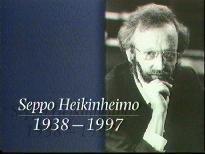
(Seppo Heikinheimo, the feared Finnish classical music critic who eventually committed suicide)
Lately I've faced some problems one has when giving and receiving criticism. There are both constructive criticism and unconstructive criticism. Unconstructive criticism is a confused mix of one's personal and subjective prejudices, biases, ignorance, frustrations and even aggressions; hardly ever giving valid arguments except those based on qualities mentioned above, and inclined to create crass generalisations and of fallacious logic. And, if possible, managing to even contradict oneself as often as possible.
Constructive criticism would require as its premises understanding at least a bit of the backgrounds and history, current scene and context. I'm not a fan of any of those current metal scenes myself, for example, but I restrain to make any comment of them, because being an outsider to that scene I have no means to understand or assess the meaning or even importance to someone, an insider, who has grown into it and derives a lot of personal sense of purpose from it.
I think a constructive critic should be able to weigh both the pros and cons of the work that are under his/her assessment and be able to place it to its appropriate genre(s) when considering the execution of its form (is it meant to polished or non-polished, e.g. progrock vs. lo-fi indie; work of an art school gradute vs. outsider art, professional vs. amateur, etc.)
And how should you assess a work of someone coming from your own peer group? Are there any other choices than to join in the mutual back-patting society? Or alternately, if you don't happen to like this person, kick the shit out of his/her work? Being impartial and objective is very hard.
Subscribe to:
Posts (Atom)