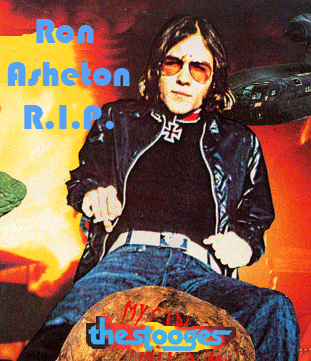
Ron Asheton, who played guitar for The Stooges, has died at the age of 60. The Stooges were born in the late 1960s in Ann Arbor, near Detroit, in the aftermath of psychedelia and garage rock explosion; often joining on gigs The MC5, who considered The Stooges their "little brother" band. Like Scott Asheton, his drummer brother and fellow Stooges member, Ron Asheton always remained in the shadow of Iggy Pop, the wild frontman of the band (who later became a successful solo artist, recording with such people as David Bowie), but it was Ron's spiky guitar sound which was there to influence punk rock some years after The Stooges had split.
The 21st century Stooges reunion saw Iggy, Ron and Scott together again, though for many fans the 2007 album The Weirdness is best to be forgotten: just stick to the classics, The Stooges (1969), Funhouse (1970) and Raw Power (1973; although Ron was only "reduced" to play bass there, with James Williamson on guitar) -- there's also plenty of sessions, unreleased and bootleg material around, just see The Stooges @ Discogs. As the band themselves put it on one of their more rare songs: Jesus Loves The Stooges! R.I.P. Ron.
Belgian artist Guy Peellaert has died at the age of 74. He was known from the controversial sleeve illustration of David Bowie's dystopian 1974 album Diamond Dogs (where Bowie appeared as a human-canine character whose genitals were deemed so offensive that they were airbrushed away from the release), also from the book Rock Dreams (1973), featuring Peellaert's fantasy illustrations of some of the biggest icons of rock history (with commentary by the rock critic Nik Cohn), and several film posters for such as Taxi Driver.
Mitch Mitchell, who played drums with The Jimi Hendrix Experience, has died at the age of 61. Mitchell was the last surviving member of The Experience, Hendrix having passed away in 1970 and the bassist Noel Redding in 2003.
The heroes of the late 70s/early 80s futu-pop: Kraftwerk, Ultravox, John Foxx, The Human League, Cabaret Voltaire, Gary Numan, Yellow Magic Orchestra, Soft Cell, Visage, Depeche Mode... and Neil Young? Yes, so it seemed when Young released in 1982 Trans, a synth and vocoder-laden (Moog 16-Channel MBVO Vocoder, to be exact) album featuring futuristic paeans to electronic age in general.
This happened way before ZZ Top added synthetic sounds to their own boogie rock on albums like Afterburner (1985). Old Young fans more accustomed to his earthy singer-songwriter style were baffled, to say the least, the reviews were mixed and this remained Young's only foray into electronic pop. Young's interest to vocoder may have originated when he found out using this device it was easier for him to communicate with his son who had a cerebral palsy. Also hearing Kraftwerk's now-classic Computer World (1981) seems to have inspired Young to explore this sort of sound.
Tracks such as 'Computer Cowboy' preceded the mid-80s cyberpunk craze: "Ride along computer cowboy / To the city just in time / To bring another system down / And leave your alias behind: Computer syscrusher". (I think some echoes of the part-utopian/part-dystopian songs of Trans can be found on the postrock band Trans Am's 1999 album Futureworld -- Young also has a track called 'Trans Am' on 1994's Sleeps With Angels.)
Some commentators tell Neil Young later disowned this record, though a page at Human Highway dedicated to the album claims: "Contrary to most people's opinion, Neil Young says that this is the one of his best two albums. The other was Everybody's Rockin'". Anyway, something about the difficult reception to the album is revealed by the fact that Trans has never been re-released on CD in the US. Nevertheless, as an electronic curio diversion to its creator's usual output and representing the era of early home-computers and futuristic dreams still prevalent in pop those days, I find the album quite enjoyable: Neil Young, the original cyberpunk cowboy?
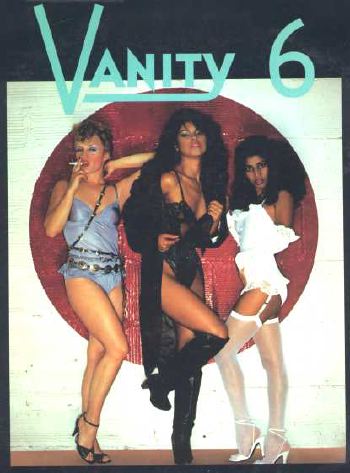
Prince obviously doesn't like Websites featuring his images, videos, lyrics or music, so here instead some pics of his early-80s protégés, a girl group Vanity 6, which later became Apollonia 6.
Prince just got 50 -- pHinnWeb congratulates. I am a huge fan of his 80s output, Prince's "Golden Age" with the winning series of albums like Dirty Mind (1980), Controversy (1981), 1999 (1982), Purple Rain (1984), Around the World in a Day (1985), Parade (1986) and Sign 'O' The Times (1987). Perhaps I'll give a closer dissemination of these one day. Anywhere, it was Lovesexy (1988) which started 2 leave me cold and after which I didn't have 2 collect from him just everything I could get into my hands. Anyway, thank U 4 the memories, influence and inspiration -- may U still live 2 see The Dawn (and hopefully a return 2 the form one day).
[NOTE: THIS COMPILATION HAS NOT BEEN OFFICIALLY RELEASED YET. PLEASE, DON'T SEND ME ANY ENQUIRIES ABOUT WHERE TO GET IT. Whenever I will receive information about the official release and label, I am going to add the info to this blog; before that, ALL ENQUIRIES WILL BE IGNORED.]
Some time ago I received from Euphonic, a Finnish record collector, this 2-CDR compilation which is now seeking for an official release. Suffice it to say I was very happily surprised and also truly flabbergasted by the contents here. You see, as old fans of this type of music, for some years me and some friends have been toying with the idea of a Finnish counterpart to the legendary compilation records Nuggets and Pebbles, consisting of garage rock, freakbeat and psychedelic pop of the 1960s.
The quest for similar Finnish bands and songs from the same era has been mind-boggling but not a little bit frustrating, especially with us not being heavy-duty vinyl-hunting record collectors ourselves but rather lazy dabblers usually happy with CD re-releases; it also often having felt there are scarcely a handful of local examples which would have even remotely fitted to this template. In that period between the early 60s Finnish rautalanka craze (instrumental guitar bands styled after The Ventures, The Shadows, et al.) and the progressive rock bands such as Wigwam and Tasavallan Presidentti emerging in the end of that same decade, as Euphonic expertly points out with his track choices, there was apparently quite a lot of "Nuggetish" music from local bands; many of them unfortunately lost in the mists of time. At least before their re-emergence here.
On the other hand, the question of what is exactly kosher and what is not for this type of compilation is of some dispute. It's good to remember even the variety of selections on countless Nuggets compilations and CD boxes can be quite heterogenous; varying from raunchier "proto-punk" of the bands like The Sonics to some more light and soft pop or ballads, even though of slightly psychedelic (or pseudo-psychedelic) flavour. Euphonic commented in the related thread at GaragePunk.com another similarly-themed (and also unofficial) compilation Pebbles from the Shores of Thousand Lakes, that the "comp was well meant and all that, but it really stretches the whole Nuggets concept into unrecognizability by including a lot of material that simply does not belong there". Likewise, following these same strict criteria, pHinnWeb's own tentative efforts to find a repertoire of representative songs here might be considered more or less misled, too... Personal tastes and preferences aside, I really think Euphonic (and his contributing record-collecting compadres) has done an amazing work here in digging up some of these little musical, erm, nuggets (or, perhaps in this case, frosty ice-covered pebbles).
The collection features a booklet of extensive liner notes by Euphonic; featuring a chockful of background information on Finnish rock scene of the day, detailed band biographies with information on respective line-ups and naturally of the original releases' record labels and catalogue numbers.
About the bands themselves, most of them hail from Helsinki, though represented too are such towns as Espoo, Tampere, Turku, Hämeenlinna, Jyväskylä, Porvoo, Kuusankoski, Somero (the pre-fame Rauli "Badding" Somerjoki on Chuck Berry), Tornio and Mariehamn; indicating that a vibrant beat scene was found all over the country, not only in its most obvious urban spots. The double-album also prominently features some bands who were not Finnish but instead recorded or enjoyed their biggest popularity here. The most notable of these is of course Birmingham's Renegades, who busted Finnish charts with their 'Cadillac'. Also Brummies were The Andicaps featured here. From Liverpool hailed The Kirkbys, and from Blackpool Reverend Black & The Rocking Vickers; the latter band featuring in its line-up one Ian Willis, later better known as Lemmy of Motörhead and Hawkwind! Such British expats as Jim Pembroke (The Pems, Blues Section) and Frank Robson (Mosaic) also have their important role here. The most curious foreign guest on the compilation must be, though, Petr Novák, appearing with George & The Beatovens, hailing from Communist Czechoslovakia, but enjoying a brief Finnish stint.
I don't know if it's too purposeful to give any detailed reviews of every featured band here, but some personal highlights include, for example, The Beat Stones' 'V.I.P.', perhaps following somewhere in the footsteps of The Yardbirds; the legendary 'Kevät' ("Spring") by New Joys with its ultra-sharp, fuzzy band sound and somewhat gloomy lyrics (during long winter nights a guy dreams of spring so he could be with his girl -- so, spring finally comes but the girl won't be anywhere to be seen); 'Meditation' by Mariehamn's Hitch Hikers (a bluesy excursion featuring some protopsychedelic-sounding guitar modulations reminiscing of Indian music); Blues Section's hard-driving, sound FX-laden 'Hey Hey Hey' and The Islanders' wah-wah guitar and violin-flavoured arrangement of 'Beat The Clock' by The McCoys (UK), featuring as its vocalist Kirill "Kirka" Babitzin, who recently died (eerily, I received these records the very same day the news were widely spread in Finnish media of Kirka's passing). As an overview, all 66 tracks featured here give even a somewhat surprising image of the 60s Finnish band scene as extremely vivid and well aware of international trends of its day. (Even though the English language in some lyrics leaves something to be desired, to say the least.) Kudos to Mr. Euphonic for putting together this massive work.
Finnish Nuggets: Original Artyfacts from a Remote Northern Country, Vol. 1 (Disc One)
1. The Renegades (UK): Cadillac 2. The Needles: A Dying Man 3. Eero & The Boys: Route 66 4. Eddy & The Lightnings: Shut Up 5. Topmost: The "In" Crowd 6. Jim & The Beatmakers: My Only One 7. The Beat Stones: V.I.P. 8. Antti "Andy" Einiö & The Islanders: Farmer John 9. The Holders: I Only Want to Look at You 10. Rev. Black & The Rocking Vickers (UK): Zing! Went The Strings of My Heart 11. Eddy & The Lightnings: Olet paha! 12. Cay & The Scaffolds: Girls 13. The Savages: Hip Hop 14. The Renegades (UK): Far From It 15. Jormas: New Orleans 16. The Firestones: Can Anyone Be True 17. Jim Pembroke (UK) & The Pems: I Don't Mind, I Got Mine 18. The Mods: Tommy Jones 19. Silvery: There's No Other (Like My Baby) 20. New Joys: Kevät 21. The Kirkbys (UK): 'Cos My Baby's Gone 22. The Roosters: Hold Me 23. Cay & The Scaffolds: You 24. Jormas: Dance to the Locomotion 25. Topmost: I'll Go Crazy 26. The Needles: Where Can She Be 27. Buddy & The Wiremen: Shanghai 28. The Downwalkers: I Don't Believe You 29. The Esquires: Tunnen sen 30. The Coyotes: Angela 31. Eero & Jussi, with The Boys: Hello Josephine 32. Jormas: California Dreamin' 33. The Gregory Allan: Shape of Surprise
Finnish Nuggets: Original Artyfacts from a Remote Northern Country, Vol. 2 (Disc Two)
1. Blues Section: Call Me On Your Telephone 2. The Scaffolds: I Wanna Be 3. Eddy & The Lightnings: Any More 4. Eero & Jussi, with The Boys: I Just Wanna Make Love to You 5.The Renegades (UK): Take A Heart 6. The Andicaps (UK): You Make Me Happy 7. The Hitch Hikers: Meditation 8. King Albert & His Strolling Bones: The Octopus 9. The Sounds: Roll Over Bach 10. Jim & The Beatmakers: You Can't Go Away 11. Eero & The Boys: Sinä vain 12. The Scaffolds: You're Running Out of Money 13. The Islanders: Beat the Clock 14. The Kirkbys (UK): Don't You Want Me No More 15. The Roosters: What Have I Got of My Own 16. The Five Comets: I'm Coming 17. Blues Section: Hey, Hey, Hey 18. Harry & The Hound Dogs: You Better Be All Right 19. The Five Yes: Bye Bye Johnny 20. Ernos: Harha 21. The Renegades (UK): Thirteen Women 22. Jormas: I Can't Break The Habit 23. Johnny & The Sounds: I Can't Break The Habit 24. The Roosters: See See Rider 25. Topmost: I Keep Forgettin' 26. The Careless: Desolate Time 27. The Victors: I'm In Love With You 28. The Rondo Four: Get On The Road 29. The First: Olet mielessäin 30. The Tonics: Hey Mister Flowerman 31. Petr Novák, with George & The Beatovens (Czechoslovakia): Why Do You Leave Me 32. Frank Robson & Mosaic: Happier Man 33. Silvery: Free
Topmost, a band featured on this compilation, was probably best known in Finland for these translated cover versions, respectively, of 'A Whiter Shade of Pale' by Procol Harum and 'Black Is Black' by Los Bravos.
The Creatures (not to be confused with Siouxsie Sioux's UK project of the same name!) was a Finnish band featuring the talents of young Kirka Babitzin (only 15 at the time of this excerpt) and Henry "Remu" Aaltonen, later best known as the drummer of The Hurriganes [sic]. Sadly the band never got to record, so one of few remaining testimonies of their fierce energy is found in Mikko Niskanen's 1966 film Käpy selän alla, where this excerpt is taken from.
Kirill "Kirka" Babitzin (born September 22, 1950 in Helsinki, Finland – died January 31, 2007) was one of Finland's most famous popular musicians.
Biography
This is a heavily condensed version of Kirka Babitzin's biography at Populaarimusiikin museo.
The third son of an immigrant family, Babitzin's musical career originally began at age 5 when his grandmother gave him an accordion. He later won an accordion competition at age 10, but left the accordion for rock and roll music. His first band was The Creatures, which he joined in 1964, under his artist name Kirka.
Babitzin got his breakthrough in 1967 when he joined the band The Islanders, originally led by Ilkka "Danny" Lipsanen, as the major vocalist, and began touring all over Finland. Kirka also recorded some singles with Blues Section.
In 1978 Babitzin released a duet album with his sister Anna, and in the next year their sister Muska joined them.
Kirka represented Finland at the Eurovision Song Contest 1984, finishing a strong ninth with the song Hengaillaan.
Babitzin was awarded the Emma award for best male singer twice, first in 1981 and then in 2000. Before his death he promised he will keep on making music at least until his 60th birthday in 2010.
Kirka Babitzin died on the morning of January 31 2007 in his home.
Discography
Kirka Babitzin released 78 singles and almost 60 albums, including 15 collections. A complete discography (in Finnish) is available here. Kirka's album Surun pyyhit silmistäni (1988) is the third most sold Finnish album.
I was just lazily channel-surfing one night when I spotted this video by a UK band called Kasabian, supposedly one of those fashionable post-Britpop acts now championed by England's indierock Bible NME.
This song sounded to me like a sort of combination of early 70s glamrock's stomping boogie beat with the pyrotechnics guitar psychedelia of late 60s; with even some organ sounds in the middle eight reminiscing of Pink Floyd's 'One of These Days'. The Kasabian video itself could be called quite Beatle-esque, with its rotoscope animation and UV light/day-glo colours reminiscing of the 1968 cartoon film Yellow Submarine, and the singer even wearing a sort of 19th century military jacket donned by The Beatles members (and Jimi Hendrix, too) during their Sergeant Pepper era. Add to this some Jackson Pollock abstract expressionism paint splashes also favoured by The Stone Roses.
My ongoing gripe has been for a long time that rock these days seems to be merely some retroist nostalgia pastiche trip whereas once that genre of music could even be called genuinely futuristic. Not futuristic in the science fiction sense of having such imagery as robots (the number one cliché in electro), faster-than-light spaceships and so on, but being futuristic music in the sense that it looked joyously into the future and tried to create something totally new by the very way it was conceived, arranged and produced. 'Strawberry Fields Forever' by The Beatles in 1967 or Giorgio Moroder's production for Donna Summer's 'I Feel Love' about ten years later were in this sense futuristic music for their own eras. Whereas a band or a musical act in 2007 trying to emulate the sounds of George Martin's productions for The Beatles or Moroder's proto-Italodisco would be helplessly retroist. So, even if I could enjoy a track by a current band like Kasabian as a clever and well-executed retroist pastiche of my favourite yesteryear bands, my enjoyment can't be totally and thoroughly honest and unreserved. Well, I'm totally aware that my personal quest for that genuine futurism in today's music is just completely naïve and not a little bit Quixotic.
Could such genres currently in vogue as grime or dubstep offer me that elusive sense of being honestly "future music", then? There was a time when even the most blatant chart pop bands could at least pretend they had some sort of social agenda in their music, but these days it's very hard to find anything like that in the psychopathic drive-by shooting fantasies of hip-hop and the empty bling-bling hedonism of R&B: for example, Lethal Bizzle's grime classic 'Forward Riddim' includes such lyrical strokes of genius as: "Killa killa real deal/Niggas know the real deal/Don't care how you feel/I will be cockin' back my steel straight/Bullets bullets run run/Fire fire bun/If you don't like killa killa/Nigga you can suck your mum". But well, you can't really blame the mirror for only reflecting its environment, can you? (Probably with grime and dubstep I would be more interested in sounds and production, anyway, than whatever lyrical content they might claim to have.) Once people actually thought they can change the world with music. From a traditional leftist-Marxist point of view there seems not to be much room for any social commentary in the early 21st century music, which is rather emphasizing the instant emotional gratification than creating any uneasy questions in a listener.
I just got The Music Machine's 2-CD compilation The Ultimate Turn-On (Ace Records, 2006), collecting together all the works of the band's original line-up; with the 1966 album Turn On (both as mono and stereo versions), all singles and some rehearsal tapes, demos and alternate takes.
The Music Machine, headed by Sean Bonniwell, was one of the most intriguing fuzz guitar-wielding "garage"-type bands coming into prominence in that golden year of 1966 when psychedelic music was still raw and relentless, having not yet decayed into boring, meandering, endless blues jams of San Francisco bands or boring, meandering, endless pseudo-classical jams of progressive rock acts. The biggest Music Machine hit was the fierce 'Talk Talk', truly punk rock, only about ten years before Johnny Rotten and his foul-mouthed compadres made British TV watchers spill their evening teas. Well, for me, the original "punk" of the ca. '64-'67 garage/"freakbeat" bands is always far more inspiring than the more nihilistic late 70s style, born under much bleaker, more cynical and disillusioned circumstances of the latter decade.
The Music Machine were forerunners in other ways, too. Preceding also gothic rock by some fifteen years, the band were uniformly dressed in black, wearing black gloves too (though curiously only in the right hand for each member), and even dyeing their moppish "beat" haircuts black. This sinister look must have been quite a sight to see among all the colourful groups of the day when hippie style, with its often-garish "day-glo" colours, was already emerging in the underground.
Some similarly gloomy overtones were also reflected in the band's music: the best psychedelic garage, more than flowers and mellow peace feelings of the hippies, always verged on the raw, gloomy feel of existential angst and even bad trip psychotic breakdown. With some extra luck and less music business shortcomings than eventually befell them, The Music Machine -- with Sean Bonniwell as their charismatic but enigmatic frontman with growling vocals and dark lyrics like Jim Morrison had, though admittedly with less "poetic" pretensions -- might finally have reached the same magnitude as The Doors did. If only...
I got me a complication And it's an only child Concernin' my reputation As something more than wild I know it serves me right But I can't sleep at night Have to hide my face Or go some other play-ay-ay-ay-ay-ace
I won't cry out for justice Admit that I was wrong I'll stay in hibernation 'Til the talk subsides to gone My social life's a dud My name is really mud I'm up to here in lies Guess I'm down to size To size
Can't seem to talk about The things that bother me Seems to be What everybody has Against me Oh, oh, all right
Here's the situation And how it really stands I'm out of circulation I've all but washed my hands My social life's a dud My name is really mud I'm up to here in lies Guess I'm down to size To size
The icon of Finnish popular music has passed away. To be honest, I had been expecting this to happen for some time now, knowing Juice's well-publicised and all the time increasing health problems, caused by his decades of unhealthy living habits. The guy was a non-conformist bohemian to the bone but unfortunately that took place at the expense of his own health.
Actually, it has to be said I've never become a big fan of his music myself -- he was a very clever lyricist (though sometimes the style was admittedly lapsing too when he tried to be too clever for his own good and when, for example, a romantic couplet was followed by some obscene rhyme) but unfortunately musically most of his stuff leaves me quite cold -- even though living in Finland you really can't avoid hearing his songs all the time. So, though I've never bothered to get any of his albums, through radio and TV I too became familiar with most popular ditties (and OK, even learned to like) that have by now gained an evergreen status, and always enjoyed his Lennon-like quick and acerbic wit of those songs and his interviews. (A lot of those songs are comical or satirical, even though there is also a lot of typical Finnish melancholy with songs like 'Syksyn sävel' or 'Viidestoista yö'). Therefore, it could well be said I found myself quite sad on hearing the news of Juice's passing. I remember a comment from someone in 2001 when film-maker and comedian Spede Pasanen (another famous Finnish humourist also hailing from Savo province) died, that it's hard to imagine the world without Spede because it feels like he has always been around. I think this is also very much the case with Juice.
Juice Leskinen's creative output is undeniably a cornerstone in the history of all recorded Finnish music. I suppose Juice's (pronounced in Finnish way, "yoo-ee-seh") importance as a domestic Finnish institution is quite hard to explain to non-Finns because his work was based so much on the mastery and wordplays of Finnish language (he also published several volumes of prose and poetry).
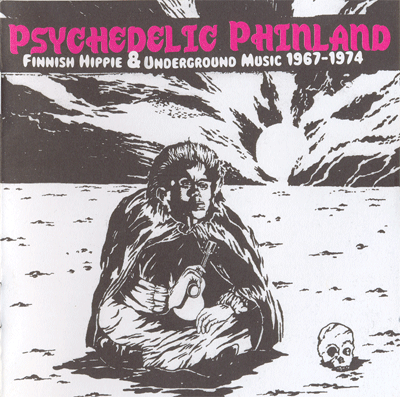
Title: Psychedelic Phinland - Finnish Hippie & Underground Music 1967-1974 Format: 2CD Label: LOVE RECORDS Date: 15 November 2006 Cat.No: LXCD 651
From press release notes (translation from Finnish and all ensuing errors by pHinn):
The hippie ideals and that fiercer underground arrived to Finland in the mental turmoil of the end of the 1960s. Their blooming was cut short, but both left their permanent mark on pop culture. The 2-CD Psychedelic Phinland collects together the nation's first hippie troubadours, pioneers of psychedelic prog, vanguard warriors of anarcho rock, acoustic tribal musicians and the extreme daredevils of the arctic avantgarde. The album presents the mashers of the fringes of consciousness from Blues Section to Tylympi Kohtalo ("The Grimmer Fate"), the wanderers of stellar spheres from Pekka Streng to Jukka Kuoppamäki, the gravediggers for the Establishment from Suomen Talvisota 1939-40 ("The Finnish Winter War 1939-40") to Apollo, those who grasped the meaning of the holy simplicity from Those Lovely Hula Hands to Kruununhaan Dynamo ("Kruununhaka's Dynamo") and the midwives of sonic revolution from The Sperm to Sähkökvartetti ("The Electric Quartet"). It's a unique sound documentary of the alternative music of the turn of the 1960s and 70s. For those already familiar with Suomen Talvisota and The Sperm are offered some curiosities which amaze by their sheer existence. Everything essential concerning the topic is presented here -- from Jorma Ikävalko's no-holds-barred hippie comedy to the flute meditation reaching for the world spirit by Sikiöt ("The Foetuses"). This compilation produced by Jukka Lindfors includes 29 tracks from 20 different artists or bands, including self-releases, radio and TV performances and live recordings. The sleeve illustration is provided by Timo Aarniala, the court artist of Finnish underground. The whole it can be best described by the words of the poet Markku Into: "Everyone does their own thing. A symphony for every member of the family, for everyone their own alienation".
CD1:
1. Topmost: The End 2. Hector & Oscar: Savu 3. Jukka Kuoppamäki: Kukkasen valta 4. Jorma Ikävalko: Hippijortsut pöhkölässä 5. Blues Section: Cherry-Cup Cake Twist 6. Wigwam: Must Be The Devil 7. Baby Grandmothers: Being Is More Than Life 8. Eero Koivistoinen: Pientä peliä urbaanissa limousinessa 9. Charlies: Taiteen kriitikistä 10. Apollo: Ajatuksia 11. Suomen Talvisota 1939-40: Kasvoton kuolema ja Sirhan Sirhan 12. Suomen Talvisota 1939-40: Tehtaan vahtimestarit 13. Suomen Talvisota 1939-40: Flaggorna fladdrade i gentlemannens WC 14. Tylympi Kohtalo: Näkemiin, voi hyvin ystäväni 15. Pekka Streng: Olen erilainen 16. Juice Leskinen & Coitus Int: Zeppeliini 17. Hector: Meiran Laulu 18. Jukka Kuoppamäki: Aurinkomaa 19. Markku Into: Olen puhunut utopiaa
CD2:
1. Those Lovely Hula Hands: Tarzan apornas apa / Tarzan gregah / Jane Porter sivistyksen muurilla 2. Those Lovely Hula Hands: Menevät miehet 3. Pekka Airaksinen: Fos 2 4. The Sperm: Heinäsirkat I 5. Sähkökvartetti: Kaukana väijyy ystäviä 6. Kruununhaan Dynamo: Simple Things 7. Sikiöt: Side One 8. Sikiöt: Trippin' Together 9. Those Lovely Hula Hands: Missä on Marilyn? 10. J.O. Mallander: Degnahc Ev'uoY
Magyar Posse is a Finnish instrumental postrock act which takes its cues among all from Ennio Morricone's film music and 70s progressive rock, à la Mike Oldfield's "Tubular Bells". This Magyar Posse video by Lauri Warsta and Jouni Karttunen was awarded the "Golden Pumpeli", the first prize at Oulu Music Video Festival of 2006.
After running since 1995, DJs Henkka and Mikko (image below) have decided to call it a day with their Alternative Night Saturday discos at Tampere's Yo-Talo. The last Alternative Night will be on Saturday 23 September 2006.
I guest-DJed myself at these events in the late 1990s but only found it really frustrating in the end, so I quit. Because there were not really too many chances to play anything that would challenge the Britpop hierarchy of the day. Still, it's a bit sad to see this institution go.
It's been a bad month for eccentric veterans of psychedelic music. First it was Syd Barrett; now Arthur Lee of the legendary Los Angeles band Love, who passed away on Thursday 3 August 2006. The cause of death was acute lymphoblastic leukemia. I'm devastated, to say the least.
Love was a rarity among 60s rock bands: a multiracial unit, with the frontman Lee and guitarist Johnny Echols being both African-American. Love started in 1965 in the wake of The Byrds' "jingle-jangle" folk-rock sound but soon developed their own idiosyncratic expression, with Lee's enigmatic and elliptical song lyrics. The band was for a short time considered the biggest name in Los Angeles rock scene but their unwillingness to tour and their growing infatuation with rock lifestyle marred their potential progress. Jim Morrison was an eager early follower of Love, to the extent of Arthur Lee's dismay, who claimed Morrison copied just any move Lee made. Paul Rothchild, the producer for both Love and The Doors, claimed Arthur Lee ate LSD like it was candy. Finally the crown of LA rock was taken over by Morrison and The Doors.
The November 1967 album Forever Changes is considered Love's masterpiece but also their eponymous debut (May 1966) and Da Capo (January 1967) are well worth checking out.
Love includes among the more Byrds-influenced moments the band's nervous and edgy cover version of Burt Bacharach and Hal David's 'My Little Red Book'. Among the little Lee gems there are also the unnerving junkie ballad 'Signed D.C.' (dedicated to the band's early drummer Don Conka who had become seriously addicted), the atmospheric guitar instrumental 'Emotions' and a pre-Hendrix version of 'Hey Joe'.
Da Capo was a more jazz-tinged effort, with an extended line-up of Love. The exploding and fast, even a proto-punk type of single '7 & 7 Is' (which ends in a sound of the explosion of an atom bomb) is an undisputable psychedelic garage rock classic with its ultra-enigmatic lyrics -- can anyone explain me what these mean...?
When I was a boy I thought about the times I'd be a man I'd sit inside a bottle and pretend that I was in a can In my lonely room I'd sit my mind in an ice cream cone You can throw me if you wanna 'cause I'm a bone and I go oop-ip-ip oop-ip-ip, yeah! If I don't start cryin' it's because that I have got no eyes My father's in the fireplace and my dog lies hypnotized Through a crack of light I was unable to find my way Trapped inside a night but I'm a day and I go Oop-ip-ip oop-ip-ip, yeah! One... Two... Three... Four!
(the A-bomb goes off, followed by the slowing down of tempo and a strangely serene solo)
Well, I guess that's psychedelia for you. There's also the lovely 'Orange Skies' and the philosophical '¡Que Vida!': "Can you find your way / Or do you want my vision / It's dark there, they say / But that's just superstition" -- "My mind's not made of gravel", indeed. The B-side has only one track, the 19-minute(!) long jam called 'The Revelation' which Arthur Lee claimed The Rolling Stones ripped off for their 'Going Home' on Aftermath album (The Stones added an insult to injury when they used the phrase from another Da Capo track, 'She Comes In Colors', in the chorus of their psychedelic-era track 'She's A Rainbow'). Incidentally, 'The Revelation' is the one most people owning the vinyl version usually skip, and without which Da Capo would probably be an immaculate masterpiece.
Well, then the ONE, Forever Changes; the album which shows up frequently on all "The Best Albums of All Time" polls. With this one Arthur Lee was obsessed with dying, thinking his days were soon to be numbered, which was reflected in the bleak overall mood of his elliptical lyrics here; a strangely sore note in the lovey-dovey days in 1967. My own favourite songs here are 'The Daily Planet' on the boredom and repetition of everyday life:
In the morning we arise and Start the day the same old way As yesterday the day before and All in all it's just a day like All the rest so do your best with Chewing gum and it is oh so Repetitious Waiting on the sun
Down on Go-stop Boulevard it Never fails to bring me down The sirens and the accidents and For a laugh there's Plastic Nancy She's real fancy with her children They'll go far, she Buys them toys to Keep in practice Waiting on the war
And 'The Red Telephone', in which there is just everything; like an absurd Beckettian play of the futility of human efforts and imminence of death, disguised as a pretty pop song:
Sitting on a hillside Watching all the people die I'll feel much better on the other side I'll thumb a ride
I believe in magic Why, because it is so quick I don't need power when I'm hypnotized Look in my eyes What are you seeing (I see...) How do you feel? (... you)
I feel real phony when my name is Phil Or was that Bill?
Life goes on here Day after day I don't know if I am living or if I'm Supposed to be
Sometimes my life is so eerie And if you think I'm happy Paint me yellow (white)
I've been here once I've been here twice I don't know if the third's the fourth or if the - The fifth's to fix
Sometimes I deal with numbers And if you wanna count me Count me out
I don't need the time of day Anytime with me's OK I just don't want you using up my time 'Cause that's not right
And the eerie and paranoid "rap" at the end of the song:
They're locking them up today They're throwing away the key I wonder who it'll be tomorrow, you or me?
We're all normal and we want our freedom Freedom... freedom... freedom... freedom Freedom... freedom... freedom... freedom (All the God's children should have their freedom)
The sound of this album is prevalently acoustic, with some tasty strings and also mariachi trumpets, as in the classic single 'Aloneagainor'.
Love had been badly in disarray already at the time of the recording of Forever Changes: living the rock'n'roll lifestyle, several band members had developed themselves "personal problems" but Arthur Lee managed to whip up some discipline to the band by threatening to replace the members with session musicians. This approach worked great with the album and the following one-off single 'Laughing Stock'/'Your Mind And We Belong Together', but this 7" (only included on Love compilation albums) remained the swansong of this classic line-up. From now on Arthur Lee was the only original member of Love in a series of changing and erratic line-ups which were to continue to the end of his life. Post-Forever Changes albums include some nice songs (like my own favourite, the hilarious 'Singing Cowboy') and I even kind of like Four Sail (1969), but these were no comparison to the classic trio of albums of 1966-68.
The rest of the days of Arthur Lee and Love were less than glorious. Alcoholism, drug addiction and even crime followed several band members, now dead or missing. Arthur Lee spent some years in prison, and only managed to revive Love a couple of years ago, with the help of the members of a band called Baby Lemonade. The revival was a short-lived one, though. Grab Love, Da Capo and Forever Changes to your hands now and remember the man as he should be remembered.