Showing posts with label politics. Show all posts

Thursday, November 06, 2008

Who's Nailin' Paylin?


The first minute off Who's Nailin' Paylin? (2008) [Safe for work watching]

Sarah Palin, the Vice President candidate for Republicans, has inspired many spoofs, parodies and countless image manipulations spreading on the Net. Obviously there's something in this former-beauty-queen-gone-icebear-hunting-ultra-conservative which especially appeals to male fantasies. [One thing that is for sure is that our own 'Sara Pain' had nothing to do with her!]

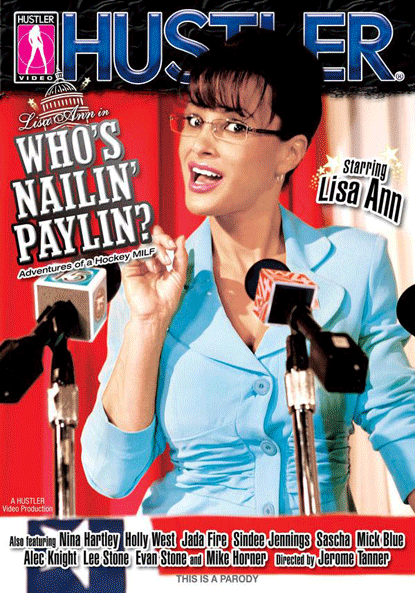
One inevitable outcome in this booming mini-industry (something that is hard to imagine with Joseph Biden) is naturally an adult movie dedicated to her exploits called Who's Nailin' Paylin? (subtitled "Adventures of a Hockey Milf"), with the up-and-coming skin flick starlet Lisa Ann playing Governor "Serra Paylin" and the adult film veteran Nina Hartley as Hillary Clinton, and brought to us by no one else than The Hustler Video. Maybe there are alternative career prospects in sight for Ms. Palin after the current election defeat.


  • Who's Nailin' Paylin? @ MySpace
  • Sarah Palin Pictures Gallery @ Freaking News
  • Sarah Palin in miniskirt @ The Museum of Hoaxes
  • An Interview with the Creator of the Sarah Palin Bikini Gun Photo


    Drill, baby, drill!
  • Sunday, August 17, 2008

    Kaj Chydenius


    Kaj Chydenius: 'Sinua sinua rakastan' (1968, off Asfalttilampaat)

    And while we are still at the topic, here is another gem from the era, 'Sinua sinua rakastan' ("You, you I love") from 1968, composed and sung by Kaj Chydenius, with lyrics by Aulikki Oksanen; from Mikko Niskanen's film Asfalttilampaat ("Asphalt lambs"), starring Eero Melasniemi and Kirsti Wallasvaara, with whom Niskanen had already worked with for Käpy selän alla.

    Kaj Chydenius (b. 1939) was probably the best-known composer for the late-60s/early-to-mid-70s Finnish political song movement, whose timeless sense of melody has guaranteed the evergreen status of his works even to our own apolitical/right-wing politics days.

    The lyrics in this one are nearly psychedelic, I think: "Miten huutaa minulle avaruus / Miten kirkuvat tähdet ohimoni läpi / Miten itkevät lapset maailman rannoilla / Ja merien yllä savuavat sydämet" (As a quickie translation: "How space yells to me / how the stars scream through my temples / How the children cry on the shores of the world / And over the seas smoulder the hearts").

  • Vesa-Matti Loiri rehearsing Lapualaisooppera with Kaj Chydenius (1966)
  • All Kaj Chydenius search results @ YouTube


    Kaj Chydenius in the late 1960s, one of "partaradikaalit" ("bearded radicals") as Finnish leftists were called then


    A scene from Asfalttilampaat, with Eero Melasniemi and Kirsti Wallasvaara
  • Kristiina Halkola and Käpy selän alla (1966)


    Kristiina Halkola: 'Laulu rakastamisen vaikeudesta' ("A song about the difficulty of loving"; off Käpyn selän alla, 1966)


    Creatures: 'Where Can She Be' (off Käpy selän alla, 1966)

    After a typically rainy summer season, everything seems still quiet on Finnish electronic dance music front, so pHinnWeb goes on its nostalgia trip of yesteryear's domestic popular culture. Enjoy, or at least, bear with me.

    Käpy selän alla, directed by Mikko Niskanen in 1966 created a sensation in Finland. (The title literally translates as "A pinecone under one's back", though the official English film title for some reason is Skin, Skin, also known as Under Your Skin, probably trying to cash off the boom of "erotic" European art films of the time, though by today's standards eroticism here seems extremely tame.) A simple, slightly comical story about two young couples' camping trip to countryside (climaxing in a drunken sojourn to see the Creatures playing at a forest dancehall) and reflecting the typical problems of baby-boomer generation, the film (largely improvised from the original script of Marja-Leena Mikkola) was a huge success and was widely received as a new beginning for Finnish cinema, forgetting the old conventions of traditional theatrical "Suomi-Filmi" style and representing a new generation of Finnish film-makers, with Niskanen's contemporaries such as Risto Jarva; taking its cues from influences such as French New Wave and international auteurs like Ingmar Bergman. Starring Kristiina Halkola, Kirsti Wallasvaara, Pekka Autiovuori and Eero Melasniemi, who were at the time of the film still fresh-faced and unknown actor students but would subsequently become household names familiar from TV and film.

    Mikko Niskanen (1929 - 1990) was a film director and actor, who had studied film-making in the Soviet Union, debuting in 1962 with Pojat ("Boys"), a film both comical and tragic about the relations of young boys, their elders and German soldiers during Finnish Continuation War of the early 40s, starring young Vesa-Matti Loiri in his memorable first role. With his late-60s films Käpy selän alla, Lapualaismorsian and Asfalttilampaat Niskanen took on the urbane themes of young baby-boomer adults, though nowadays it's the naturalistic rural tragedy Kahdeksan surmanluotia ("Eight Deadly Shots") of 1972, which is considered his most lasting masterpiece.


    The singing actress Kristiina Halkola (b. 1945), with her beautiful dark looks and memorable pout, would also be seen in many other films of this era, such as Niskanen's Lapualaismorsian and Jörn Donner's Mustaa valkoisella (she would later sue Donner, who had infamously used a body double for her in the film's erotic scenes) and participate in Finnish leftist political song movement (in the Bertolt Brecht/Kurt Weill cabaret song tradition, with such lyricist-vocalists as Aulikki Oksanen, singing groups called with names such as Agit Prop or heavily wailing chanteuses like Kaisa Korhonen and her then-husband Kaj Chydenius, perhaps the movement's best known composer), recording for Love Records an album Täytyy uskaltaa ("One has to dare") in 1971. Halkola's singing performances for the late-60s TV shows in the style of the political Orvokki-Kabaree stirred controversy, with then-provocative songs concerning such subjects as mocking the twenty richest families of Finland or interpreting an old church hymn as a go-go version. Kristiina Halkola also participated in leftist politics as a member of Finnish Communist Party and its later incarnation Demokraattinen Vaihtoehto. Her children with Eero Melasniemi have continued as actors and musicians. Nowadays Kristiina Halkola is considered an icon of the heavily politicized "Taistolaisuus" era of the late 1960s and 1970s. The politics may not have stood the test of time but the best songs created through it well have; like their more capitalist contemporaries, Finnhits iskelmäs, enjoying a huge nostalgia movement in the 21st century Finland.

    Mikko Niskanen in Finnish:

  • Kahdeksan surmanluotia clips @ Yle Elävä Arkisto
  • Wikipedia

    Mikko Niskanen in English:

  • Skin, Skin @ Siffblog
  • Eight Deadly Shots @ Siffblog

    More video clips of songs by Kristiina Halkola:

  • 'Ei puolikasta' (audio only)
  • 'Jos rakastat' (audio only)
  • 'Kätten työtä' (audio only)
  • 'Laulu 20 perheestä' (1969)
  • 'Laulu siirtotyöläisestä' (audio only)
  • 'Sinun lapsesi'
  • 'Suomalainen tulee toimeen omillaan' (1969, with Vesa-Matti Loiri)
  • 'Tartu hetkeesi' (audio only)
  • 'Virsi 639' (1968, with Liisa-Maija Laaksonen)

    Käpy selän alla links:

  • IMDB
  • Suomalaisen elokuvan festivaali (in Finnish)
  • Pajakkakino (in Finnish)
  • Elonet (in Finnish)


    Aulikki Oksanen, Kirsti Wallasvaara and Kristiina Halkola back then
  • Wednesday, January 09, 2008

    Andrey Budaev


    Andrey Budaev (born 1963 in Moscow) is a Russian artist familiar for his collages which carefully craft into some famous paintings of world art photographs of the politicians of our day, thus giving the new works some surprising juxtapositions with satirical and provocative meanings.

    In Finland Budaev's works are exhibited at Savonlinnan maakuntamuseo from 30 November 2007 to 27 January 2008.

    Monday, May 08, 2006

    Détournement & Politicszzz

    If I can, I consciously avoid wasting the space of this blog to political topics. Alongside newspaper commentators around the world, tons of other blog writers with greater argumentation abilities than yours truly (or then not) have already commented such things as Dubya's politics, Danish Mohammed cartoons or the Mayday night riots at Helsinki's VR-Makasiinit (or the burning down of said Makasiinit), so I don't feel I've got anything to add there to those discussions already filled with enough banalities, finger-pointing, mindless bigot attitudes on both sides; not to talk about downright idiocy.

    Of course, I read two newspapers daily (editorial columns of the biggest newspapers in Finland seem to be filled daily by the sermon-like scribbles of 60-year old men pushing insistently such topics such as why Finland should join NATO as soon as possible, and why neoliberalist economics and employment politics benefit everyone) and try to keep up with BBC's World News and Euronews on TV, but I really don't feel I could add any worthwhile comments there that would somehow open up any new points of view or add beneficially to the ongoing discussion.

    However, this little news item from Ken Knabb's Situationist Website Bureau of Public Secrets caught my eye, so I feel it's somehow appropriate to reprint it here (again, apologies to all copyright holders, etc. etc.) [You might try to find more information about Situationism from Wikipedia, provided any related info pages there are not yet ravaged to death by pedantic Wikiwankers and Wikidiots]:

    ---------- Forwarded message ----------
    Date: Wed, 3 May 2006 09:57:13 -0700
    From: Bureau of Public Secrets

    Subject: Colbert skewers Bush

    [NOTE: Yesterday I sent out the message below to a few dozen friends. The response was so enthusiastic, and so many of them said they hadn't even been aware of the event, that I am sending it out to my larger, more general emailing list. Apologies for duplicate mailings. --Ken Knabb]

    [NOTE ALSO: The fact that much of the mass media did not even mention this astonishing event, or dismissed it with a few contemptuous sentences, is one more demonstration of the media complicity Colbert was satirizing. And the fact that online video clips of his performance have now been seen by several million
    people is one more indication that the Internet and other alternative means of communication are in the process of making the mass media increasingly irrelevant.
    --KK]

    **********************************************************

    Comedian Stephen Colbert's keynote speech at the White House Correspondents' Association dinner last Saturday may represent a new stage in the crumbling of the Bush regime's image from within the dominant spectacle itself. The following link gives a Windows Media clip of the last 15 minutes --
    http://movies.crooksandliars.com/WH-Dinner-Colbert.wmv . The entire
    talk (about 25 minutes) can be viewed in three parts here --
    http://youtube.com/results?search=colbert%20bush%20cspan&sort=title_sort.

    It's a bizarre experience because most of the audience was decidedly not sympathetic. Not only was Bush himself sitting a few feet away at the same table along with various other political bigwigs, but the major portion of the audience was the very journalists who with rare exceptions have treated the Bush regime with kid gloves over the last five years, and who were satirized almost as scathingly as
    Bush himself. So some of Colbert's funniest remarks are received with a deafening silence, and the rare moments of laughter are brief and uneasy, the audience obviously not having expected such a scandal and wondering how they were supposed to take it.

    The following article, which originally appeared at the Salon.com website, gives some information and commentary on the event, but is also of interest because the author makes a somewhat dubious and confused, but not totally inappropriate, link between Colbert's methods and the subversive tactics of the situationists.

    On the latter, see:

    "A User's Guide to Détournement"

    "Détournement as Negation and Prelude"

    "The Situationists and the New Forms of Action Against Politics and Art"

    *******************************************************

    The Truthiness Hurts

    Stephen Colbert's brilliant performance unplugged the Bush myth machine -- and left the clueless D.C. press corps gaping.

    By Michael Scherer

    May 1, 2006 | Make no mistake, Stephen Colbert is a dangerous man -- a bomb thrower, an assassin, a terrorist with boring hair and rimless glasses. It's a wonder the Secret Service let him so close to the president of the United States.

    But there he was Saturday night, keynoting the year's most fawning celebration of the self-importance of the D.C. press corps, the White House Correspondents' Association dinner. Before he took the podium, the master of ceremonies ominously announced, "Tonight, no one is safe."

    Colbert is not just another comedian with barbed punch lines and a racy vocabulary. He is a guerrilla fighter, a master of the old-world art of irony. For Colbert, the punch line is just the addendum. The joke is in the setup. The meat of his act is not in his barbs but his character -- the dry idiot, "Stephen Colbert," God-
    fearing pitchman, patriotic American, red-blooded pundit and champion of
    "truthiness." "I'm a simple man with a simple mind," the deadpan Colbert announced at the dinner. "I hold a simple set of beliefs that I live by. Number one, I believe in America. I believe it exists. My gut tells me I live there."

    Then he turned to the president of the United States, who sat tight-lipped just a few feet away. "I stand by this man. I stand by this man because he stands for things. Not only for things, he stands on things. Things like aircraft carriers and rubble and recently flooded city squares. And that sends a strong message, that
    no matter what happens to America, she will always rebound -- with the most powerfully staged photo ops in the world."

    It was Colbert's crowning moment. His imitation of the quintessential GOP talking head -- Bill O'Reilly meets Scott McClellan -- uncovered the inner workings of the ever-cheapening discourse that passes for political debate. He reversed and
    flattened the meaning of the words he spoke. It's a tactic that cultural critic Greil Marcus once called the "critical negation that would make it self-evident to everyone that the world is not as it seems."

    Colbert's jokes attacked not just Bush's policies, but the whole drama and language of American politics, the phony demonstration of strength, unity and vision. "The greatest thing about this man is he's steady," Colbert continued, in a nod to George W. Bush. "You know where he stands. He believes the same thing Wednesday that he
    believed on Monday, no matter what happened Tuesday."

    It's not just that Colbert's jokes were hitting their mark. We already know that there were no weapons of mass destruction in Iraq, that the generals hate Rumsfeld or that Fox News lists to the right. Those cracks are old and boring. What Colbert did was expose the whole official, patriotic, right-wing, press-bashing discourse as a sham, as more "truthiness" than truth.

    Obviously, Colbert is not the first ironic warrior to train his sights on the powerful. What the insurgent culture jammers at Adbusters did for Madison Avenue, and the Barbie Liberation Organization did for children's toys, and Seinfeld did for the sitcom, and the Onion did for the small-town newspaper, Jon Stewart discovered he could do for television news. Now Colbert, Stewart's spawn, has taken on the right-wing message machine.

    In the late 1960s, the Situationists in France called such ironic mockery
    "détournement," a word that roughly translates to "abduction" or "embezzlement." It was considered a revolutionary act, helping to channel the frustration of the Paris student riots of 1968. They co-opted and altered famous paintings, newspapers,
    books and documentary films, seeking subversive ideas in the found objects of popular culture. "Plagiarism is necessary," wrote Guy Debord, the famed Situationist, referring to his strategy of mockery and semiotic inversion. "Progress demands it. Staying close to an author's phrasing, plagiarism exploits his expressions, erases false ideas, replaces them with correct ideas."

    But nearly half a century later, the ideas of the French, as evidenced by our "freedom fries," have not found a welcome reception in Washington. The city is still not ready for Colbert. The depth of his attack caused bewilderment on the face of the president and some of the press, who, like myopic fish, are used to ignoring the water that sustains them. Laura Bush did not shake his hand.

    Political Washington is accustomed to more direct attacks that follow the rules. We tend to like the bland buffoonery of Jay Leno or insider jokes that drop lots of names and enforce everyone's clubby self-satisfaction. (Did you hear the one about John Boehner at the tanning salon or Duke Cunningham playing poker at the
    Watergate?) Similarly, White House spinmeisters are used to frontal assaults on their policies, which can be rebutted with a similar set of talking points. But there is no easy answer for the ironist. "Irony, entertaining as it is, serves an almost exclusively negative function," wrote David Foster Wallace, in his seminal 1993 essay "E Unibus Pluram." "It's critical and destructive, a ground clearing."

    So it's no wonder that those journalists at the dinner seemed so uneasy in their seats. They had put on their tuxes to rub shoulders with the president. They were looking forward to spotting Valerie Plame and "American Idol's" Ace Young at the Bloomberg party. They invited Colbert to speak for levity, not because they wanted to be criticized. As a tribe, we journalists are all, at heart, creatures
    of this silly conversation. We trade in talking points and consultant-speak. We too often depend on empty language for our daily bread, and -- worse -- we sometimes mistake it for reality. Colbert was attacking us as well.

    A day after he exploded his bomb at the correspondents dinner, Colbert appeared on CBS's "60 Minutes," this time as himself, an actor, a suburban dad, a man without a red and blue tie. The real Colbert admitted that he does not let his children watch his Comedy Central show. "Kids can't understand irony or sarcasm, and I don't
    want them to perceive me as insincere," Colbert explained. "Because one night, I'll be putting them to bed and I'll say ... 'I love you, honey.' And they'll say, 'I get it. Very dry, Dad. That's good stuff.'"

    His point was spot-on. Irony is dangerous and must be handled with care. But America can rest assured that for the moment its powers are in good hands. Stephen Colbert, the current grandmaster of the art, knows exactly what he was doing.

    Just don't expect him to be invited back to the correspondents dinner.

    Thursday, October 27, 2005

    Sauli Niinistö, The Working Class President of Finland?

    Sauli Niinistö, the presidential candidate of the right-wing party Kokoomus claims on his recently published campaign ad to be the "President of Working People". I laughed out aloud when this caught my eye on Tuesday's paper.

    Mr. Niinistö piously declares on this ad that: "The time of confrontation is over. Finland is the enterprise of all of us. It is time to end the unnecessary confrontation. This concerns both the employees and employers -- the whole working people of today. Without work economy cannot run. And with working economy we cannot take care of the education, health services and good old age".

    It is nothing short of grotesque that Finland's leading right-wing party -- which has favoured the neoliberalist politics of cutting off any benefits for the poor, sick and old, and giving even more of them to the elite of the rich -- should now adopt the traditional slogans of the left, about the workers/working people/working class.

    Mr. Niinistö who these days works for the European Central Bank used to be the Finnish Minister of Treasury in the aftermath of 1990s recession, and in that job responsible for his part for the political decisions which took benefits away from the very working class whose President he has now declared himself as.

    At the same time such MPs of Mr. Niinistö's party Kokoomus as Ben Zyskowicz are notorious for their ongoing populist chase after the people who abuse welfare benefits. The only people in whose welfare Kokoomus seems to have any interest are those well off: the rich and the elite.

    So, who do Kokoomus think they are fooling here? How many people they are expecting to buy their cynical lip service?

    I don't think the time of confrontation in Finland is over. Far from it. On the contrary, the general discontent is increasing rapidly all the time, sped up by such scandals as the recent squabble over the enormous stock options granted to the directors of the state-owned energy company Fortum. Simultaneously, Finnish pensioners felt generally insulted by the mere five euros' monthly raise to their pensions. No, Mr. Niinistö, the confrontation is just beginning.

    Politics in Finland @ Wikipedia

    Friday, October 14, 2005

    Maggie Thatcher 80 Years


    Maggie Thatcher, the former British Prime Minister and "Iron Lady" of UK politics, whose best mates included Ronnie Raygun and Augusto Pinochettio, turns 80. pHinnWeb congratulates (don't click if you're under 18).

    Friday, September 09, 2005

    Anarchy In, Erm, Germany

    [Skip this entry if you're under 18.]


    http://www.kotzreiz.de/wahl/wahlspot.mp4
    or
    http://appd.goerres-kompakt.de/wahlspot.wmv
    or
    http://blogfiles.wfmu.org/KF/0509/wahlspot.mp4
    and
    http://www.appd.de/wahlspot/wahlspot.php


    Anarchist party's TV ad offends viewers
    Wed Sep 7, 2005

    BERLIN - A fringe German anarchist party has outraged national television audiences with its election campaign television spot -- a video montage of booze-fuelled chaos, syringe needles and men cavorting with topless women.

    An estimated one million viewers watched the German Anarchist Pogo Party's already heavily censored political broadcast when it was shown for the first time Monday.

    Rather than offer any presentation of policies, the party's campaign spot spliced together scenes of debauched revellers smashing furniture, pouring beer down each other's throats and groups of couples kissing and groping each other, all set to a frantic heavy metal soundtrack [to me it sounded more like a punk version of polka, with accordion and all -pH].

    As an officially registered political party, the Hamburg-based APPD, which sells t-shirts on its Web site that proclaim "Arbeit ist Scheisse" ("work is shit"), is entitled to free television air time for its advertisements.

    Karl Nagel, campaign manager of the APPD told Reuters on Wednesday that the party will continue to run the ad.

    "The next broadcast is scheduled for Monday night," he said.

    However, he said the broadcasting authorities may insist they remove scenes featuring needles, which he said depicted people taking a blood sample and not intravenous drug abuse.

    German newspapers say the party's roughly 750 members would not have any discernable impact on the September 18 parliamentary elections.


    More:

    Indymedia UK
    Wikinews

    ***

    Too bad the political scene here in Finland is much more boring. As far as it goes here is a local racist/extreme right-wing bigot/village idiot spreading fake nude pics of our President on his Website (no, I won't give you the original URL where I found this hilarious(?) "pin-up" because people like that don't deserve any more publicity) -- some people do have interesting sex fantasies, though. Anyway, here's for all you real Fennophiles:


    Earlier

    Thursday, September 08, 2005

    New World Orleans: Microcosm for the "New America"


    New World Orleans: Microcosm for the "New America"
    Special report on the elite police state takeover by Steve Watson:

    http://www.infowars.com/articles/new_orleans/new_world_orleans.htm


    If it keeps on rainin', levee's goin' to break,
    If it keeps on rainin', levee's goin' to break,
    When the levee breaks I'll have no place to stay.

    Mean old levee taught me to weep and moan,
    mean old levee taught me to weep and moan,
    Got what it takes to make a mountain man leave his home,
    Oh, well, oh, well, oh, well.

    Don't it make you feel bad
    When you're tryin' to find your way home,
    You don't know which way to go?
    If you're goin' down South
    They go no work to do,
    If you don't know about Chicago.

    Cryin' won't help you, prayin' won't do you no good,
    Now, cryin' won't help you, prayin' won't do you no good,
    When the levee breaks, mama, you got to move.

    All last night sat on the levee and moaned,
    all last night sat on the levee and moaned,
    Thinkin' about me baby and my happy home.
    Going, going to Chicago... Going to Chicago... Sorry but I can't take you...
    Going down... going down now... going down....

    - Memphis Minnie: 'When The Levee Breaks'


    --

    pHinnWeb Conscience Links: badly updated, but I do what I can...

    Tuesday, May 31, 2005

    Antonio Negri


    Antonio Negri (b. 1933) is an Italian philosopher, who has been one of the most proponent members and inspiration for current anti-globalization movement. In the politically charged years of 1960s and 70s Negri was an original member of the Italian movements called Potere Operaio and Autonomia which succeeded it. Antonio Negri was jailed when his writings were claimed to have been inciting the 1978 kidnapping and murder of the Italian Christian Democrat party president Aldo Moro by the terrorist organisation Red Brigades.

    The political developments after the "mad year" 1968 had radicalised European youth, and had worked as the platform in forming RAF and Baader-Meinhof groups in Germany, Italian Red Brigades, and also outside Europe, the Japanese Red Army, whose goal was the violent overthrowing of bourgeoisie society by the means of armed terrorism. Instead of the hoped-for revolution, the terrorists' actions only strengthened this society, by giving it an excuse for the police state-like actions and more tightened surveillance of its citizens (in a parallel to what was happening in the United States and the rest of the world post-9/11). This can be compared to body's natural immune system strengthened by the bacterial attacks; thus, terrorists only shot (and will shoot) themselves in the leg.

    Antonio Negri left Italy for France to live in exile, living there for 14 years, and returning voluntarily in 1997. After spending some more years in prison, he's now a free man again, even though his public performances and political activities in Italy have been restricted.

    Empire (2000), which Negri wrote with Michael Hardt, has already been called the Communist Manifesto for the 21st century, which takes information society into account when taking a look into the development of postmodern/postindustrial capitalist society. As Eric de Place writes, "Hardt and Negri maintain that Empire -- traditionally understood as military or capitalist might -- has embarked upon a new stage of historical development and is now better understood as a complex web of sociopolitical forces. They argue, with a neo-Marxist bent, that 'the multitude' will transcend and defeat the new empire on its own terms".

    http://www.antonionegri.com/

    Antonio Negri @ Generation Online

    The Relevance of Antonio Negri to the Anti-Globalization Movement

    "Postmodernisation, or The Informatisation of Production" from Empire

    Download Empire for free

    pHinnWeb's Conscience Links

    Monday, May 23, 2005

    Star Wars: Episode III And Politics


    The new Star Wars movie, Episode III: Revenge of the Sith, directed by the series' creator George Lucas, has caused a furore in the United States over the alleged parallels of the film and President George W. Bush's politics.

    I have so far only seen the Episode I: The Phantom Menace, and that was on TV, and I'm probably going to wait for another few years for these latter two installments having their local TV premiere, since I haven't become exactly convinced that these new Star Wars movies are anything more that FX-heavy computer games disguising as some sort of weak excuses for a movie, at the expense of any proper plot or characters. (My own Star Wars episode is Empire Strikes Back where George Lucas had some writing help from such people as an old film veteran Leigh Brackett and the director Irwin Kershner who added some Zen Buddhism sort of touches.) Even though people have said that Episode III is a considerably better offering compared to the first two ones, I think these new Star Wars films will be remembered as examples of an era of film-making when technology took over and threw such old-fashioned things as a good story and memorable characters overboard, and replaced those with FX and CGI wizardry.

    Anyway, some US conservatives have now been lacerating Lucas over the film's perceived jabs at President Bush -- as when Anakin Skywalker, on his way to becoming the evil Darth Vader, tells his one-time mentor, Obi-Wan Kenobi: "If you're not with me, you're my enemy," in an echo of Mr. Bush's post-9/11 ultimatum: "Either you are with us, or you are with the terrorists."

    Commentators have also seen other parallels to the Bush administration in the film, such as the Sith plot where when seeking to strengthen security during wartime, Chancellor Palpatine persuades the Senate to give up civil liberties and elect him emperor for life. "So this is how liberty dies -— to thunderous applause," Senator Amidala laments. Compare this to the Bush plot: seeking to strengthen security after the terrorist attacks of Sept. 11, 2001, President Bush urged legislators to pass the Patriot Act, which opponents say infringes on civil liberties.

    Or Sith's war: Palpatine starts a war to divert attention from his true political motives. In Bush's war Bush persuaded Congress to go to war with Iraq based on evidence that has now been largely dismissed.

    A conservative film Website Pabaah.com ("Patriotic Americans Boycotting Anti-American Hollywood") added George Lucas to its list of boycotted entertainers, along with more than 200 others, including Michael Moore, Jane Fonda, Susan Sarandon, Sean Penn and the Dixie Chicks.

    The liberal advocacy group Move On was preparing to spend $150,000 to run advertisements on CNN over the next few days -- and to spread leaflets among audiences in line at multiplexes -- comparing Senator Bill Frist of Tennessee, the majority leader, to the movie's power-grabbing, evil Chancellor Palpatine, for Dr. Frist's role in the Senate's showdown over the confirmation of federal judges.

    Even the Drudge Report Website got into the act: beneath a picture of Darth Vader, it compared the White House press corps to the vengeful Sith, after reporters peppered a press secretary for pressing Newsweek magazine to "repair the damage" in the Muslim world caused by a
    retracted report about desecration of the Koran.

    The White House has declined to comment on the controversy.

    There is nothing all that new or imaginative, of course, about politicians borrowing from popular movies to score points; witness Ronald Reagan's co-opting of the "evil empire" metaphor for use against the Soviet bloc, or his critics lampooning his missile defense ideas as something straight out of Star Wars. And Senator John McCain of Arizona compared his 2000 primary campaign to Luke Skywalker's fighting his way out of the Death Star.

    But it is highly unusual for a mainstream Hollywood movie to wind up in the swirl of politics even before it has opened -- though that did occur with 20th Century Fox's Day After Tomorrow, with its apocalyptic vision of global warming's consequences, which advocates including Moveon.org and Al Gore used to protest the Bush administration's environmental policy.

    As a rule, Hollywood studios go to great lengths to ensure that their projects -- both in the development stage and especially when they are positioned in the marketplace -- are free of messages that could be offensive to any great swath of the moviegoing public. Like, say, people who vote for one political party or the other.

    Lucas told the audience at the Cannes Film Festival that he had not realised in plotting the film years ago that fact might so closely track his fiction.

    Alluding to Michael Moore's remarks about Fahrenheit 9/11 at Cannes a year earlier, George Lucas joked, "Maybe the film will waken people to the situation."

    Apparently in all seriousness, though, he went on to say that he had first devised the Star Wars story during the Vietnam War: "In terms of evil, one of the original concepts was how does a democracy turn itself into a dictatorship". Lucas told at the Cannes Film Festival that the movie was written before the Iraq war. "We were just funding Saddam Hussein and giving him weapons of mass destruction," he said, adding, "The parallels between Vietnam and what we're doing in Iraq now are unbelievable." "On the personal level it was how does a good person turn into a bad person, and part of the observation of that is that most bad people think they are good people, they are doing it for the right reasons", Lucas added.

    Peter Sealey, a former marketing chief at Columbia Pictures, said the partisan tug of war over the new Star Wars episode seemed absurd, likening the political interpretations of it to a Rorschach test. But he said Mr. Lucas was probably savvy in adding sizzle and relevance to a movie that otherwise might have earned publicity only by its effectiveness as entertainment.

    "He could've come out and said, 'That's ridiculous -- this is the white hats and black hats of the 1950's in space,' and quashed it," said Mr. Sealey, who teaches entertainment marketing at the University of California, Berkeley. "Did he do that? No, and it was probably smart. If he can get Star Wars brought into the debate over unilateralism and the Iraq war, it just brings a current spin to it. And I don't think it's going to rule people out."

    Indeed, it is extremely unlikely that all the online screeds and boycotts put together will leave so much as a dent in the movie's box office results. On its opening weekend the film scored the second-best three-day weekend of all time, selling an estimated $108.5 million worth of tickets for the Friday-to-Sunday period, taking its total to $158.5 million since it opened after midnight on Thursday.

    But Mr. Sealey said other filmmakers and marketers might do well to inspect their pictures for latent political messaging before the public does it for them.

    He noted that a Universal Pictures marketing executive had given a lecture to his marketing class about Peter Jackson's King Kong, which is coming out later this year. "Is there a political overtone to it?" Mr. Sealey said. "I suspect he's got to think that through today. The political sensitivities are so great that you have to take that calculus into consideration. Is somebody going to read into 'King Kong' that it's pro-Iraq, or it's going to get PETA upset?"

    Well, as we know, any of these film boycotts (remember Scorsese's Last Temptation of Christ?) only contribute to add the interest for the particular piece, so in any case, we may be only expecting George Lucas to laugh all the way to the bank.

    pHinnWeb's Cinema Links
    Monday, March 07, 2005

    Pentti Haanpää on Economy

    Finnish novelist Pentti Haanpää (1905-1955) was in his lifetime a controversial character, whose leftist-leaning writings were not seen favourably in the nationalist-militarist Finland of the time. (Harri Teikka chose his writer pseudonym as tribute to a character called Pate Teikka in Haanpää's Noitaympyrä ("Witch Circle")). In 1933 Pentti Haanpää wrote (and was subsequently fined for his troubles):


    Talousjärjestelmä on muka luonnonilmiö, jumalainen koneisto, jonka toimintaan valtiovalta ei saa sekaantua. Tätä saarnaavat juuri ne piirit, virkakunta, pankit ja yhtymät, jotka juuri valtiovallan sekaantumisen kautta ovat saaneet yhteiskunnassa kadehdittavat olot, vapaudet ja väljyydet.

    ("The economic system is supposedly a natural phenomenon, a divine machinery with which government can't meddle. This is preached exactly by those circles, bureaucracy, banks and corporations who have gained their enviable status in society, their freedom and elbowroom, just through the government meddling.")


    More on Haanpää (in Finnish)

    Tuesday, November 16, 2004

    The Official Truth Of Finland

    In his latest Net column, Finnish Foreign Minister Erkki Tuomioja (of Finland's Social-Democratic Party) criticizes Finnish media:

    "In Finland, there is undergoing a clear and systematic campaign to change the social and foreign policies in Finland. One does not have to argument this view with any conspiracy theories, it is enough to keep following Finnish main media to see how its agenda has become harder, its message more right-wing."

    Especially Tuomioja criticizes Helsingin Sanomat, the largest morning newspaper in Finland, for actively propagating these views.

    The Helsingin Sanomat chief editor Janne Virkkunen quotes on the paper's head column the German leftist playwright and poet Bertolt Brecht who, while staying as a refugee in Finland during World War II, wrote about the Finns being a people, who "keeps silent in two languages".

    Virkkunen claims that Finland is still the country of one official truth, which shuns presenting any alternatives and dissidence, just as in the era of Soviet Union, when Finland's foreign and domestic policy were heavily dictated by our Eastern neighbour; making the Western observers come up with the term "Finlandisierung" about this delicate tightrope-walking type of political balance, where the Finns had to nourish good relations with Russians but also prove their being another Western democracy.

    Virkkunen also quotes the recent " Roadmap to Finland's Future Success" report by EVA, Finnish Business and Policy Forum. The report summarizes: "The message is clear: Finnish society must finally create an attractive environment for working, entrepreneurship and ownership –- otherwise Finland’s long term success cannot be guaranteed." In Tuomioja's opinion, it is these sort of views, that represent Finland's "Official Truth" at the moment -- neo-liberalist, right-wing, anti-welfare state -- the type of which Helsingin Sanomat and other head columns in Finland are trying to propagate at the moment.

    Erkki Tuomioja quotes another poem by Bertolt Brecht: "Wouldn't it be easier to disintegrate the people and elect someone else in their stead?". Tuomioja thinks this is something that could well be directed to EVA and Finnish employees who represent the current powers that be, their message to the people being: "They should work twice as much with a wage twice as small, so they elite could enjoy their own double income, preferably without the disturbing intervention by taxes", as Tuomioja puts it.

    Wednesday, October 27, 2004

    pHinnWeb Politics - A New Mailing List Starts

    http://groups.yahoo.com/group/phinnwebpolitics/

    This new group is meant for the discussion of political issues that would be off-topic for the pHinnWeb's mailing list. Differing political opinions are tolerated (bar extreme right-wing, chauvinistic-nationalist, racist, sexist, homophobic, religious bigot, etc. views) but all members are advised to follow netiquette. The discussion on this list is mostly in English.

    Tuesday, September 21, 2004

    Japanese Red Army

    A wave of student radicalism swept through the whole world in the late 1960s and early 1970s. Vietnam war, American civil rights movement, May of 1968 in Paris, the "Spring of Prague" followed by Soviet occupation of Czechoslovakia in the same year and the 1973 military coup in Chile were catalysts in this international turmoil. Here in Finland the pinnacle of cultural radicalism was the Marxist-Leninist Taistolaiset movement, who leaned heavily in their ideology towards the Soviet Union. There was a lot of heated discussion on revolutionary dialectism, but in the end the dogmatic Taistolaiset rhetoric was more violent than their actions. This was not the case in Japan, however, where the terrorist organisation Japanese Red Army was formed.

    The Japanese Red Army had its roots in the leftist student movement, who opposed the US-Japan security treaty of 1960, which was renewed ten years later. Japan hosted American military bases, and arms shipments (including napalm) and maintenance for the Vietnam war were operated from these bases. Furthermore, the leftist students pointed an accusing finger to Japan's own past as a "fascistic occupator".

    The revolt against high officials started at the elite university of Todai as well as at Nichidai, which was a more working class-based university with the massive attendance of 100.000 students. In 1967 in the village of Sanzurika north of Tokyo students together with local farmers were waging war with the government over the construction of Narita International Airport. Farmers were expected to relocate from the lands of their ancestors, which they refused, and they were joined by students who saw the construction of Narita purely in geopolitical terms. Students also blocked in October 1968 the Shinjuku Railway Station through which travelled the trains carrying arms supplies meant for the Vietnamese war. The student activist organisation Zenkyoto demanded academic reforms and democratization of the university. Different Japanese activist factions were known for their helmets of different colours (for example, Communists wore yellow helmets): these were useful in the incidents of gebabo or gewalt, violent staves.

    Zenkyoto prevented the entrance examination for fiscal year by barricades and then they occupied the Yasuda Hall of Todai in January 1969. There was a riot police siege around the building and Molotov cocktails were thrown. When the occupation ended after three days, 768 students were arrested, 170 policemen and 47 students having been injured.

    The Yasuda incident was a major blow for the Japanese student movement, after which took place the fragmention into various of socialist, communist and anarchist fractions.

    Some of those undertook the way of armed revolt. The Red Army, which had reorganised itself in 1971, attacked banks and police stations. They carried out a series of attacks around the world: the most notorious was the machine gun and grenade attack at Israel's Lod Airport (now Ben Gurion) in 1972, a massacre which left 26 dead and 78 injured. There were also two Japanese airliner hijackings -- in 1970 a Red Army faction forced a JAL plane to fly to the North Korean capital Pyongyang -- and an attempted takeover of the US Embassy in Kuala Lumpur. The group based itself in Lebanon in the 1970s, where they linked up with Palestinian extremists.

    On February 19, 1972, five members of the Red Army, or Rengô Sekigun, took a hostage and shut themselves up in a Asama mountain villa in Karuizawa, Nagano Prefecture, but were finally arrested on February 28. The battle between the radicals and the police was broadcast live on television: both NHK and commercial broadcasters relayed more than 10 hours of footage of the incident. Police ended the siege by crushing the villa with a crane and demolition ball. After the suppression of the revolt, it turned out that the far-left radicals had committed brutal purge murders within themselves under the name of sôkatsu (summary) while they were leading a fugitive life. To many people the Asama Sansô incident meant the final failure of the New Left mass movement. Purge murder victims numbered 12. Three were shot dead in the Asama Sansô battle.

    Radical film-makers such as Shinsuke Ogawa also joined the student revolt with their controversial films (not to talk about the era's other films of subversion and violence, or such Japanese sexploitation genres as pink eiga or roman porno -- and of course Nagisa Oshima's In the Realm of Senses). Shinsuke had already documented the struggle against the construction of the Narita Airport.

    Films directed by Koji Wakamatsu, Yoshishige Yoshida, Shohei Imamura and Nagisa Oshima pursued revolutionary politics and questioned the repressive side of Japanese society. After 1968, Wakamatsu's films had become increasingly political -- not least because Wakamatsu's screenwriter Masao Adachi became heavily involved with the politics of the extreme left. Adachi, who directed seven pink eiga, eventually became a member of the Japanese Red Army. In 1973 he left Japan to join the Palestinian Liberation Front PFLP in Lebanon where he stayed until he was extradited to Japan in March 2000. After a trial and brief prison term, he has returned to the film industry with plans for a new movie.

    In April 1988, Japanese Red Army operative Yu Kikumura was arrested with explosives on the New Jersey Turnpike, apparently planning an attack to coincide with the bombing of a USO club in Naples, a suspected JRA operation that killed five, including a US servicewoman. He was convicted of the charges and is serving a lengthy prison sentence in the United States. Tsutomu Shirosaki, captured in 1996, is also jailed in the United States. In 2000, Lebanon deported to Japan four members it arrested in 1997, but granted a fifth operative, Kozo Okamoto, political asylum. Red Army's long-time leader Fusako Shigenobu, "the Red Queen", was arrested in Osaka in November 2000 after having been previously living in Lebanon for thirty years.

    Wednesday, September 08, 2004

    Michel Onfray On The Slavery By Economists

    These following quoted excerpts (via Voima magazine) are from Michel Onfray's book The Politics of a Rebel. A Study on Resistance and Uncompromising Nature. The English translation from Finnish version by Tapani Kilpeläinen (and all ensuing mistakes) my own.

    "In the politics the incurably melancholic are only those who want to keep the rules of the game unchanged: capitalism winning as the unruly, infuriated liberalism. It is to the advantage of them to promote the idea that there is only an enormous global movement we can't disengage ourselves from. Without the spirit of oppositional resistance to the totalitarism of standardized thinking, the economic monotheism and the end of history will soon force one to obey their own laws, thus accomplishing a dictatorship with no equal in history."

    So, this is how Michel Onfray writes. I think 'Economism' is the one, only and true religion of our days; the economists being the high priests, and the stock exchanges being the temples of worship. 'Liberalism', the word loved by the economists is nothing but a pernicious oxymoron since the notion of 'liberty' included in that very word means the total opposite of freedom for the great majority -- who work more and earn less to keep the minority of economists and shareholders satisfied. One should think that automation, computers and new technology would decrease people's workload, but in these days of quartal capitalism it seems people (i.e., those 'happy ones' still holding on to their jobs in the age of mass unemployment) have to work longer hours under greater stress to maintain their current living standard, and to meet the demands of this well-greased machinery. Michael Onfray goes on here:

    "Technology in itself is not good or evil, but its use dictates whether it's excellent or not. Therefore one has to celebrate and develop all technologies, the novelty of which allows economy, or, prevents the kind of sacrificing of dignity which is allowed under capitalistic means of production."

    "The machine should not be submitted only to its owner seeking profit and benefit, but also to the relieving of any tasks and even to reducing the working hours. This preconceives the ethical regulation of mechanization and blind production. Every such victory in ethics would mean the retreat of the devout ideology of the believers in capital."

    "Returning enchantment to the world can only happen by ending the religiously celebrated economism which is now understood as the only possible social bond. It is vitally necessary to subordinate the economy to the laws of politics. As long as the contrary situation goes on, only the law of marketplace can win, without there being any counterbalance. Thanatos has been chosen as the protecting god of the unrestrained capitalism. Its shadow and its cross, its fetishistic divinity are to blame for the burnt offering and daily sacrifices made to it."

    "To work less, better and in other ways, to separate the income and the workload: one has to strive for economy which is submitted to the people and their liberation, to serve the cause of people reclaiming themselves back to themselves."

    Friday, August 20, 2004

    Culture Is The New Politics

    "Since politics have left the realm of visions by becoming a management of economics, culture has to replace politics by taking its visionary spirit. That's why art is so important today. Artists have to take the responsibility to change unified minds and to give them back a visionary feeling of politics in the original sense: the matter of the singular citizen in correspondence to society's interest. Culture is not luxury, culture is the new politics in opposition to pure economics."

    - Felix Kubin in his interview to The Wire magazine, September 2004

    Saturday, May 29, 2004

    Folk Is Not Hippie Music Any More

    Here are some interesting Net articles on the connections between "neo-folk", gothic, dark wave and industrial subcultures, and their connections to extreme right-wing. Nazis were known for their interest for pagan mysticism and anything "völkisch". Rock'n'roll is based on black (African-American) musical styles of rhythm'n'blues, blues and jazz; therefore it's not suitable listening for any self-respecting racial bigot. But of course, it would not be justified to claim that being a fan of any musical style or interest in ancient mythologies or paganism would make anyone a fascist sympathizer or racist; just some interesting facts telling something about the dark undercurrents of the culture we're living in.

    http://media.hyperreal.org/zines/est/articles/freedom.html

    http://www.guardian.co.uk./weekend/story/0,3605,839755,00.html

    http://www.morbidoutlook.com/nonfiction/articles/2003_10_notclothes.html

    http://www.morbidoutlook.com/nonfiction/articles/2003_11_notclothes.html

    http://d-a-s-h.org/dossier/05/05_gothic-en.html

    http://www.laweekly.com/ink/printme.php?eid=41247

    http://www.searchlightmagazine.com/stories/MusicMaims.htm

    The punk-rockers such as Siouxsie Sue and early industrial music-makers such as Throbbing Gristle used the emblems of Nazism purely for their shock value, but the ambivalence there was subsequently lost on some people. The Who's drummer Keith Moon loved to dress in a Nazi uniform, David Bowie is claimed to have given a Nazi salute to his fans (this was during his muddled 70s cocaine period) but probably both of these artists would have been shot or sent to concentration camps in the 1930s and 40s Germany: real totalitarian ideologies do not tolerate any free-thinking, mischievous non-conformists. Which is what these youth subcultures are basically all about. Another paradox of democracy is that you're free to disagree with those very ideas of democracy, equality and tolerance as much as you will and form your own opinion (even as misguided from the point of majority that would be) -- it would not be the case in an actual totalitarian state.