Russ Meyer, a master of sexploitation filmmaking who was called "king of the nudies" or "King Leer" for such soft-core pornography classics as Faster, Pussycat! Kill! Kill! and Vixen, has died. He was 82.
Russ Meyer, who also directed the major studio release Beyond the Valley of the Dolls, died Saturday 18 September 2004 at his home in the Hollywood Hills, according to his company, RM Films International Inc. Spokeswoman Janice Cowart said Meyer had suffered from dementia and died of complications of pneumonia.
Something of a one-man studio, Russ Meyer produced, directed, financed, wrote, edited and shot 23 tantalizing but teasing films that pioneered a genre of skinflicks with much violence and large-busted women but little sex. The titles of the X-rated fare that made him millions are descriptive — The Immoral Mr. Teas, Erotica, Wild Gals of the Naked West, Heavenly Bodies, Mudhoney, Mondo Topless, Common Law Cabin, Supervixens and Europe in the Raw.
"I love big-breasted women with wasp waists," he told the London Times in 1999, two decades after making his final film. "I love them with big cleavages." Little wonder that Time magazine critic Richard Corliss called Meyer's films "bosomacious melodramas" or that Meyer came to be viewed as an auteur.
In a 1996 interview with The Associated Press, Meyer described his films as "passion plays ... beauty against something that's totally evil." Meyer was unapologetic for his movies, arguing the onscreen female nudity put customers in theater seats. But he maintained that women liked the films. "The girls kick the hell out of the guys. I've always played well at the Ivy League — Cornell, Dartmouth. I have never encountered a berating woman," he said. "Stag films were the earliest version of pornographic movies, but then they got hard-core, and I didn't," he told the AP. "Mine are put-ons, send-ups, humorous. I think I've got an ability to provoke, be teasing, be provocative. "It's all a joke."
But with age came grace -- and admiration -- as Meyer's work was honoured at film festivals around the world including at the American Cinematheque in Hollywood and the National Film Theater in London. His movies were discussed in classes at Yale and Harvard, and purchased by such respectable institutions as the New York Museum of Modern Art.
In 2002, an exhibit of his striking pinup and studio still photos from the 1950s and 1960s was staged at the prestigious Feigen Gallery in New York, which also handles the work of the late caricaturist Al Hirschfeld.
When the Russ Meyer Film Festival opened at Los Angeles' Vagabond Theater in 1992, Times film writer Kevin Thomas wrote: "No one projects heterosexual male sex fantasies with greater gusto and resolute dedication than Meyer, who at heart is a puritan and who has always been a bigger tease than any burlesque queen. His world is populated with an abundance of pneumatic women carefully photographed to make them look as cantilevered as possible, dirty old men and blockhead heroes plus dialogue heavy with double-entendre."
By the time Meyer made Vixen in 1969, Thomas wrote in the 1992 article on the festival, "Meyer pictures had begun to look like good clean fun for adults, and with great disarming heartiness he tackles not only adultery, homosexuality and incest but also takes a couple of potshots at communists and racial prejudice."
Meyer's films continue to engender debate, which may explain their popularity in film classes at USC and across the country. A San Francisco Chronicle critic labeled the 1966 Faster, Pussycat! Kill! Kill! as "the worst film ever made," but director John Waters has called it "beyond doubt, the best movie ever made … possibly better than any film that will ever be made in the future." (The film fared poorly at the box office in its original release but was a hit on the art house circuit 30 years later.) Faster Pussycat, Kill! Kill! is about three go-go girl club dancers who go on a vengeful murder spree against the men who did them wrong. "This film is not derogatory to women," Meyer said. "There were three tough cookies to deal with. Besides, they get what's coming."
In further homage, three rock groups have named themselves for Meyer films -- Mudhoney, Vixen and Faster Pussycat.
Because of Meyer's uncanny ability to produce visual films on a low budget -- his initial The Immoral Mr. Teas in 1959 returned $1 million on his $24,000 investment and the 1969 Vixen earned $6 million on a $76,000 investment -- then-20th Century Fox president Richard D. Zanuck hired Meyer for mainstream studio projects.
First came 1970's Beyond the Valley of the Dolls, a satirical in-name-only sequel to 1967's Valley of the Dolls made from the bestselling Jacqueline Susann novel. Written by movie critic Roger Ebert, the X-rated sequel proved popular and in many ways a better movie than the original. However, New York critic John Simon derided Beyond the Valley of the Dolls as "awful, stupid and preposterous" but said the film was "also weirdly funny and a real curio, rather like a Grandma Moses illustration for a work by the Marquis de Sade", according to Halliwell's Film and Video Guide. As Leonard Maltin says in his 2004 Movie and Video Guide, two "prominent critics" even selected Beyond as one of the 10 best U.S. films from 1968 to 1978.
The film was Meyer's favourite. "It is by far the most important film I ever made", he told the Toronto Star in 1995. "Roger and I embrace that one to our bosoms, or co-bosoms."
Ebert evaluated Meyer's oeuvre in an article in Playboy in 1995, the year Beyond recirculated: "Meyer uses his productions, I believe, to recapture the joy he felt during the formative and most enjoyable period of his life -- the war. It was then that he formed lifelong friendships, discovered his skill as a cameraman and experienced, in a French bordello, his sexual awakening with a buxom partner who became the archetype of the R.M. woman."
Pleased with Meyer's work on Beyond, Zanuck handed him The Seven Minutes, which was based on Irving Wallace's bestselling novel about a pornography trial. But the mainstream 1971 film, featuring such well-known character actors as Philip Carey, Yvonne De Carlo and John Carradine and also Meyer's onetime wife Edy Williams, failed at the box office.
Meyer returned to his own RM Films International Inc. and made movies that were fodder for drive-in theaters and audiences not quite ready for the blatant sex that later became standard fare. As drive-ins dwindled and tastes changed, Meyer wound down his filmmaking with Beneath the Valley of the Ultravixens in 1979.
In recent years, he had discussed making another film with Ebert to be titled The Bra of God. But the project never materialized.
Born in Oakland on March 21, 1922, Meyer was the son of a police officer and a nurse. With money borrowed from his mother, he bought an 8-millimeter Univex "picture-taking machine" when he was 12 and began making amateur films.
He was in junior college when an ad for combat photographers for the Army Signal Corps lured him to Hollywood. Sent to France and Germany, Meyer was credited with shooting combat films and newsreels under some of the most dangerous conditions in World War II.
At the same time, he was honing skills for high-speed, somewhat disjointed cinematography that would force grudging critics to admire his art, however vulgar. Even critics who panned his movies praised his work behind the camera.
After the war, Meyer worked as a cinematographer for Southern Pacific Railroad and occasionally was a still photographer on studio sets, including Guys and Dolls and Giant.
He also began photographing models for nude magazines and parlayed that expertise into photographing some of the first centerfold layouts for Playboy magazine. He married one of the playmates, Eve Turner, for whom he named his first company, Eve Productions.
In 1992, Meyer published his three-volume autobiography, Clean Breast: The Life and Loves of Russ Meyer with such chapter titles as "Mammaries Are Made of This."
Meyer married and divorced and lived with a series of models, playmates, strippers and actresses. His studio said he left no survivors.
Thursday, September 23, 2004
Wednesday, September 22, 2004
The Exotica Of Extreme Japan
Japan intrigues me in all its extremity and its certain cultural manifestations, which can seem totally strange and weird for a Western observer.
I emphasize I don't want to fall into any Euro-centric, xenophobic or even racistic prejudices here. "White man's burden" type of colonialistic thinking is always typified by its morbid fascination with anything reeking of "exoticism", "alien", "other" -- which can sometimes make "healthy" (or "scientific") interest in foreign cultures seem problematic or at least ambivalent.
Think of, for example, the Western interest in Eastern religions (Hinduism, Buddhism, Zen, etc.) which started with the 19th century Theosophists, continued with C.G. Jung and found its modern expression in the 1950s with American Beat Generation writers; or any phenomenon of "tribal" culture found from the so called Third World countries or the outskirts of "our" civilization: the "new primitivism" and its fascination with Native American cultures both in North and South America, the 1950s "Tiki" fad of Hawaiian/Polynesian origin, fashionable Maori tattoos of New Zealand, the all-encompassing New Age mysticism combining Hopi Indian beliefs to Sufism and Tibetan Buddhism; even the whole genre of "World Music", just to mention some examples.
Of course, as mentioned, it can get very difficult to discern the faddish interest in anything "exotic" from the genuine interest and sympathy for foreign cultures, and it's not really my task to find out which is which actually. Perhaps one can find here certain traces of Rousseau's 18th century "Back to Nature" thinking, but personally I'm more interested now in the hybrids of so called primitive or traditional cultures with our technological, modern way of life. Therefore Japan.
It's fascinating how in Japanese culture one can find Western influences that have mutated into something totally different and new, when it finds its expression in Japanese milieu and its characteristic and traditional way of thinking, code of conduct and mentality, which can appear as peculiar to us Westerners. I understand that Japanese tradition emphasizes heavily group pressure and conformity which can seem totally opposite to Western ideas of individualism and "personal freedom".
Could it be that certain expressions of contemporary Japanese culture are then some sort of "safety valves" to let off this steam: that mental pressure which is created by a strongly conforming culture? Thus, for example the often extremely violent/sexual content of manga comics or Japanese film could be expression of this psychopathology which can't be outvented in any other way in society which emphasizes a strict code of conduct, honour and conformity. And therefore these explicit and even antisocial, often unaccepted forms of expression act, in fact, as a preserving factor in society?
I emphasize I don't want to fall into any Euro-centric, xenophobic or even racistic prejudices here. "White man's burden" type of colonialistic thinking is always typified by its morbid fascination with anything reeking of "exoticism", "alien", "other" -- which can sometimes make "healthy" (or "scientific") interest in foreign cultures seem problematic or at least ambivalent.
Think of, for example, the Western interest in Eastern religions (Hinduism, Buddhism, Zen, etc.) which started with the 19th century Theosophists, continued with C.G. Jung and found its modern expression in the 1950s with American Beat Generation writers; or any phenomenon of "tribal" culture found from the so called Third World countries or the outskirts of "our" civilization: the "new primitivism" and its fascination with Native American cultures both in North and South America, the 1950s "Tiki" fad of Hawaiian/Polynesian origin, fashionable Maori tattoos of New Zealand, the all-encompassing New Age mysticism combining Hopi Indian beliefs to Sufism and Tibetan Buddhism; even the whole genre of "World Music", just to mention some examples.
Of course, as mentioned, it can get very difficult to discern the faddish interest in anything "exotic" from the genuine interest and sympathy for foreign cultures, and it's not really my task to find out which is which actually. Perhaps one can find here certain traces of Rousseau's 18th century "Back to Nature" thinking, but personally I'm more interested now in the hybrids of so called primitive or traditional cultures with our technological, modern way of life. Therefore Japan.
It's fascinating how in Japanese culture one can find Western influences that have mutated into something totally different and new, when it finds its expression in Japanese milieu and its characteristic and traditional way of thinking, code of conduct and mentality, which can appear as peculiar to us Westerners. I understand that Japanese tradition emphasizes heavily group pressure and conformity which can seem totally opposite to Western ideas of individualism and "personal freedom".
Could it be that certain expressions of contemporary Japanese culture are then some sort of "safety valves" to let off this steam: that mental pressure which is created by a strongly conforming culture? Thus, for example the often extremely violent/sexual content of manga comics or Japanese film could be expression of this psychopathology which can't be outvented in any other way in society which emphasizes a strict code of conduct, honour and conformity. And therefore these explicit and even antisocial, often unaccepted forms of expression act, in fact, as a preserving factor in society?
Tuesday, September 21, 2004
Japanese Red Army
A wave of student radicalism swept through the whole world in the late 1960s and early 1970s. Vietnam war, American civil rights movement, May of 1968 in Paris, the "Spring of Prague" followed by Soviet occupation of Czechoslovakia in the same year and the 1973 military coup in Chile were catalysts in this international turmoil. Here in Finland the pinnacle of cultural radicalism was the Marxist-Leninist Taistolaiset movement, who leaned heavily in their ideology towards the Soviet Union. There was a lot of heated discussion on revolutionary dialectism, but in the end the dogmatic Taistolaiset rhetoric was more violent than their actions. This was not the case in Japan, however, where the terrorist organisation Japanese Red Army was formed.
The Japanese Red Army had its roots in the leftist student movement, who opposed the US-Japan security treaty of 1960, which was renewed ten years later. Japan hosted American military bases, and arms shipments (including napalm) and maintenance for the Vietnam war were operated from these bases. Furthermore, the leftist students pointed an accusing finger to Japan's own past as a "fascistic occupator".
The revolt against high officials started at the elite university of Todai as well as at Nichidai, which was a more working class-based university with the massive attendance of 100.000 students. In 1967 in the village of Sanzurika north of Tokyo students together with local farmers were waging war with the government over the construction of Narita International Airport. Farmers were expected to relocate from the lands of their ancestors, which they refused, and they were joined by students who saw the construction of Narita purely in geopolitical terms. Students also blocked in October 1968 the Shinjuku Railway Station through which travelled the trains carrying arms supplies meant for the Vietnamese war. The student activist organisation Zenkyoto demanded academic reforms and democratization of the university. Different Japanese activist factions were known for their helmets of different colours (for example, Communists wore yellow helmets): these were useful in the incidents of gebabo or gewalt, violent staves.
Zenkyoto prevented the entrance examination for fiscal year by barricades and then they occupied the Yasuda Hall of Todai in January 1969. There was a riot police siege around the building and Molotov cocktails were thrown. When the occupation ended after three days, 768 students were arrested, 170 policemen and 47 students having been injured.
The Yasuda incident was a major blow for the Japanese student movement, after which took place the fragmention into various of socialist, communist and anarchist fractions.
Some of those undertook the way of armed revolt. The Red Army, which had reorganised itself in 1971, attacked banks and police stations. They carried out a series of attacks around the world: the most notorious was the machine gun and grenade attack at Israel's Lod Airport (now Ben Gurion) in 1972, a massacre which left 26 dead and 78 injured. There were also two Japanese airliner hijackings -- in 1970 a Red Army faction forced a JAL plane to fly to the North Korean capital Pyongyang -- and an attempted takeover of the US Embassy in Kuala Lumpur. The group based itself in Lebanon in the 1970s, where they linked up with Palestinian extremists.
On February 19, 1972, five members of the Red Army, or Rengô Sekigun, took a hostage and shut themselves up in a Asama mountain villa in Karuizawa, Nagano Prefecture, but were finally arrested on February 28. The battle between the radicals and the police was broadcast live on television: both NHK and commercial broadcasters relayed more than 10 hours of footage of the incident. Police ended the siege by crushing the villa with a crane and demolition ball. After the suppression of the revolt, it turned out that the far-left radicals had committed brutal purge murders within themselves under the name of sôkatsu (summary) while they were leading a fugitive life. To many people the Asama Sansô incident meant the final failure of the New Left mass movement. Purge murder victims numbered 12. Three were shot dead in the Asama Sansô battle.
Radical film-makers such as Shinsuke Ogawa also joined the student revolt with their controversial films (not to talk about the era's other films of subversion and violence, or such Japanese sexploitation genres as pink eiga or roman porno -- and of course Nagisa Oshima's In the Realm of Senses). Shinsuke had already documented the struggle against the construction of the Narita Airport.
Films directed by Koji Wakamatsu, Yoshishige Yoshida, Shohei Imamura and Nagisa Oshima pursued revolutionary politics and questioned the repressive side of Japanese society. After 1968, Wakamatsu's films had become increasingly political -- not least because Wakamatsu's screenwriter Masao Adachi became heavily involved with the politics of the extreme left. Adachi, who directed seven pink eiga, eventually became a member of the Japanese Red Army. In 1973 he left Japan to join the Palestinian Liberation Front PFLP in Lebanon where he stayed until he was extradited to Japan in March 2000. After a trial and brief prison term, he has returned to the film industry with plans for a new movie.
In April 1988, Japanese Red Army operative Yu Kikumura was arrested with explosives on the New Jersey Turnpike, apparently planning an attack to coincide with the bombing of a USO club in Naples, a suspected JRA operation that killed five, including a US servicewoman. He was convicted of the charges and is serving a lengthy prison sentence in the United States. Tsutomu Shirosaki, captured in 1996, is also jailed in the United States. In 2000, Lebanon deported to Japan four members it arrested in 1997, but granted a fifth operative, Kozo Okamoto, political asylum. Red Army's long-time leader Fusako Shigenobu, "the Red Queen", was arrested in Osaka in November 2000 after having been previously living in Lebanon for thirty years.
The Japanese Red Army had its roots in the leftist student movement, who opposed the US-Japan security treaty of 1960, which was renewed ten years later. Japan hosted American military bases, and arms shipments (including napalm) and maintenance for the Vietnam war were operated from these bases. Furthermore, the leftist students pointed an accusing finger to Japan's own past as a "fascistic occupator".
The revolt against high officials started at the elite university of Todai as well as at Nichidai, which was a more working class-based university with the massive attendance of 100.000 students. In 1967 in the village of Sanzurika north of Tokyo students together with local farmers were waging war with the government over the construction of Narita International Airport. Farmers were expected to relocate from the lands of their ancestors, which they refused, and they were joined by students who saw the construction of Narita purely in geopolitical terms. Students also blocked in October 1968 the Shinjuku Railway Station through which travelled the trains carrying arms supplies meant for the Vietnamese war. The student activist organisation Zenkyoto demanded academic reforms and democratization of the university. Different Japanese activist factions were known for their helmets of different colours (for example, Communists wore yellow helmets): these were useful in the incidents of gebabo or gewalt, violent staves.
Zenkyoto prevented the entrance examination for fiscal year by barricades and then they occupied the Yasuda Hall of Todai in January 1969. There was a riot police siege around the building and Molotov cocktails were thrown. When the occupation ended after three days, 768 students were arrested, 170 policemen and 47 students having been injured.
The Yasuda incident was a major blow for the Japanese student movement, after which took place the fragmention into various of socialist, communist and anarchist fractions.
Some of those undertook the way of armed revolt. The Red Army, which had reorganised itself in 1971, attacked banks and police stations. They carried out a series of attacks around the world: the most notorious was the machine gun and grenade attack at Israel's Lod Airport (now Ben Gurion) in 1972, a massacre which left 26 dead and 78 injured. There were also two Japanese airliner hijackings -- in 1970 a Red Army faction forced a JAL plane to fly to the North Korean capital Pyongyang -- and an attempted takeover of the US Embassy in Kuala Lumpur. The group based itself in Lebanon in the 1970s, where they linked up with Palestinian extremists.
On February 19, 1972, five members of the Red Army, or Rengô Sekigun, took a hostage and shut themselves up in a Asama mountain villa in Karuizawa, Nagano Prefecture, but were finally arrested on February 28. The battle between the radicals and the police was broadcast live on television: both NHK and commercial broadcasters relayed more than 10 hours of footage of the incident. Police ended the siege by crushing the villa with a crane and demolition ball. After the suppression of the revolt, it turned out that the far-left radicals had committed brutal purge murders within themselves under the name of sôkatsu (summary) while they were leading a fugitive life. To many people the Asama Sansô incident meant the final failure of the New Left mass movement. Purge murder victims numbered 12. Three were shot dead in the Asama Sansô battle.
Radical film-makers such as Shinsuke Ogawa also joined the student revolt with their controversial films (not to talk about the era's other films of subversion and violence, or such Japanese sexploitation genres as pink eiga or roman porno -- and of course Nagisa Oshima's In the Realm of Senses). Shinsuke had already documented the struggle against the construction of the Narita Airport.
Films directed by Koji Wakamatsu, Yoshishige Yoshida, Shohei Imamura and Nagisa Oshima pursued revolutionary politics and questioned the repressive side of Japanese society. After 1968, Wakamatsu's films had become increasingly political -- not least because Wakamatsu's screenwriter Masao Adachi became heavily involved with the politics of the extreme left. Adachi, who directed seven pink eiga, eventually became a member of the Japanese Red Army. In 1973 he left Japan to join the Palestinian Liberation Front PFLP in Lebanon where he stayed until he was extradited to Japan in March 2000. After a trial and brief prison term, he has returned to the film industry with plans for a new movie.
In April 1988, Japanese Red Army operative Yu Kikumura was arrested with explosives on the New Jersey Turnpike, apparently planning an attack to coincide with the bombing of a USO club in Naples, a suspected JRA operation that killed five, including a US servicewoman. He was convicted of the charges and is serving a lengthy prison sentence in the United States. Tsutomu Shirosaki, captured in 1996, is also jailed in the United States. In 2000, Lebanon deported to Japan four members it arrested in 1997, but granted a fifth operative, Kozo Okamoto, political asylum. Red Army's long-time leader Fusako Shigenobu, "the Red Queen", was arrested in Osaka in November 2000 after having been previously living in Lebanon for thirty years.
Friday, September 17, 2004
John Titor Hoax
John Titor was (will be?) supposedly a time traveller from 2036, who visited our era in 2000 and 2001, and left behind him a trail of e-mail messages telling a bit about the times to come. According to Mr. Titor, USA should be in for another Civil War, starting just about these days. Well, wake me up when it starts. It's amazing how time after time people fall for these prophets of doom: the world should have ended myriads of times now, if all the predictions put forth in the course of world history would have become reality. The idea of apocalypse is obviously deeply ingrained in our culture. I admit I have an interest in all things called "paranormal" or "supernatural" or whatever, but then, I guess I'm a bit of a sucker for anything fanciful. Unfortunately, in my own life I haven't experienced much anything out of ordinary, except perhaps some occasions of synchronistic telepathy, some vague forebodings of future happenings (not actually "knowing" what's going to happen, but just a feeling that something is "in the air"), but then, maybe there's really nothing "supernatural" about having developed a sort of an intuition about people and the connections of this world. (I wish I had a time machine now: my allotted time here at the library computer is about to end, and I can't write more today.)
Some spooky things @ pHinnWeb
Some spooky things @ pHinnWeb
Wednesday, September 15, 2004
The Geography Of Violence
He wanted to live like Native Americans of his romantic fantasies, but the desert of brownstone was the only dwelling he knew of. Its forests were asphalt and concrete, its air dust and exhaust fumes, its territorial marks stains of oil and graffitis. Everyone passing him on the street was a stranger; everyone was alone in the crowd. The tribes would gather evenings at bars, kept in touch through the Internet. In the end everyone was lonely, and as for him, he was a wanderer in the desolation of stone. Only reflections everywhere in the maze of mirrors, his face repeated thousand-fold and distorted. The fragile mirror people easily broken; everyone of them a seven years' misfortune. His face was tempered into a mask which didn't let any emotions through. He was only passing through, the ostensible indifference was the means of survival in the city.
By night the city became a labyrinth of fear. The predators surfaced out of their hiding holes: the beasts pushed into a corner, knowing no other recourse than to attack. It was wisest only to walk fast; not to glance around if one didn't want to end up in the middle of a turf struggle, where everyone could become the victim of random, senseless violence. It was the only way to react for those downtrodden and pushed into a corner; the only indication of power they didn't really have: a turf fight over a filthy patch of the street. When one was part of a gang, it was easy to kick a lonely victim in the head; a victim who had no ways to defend oneself or to fight back. The only reason for this punishment being that one was in the wrong time in the wrong place.
The anatomy of a human beast was created in the suburbs where tens of children were pushed into school classes, being taught from the very beginning that one was no-one and nothing, and nothing matters. The parents were not interested: just warm up yourself some pizza in the microwave oven, here's a tenner, now get off my feet. The upbringing was taken care by the street and violent entertainment of TV, movies and computer games. No responsibility for anything or anyone. Thus is created human filth. Rats pushed into a corner.
By night the city became a labyrinth of fear. The predators surfaced out of their hiding holes: the beasts pushed into a corner, knowing no other recourse than to attack. It was wisest only to walk fast; not to glance around if one didn't want to end up in the middle of a turf struggle, where everyone could become the victim of random, senseless violence. It was the only way to react for those downtrodden and pushed into a corner; the only indication of power they didn't really have: a turf fight over a filthy patch of the street. When one was part of a gang, it was easy to kick a lonely victim in the head; a victim who had no ways to defend oneself or to fight back. The only reason for this punishment being that one was in the wrong time in the wrong place.
The anatomy of a human beast was created in the suburbs where tens of children were pushed into school classes, being taught from the very beginning that one was no-one and nothing, and nothing matters. The parents were not interested: just warm up yourself some pizza in the microwave oven, here's a tenner, now get off my feet. The upbringing was taken care by the street and violent entertainment of TV, movies and computer games. No responsibility for anything or anyone. Thus is created human filth. Rats pushed into a corner.
Simulacra Dolorosa
The world has fragmented into smithereens, everything having become simulation. If you hit, beat up, shoot one into a bloody mess with pump-action shotgun; hack off body members and the head with samurai sword, it's all only a game on computer display. Critics keep praising the genius of his generation, a film director churning out ballets of gore for the silver screen, manifacturing corpses as if on a conveyor belt, accompanied by spurting spray of blood.
Jesus himself has become a character in the cinema of violence, whose ardous torture to death these so called Christians queue up to see, enjoying the righteous suffering. Suicide bombers wishing to become martyrs blow up themselves and hundreds of bystanders into pieces, thus securing themselves their place in paradise with lovely maidens and flowing honey (at least this is what they are made to believe). The only existing superpower and its military industry keep each other propped up, when cluster bombs grind towns into the ground, and the propaganda machinery of television takes care that people get their daily violence porn, for which the tone is set up political and religious leaven. Killing is a big business.
At the homefront, though, the greatest concern is for how many mobile phones they are able to sell this year, will they keep their market share, or will they have to transfer their factories to the third world countries. If there was another crash, one could spectate again stockbrokers making fancy dives off the skyscraper windows, just as on the 11th of September, when the New York skyline was filled with the sight of burning people.
Life mediated through the computer screen, TV, mobile phone display -- not as lived. It is even easier to retreat into the artificially created virtual worlds, even harder to exit them. The spectacle factory manufactures dreams for the masses. While the "real" reality means endless queues to the supermarket cash register, the grey sky drizzling sleet, a wino vomiting bile, the artificial reality of mass entertainment offers us the life of luxury for millionaires at a French chateau, the butler picking up a bottle of champagne from the frosty silver bucket and popping it open; supermodels with long legs exiting stretch limousines in the crossfire of flashlights. Well, at least this is the dream they want to sell us through TV and gossipy magazines.
Jesus himself has become a character in the cinema of violence, whose ardous torture to death these so called Christians queue up to see, enjoying the righteous suffering. Suicide bombers wishing to become martyrs blow up themselves and hundreds of bystanders into pieces, thus securing themselves their place in paradise with lovely maidens and flowing honey (at least this is what they are made to believe). The only existing superpower and its military industry keep each other propped up, when cluster bombs grind towns into the ground, and the propaganda machinery of television takes care that people get their daily violence porn, for which the tone is set up political and religious leaven. Killing is a big business.
At the homefront, though, the greatest concern is for how many mobile phones they are able to sell this year, will they keep their market share, or will they have to transfer their factories to the third world countries. If there was another crash, one could spectate again stockbrokers making fancy dives off the skyscraper windows, just as on the 11th of September, when the New York skyline was filled with the sight of burning people.
Life mediated through the computer screen, TV, mobile phone display -- not as lived. It is even easier to retreat into the artificially created virtual worlds, even harder to exit them. The spectacle factory manufactures dreams for the masses. While the "real" reality means endless queues to the supermarket cash register, the grey sky drizzling sleet, a wino vomiting bile, the artificial reality of mass entertainment offers us the life of luxury for millionaires at a French chateau, the butler picking up a bottle of champagne from the frosty silver bucket and popping it open; supermodels with long legs exiting stretch limousines in the crossfire of flashlights. Well, at least this is the dream they want to sell us through TV and gossipy magazines.
Tuesday, September 14, 2004
Deep-focus photography
BBC News Website tells that a specially shaped camera lens and processing method to ensure images are always in focus has been developed. This research started for military purposes (what else?). Deep-focus is the same technique Gregg Toland used for Orson Welles' Citizen Kane.
Monday, September 13, 2004
Conflict
"The future holds nothing but confrontation."
- Public Enemy
I see life as an ongoing conflict. A conflict between not only individuals, economies, and nations but also of hierarchies, ideologies, religions and hegemonies. Conflicting interests, wishes, hopes and dreams. Even though Friedrich Nietzsche has become every tyrant's and bully's best friend, Nietzsche's idea of "Will To Power" still prevails. Every day is a struggle for survival on multiple levels. Is this struggle really necessary for our continuing existence and improvement or could we actually do without it? We have been dehumanized and turned into a part of machinery. Efficiency and ability to compete with others require that, or so they say. One has to compete with one's fellow human beings for education, jobs and income, finding a mate, housing; if you're an artist or a creative person, for publicity; just on every imaginable field of life. I have to be ready to be resourceful, competitive, aggressive and ensure my own Lebensraum, by any means necessary. To rip open throats with my bare teeth if required, but do it in the nicest and most business-like way necessary:
"There's room at the top they are telling you still
But first you must learn how to smile as you kill
If you want to be like the folks on the hill"
- John Lennon: 'Working Class Hero'
And not everyone can take this competion in the long run; there are people who can't stand a chance in the first place. Thus are created society's miscasts, the people on the fringe, the people which you see on the street and pace up. Don't get deceived by the game: for everyone who's bound to win, there are masses of those who don't.
There are those who think the current system or way of life can't last. Therefore, how about an alternative paradigm, based on co-operation and helping each other, instead of competition and dog-eat-dog? In the long run, our survival may even depend on that.
- Public Enemy
I see life as an ongoing conflict. A conflict between not only individuals, economies, and nations but also of hierarchies, ideologies, religions and hegemonies. Conflicting interests, wishes, hopes and dreams. Even though Friedrich Nietzsche has become every tyrant's and bully's best friend, Nietzsche's idea of "Will To Power" still prevails. Every day is a struggle for survival on multiple levels. Is this struggle really necessary for our continuing existence and improvement or could we actually do without it? We have been dehumanized and turned into a part of machinery. Efficiency and ability to compete with others require that, or so they say. One has to compete with one's fellow human beings for education, jobs and income, finding a mate, housing; if you're an artist or a creative person, for publicity; just on every imaginable field of life. I have to be ready to be resourceful, competitive, aggressive and ensure my own Lebensraum, by any means necessary. To rip open throats with my bare teeth if required, but do it in the nicest and most business-like way necessary:
"There's room at the top they are telling you still
But first you must learn how to smile as you kill
If you want to be like the folks on the hill"
- John Lennon: 'Working Class Hero'
And not everyone can take this competion in the long run; there are people who can't stand a chance in the first place. Thus are created society's miscasts, the people on the fringe, the people which you see on the street and pace up. Don't get deceived by the game: for everyone who's bound to win, there are masses of those who don't.
There are those who think the current system or way of life can't last. Therefore, how about an alternative paradigm, based on co-operation and helping each other, instead of competition and dog-eat-dog? In the long run, our survival may even depend on that.
Wednesday, September 08, 2004
Michel Onfray On The Slavery By Economists
These following quoted excerpts (via Voima magazine) are from Michel Onfray's book The Politics of a Rebel. A Study on Resistance and Uncompromising Nature. The English translation from Finnish version by Tapani Kilpeläinen (and all ensuing mistakes) my own.
"In the politics the incurably melancholic are only those who want to keep the rules of the game unchanged: capitalism winning as the unruly, infuriated liberalism. It is to the advantage of them to promote the idea that there is only an enormous global movement we can't disengage ourselves from. Without the spirit of oppositional resistance to the totalitarism of standardized thinking, the economic monotheism and the end of history will soon force one to obey their own laws, thus accomplishing a dictatorship with no equal in history."
So, this is how Michel Onfray writes. I think 'Economism' is the one, only and true religion of our days; the economists being the high priests, and the stock exchanges being the temples of worship. 'Liberalism', the word loved by the economists is nothing but a pernicious oxymoron since the notion of 'liberty' included in that very word means the total opposite of freedom for the great majority -- who work more and earn less to keep the minority of economists and shareholders satisfied. One should think that automation, computers and new technology would decrease people's workload, but in these days of quartal capitalism it seems people (i.e., those 'happy ones' still holding on to their jobs in the age of mass unemployment) have to work longer hours under greater stress to maintain their current living standard, and to meet the demands of this well-greased machinery. Michael Onfray goes on here:
"Technology in itself is not good or evil, but its use dictates whether it's excellent or not. Therefore one has to celebrate and develop all technologies, the novelty of which allows economy, or, prevents the kind of sacrificing of dignity which is allowed under capitalistic means of production."
"The machine should not be submitted only to its owner seeking profit and benefit, but also to the relieving of any tasks and even to reducing the working hours. This preconceives the ethical regulation of mechanization and blind production. Every such victory in ethics would mean the retreat of the devout ideology of the believers in capital."
"Returning enchantment to the world can only happen by ending the religiously celebrated economism which is now understood as the only possible social bond. It is vitally necessary to subordinate the economy to the laws of politics. As long as the contrary situation goes on, only the law of marketplace can win, without there being any counterbalance. Thanatos has been chosen as the protecting god of the unrestrained capitalism. Its shadow and its cross, its fetishistic divinity are to blame for the burnt offering and daily sacrifices made to it."
"To work less, better and in other ways, to separate the income and the workload: one has to strive for economy which is submitted to the people and their liberation, to serve the cause of people reclaiming themselves back to themselves."
"In the politics the incurably melancholic are only those who want to keep the rules of the game unchanged: capitalism winning as the unruly, infuriated liberalism. It is to the advantage of them to promote the idea that there is only an enormous global movement we can't disengage ourselves from. Without the spirit of oppositional resistance to the totalitarism of standardized thinking, the economic monotheism and the end of history will soon force one to obey their own laws, thus accomplishing a dictatorship with no equal in history."
So, this is how Michel Onfray writes. I think 'Economism' is the one, only and true religion of our days; the economists being the high priests, and the stock exchanges being the temples of worship. 'Liberalism', the word loved by the economists is nothing but a pernicious oxymoron since the notion of 'liberty' included in that very word means the total opposite of freedom for the great majority -- who work more and earn less to keep the minority of economists and shareholders satisfied. One should think that automation, computers and new technology would decrease people's workload, but in these days of quartal capitalism it seems people (i.e., those 'happy ones' still holding on to their jobs in the age of mass unemployment) have to work longer hours under greater stress to maintain their current living standard, and to meet the demands of this well-greased machinery. Michael Onfray goes on here:
"Technology in itself is not good or evil, but its use dictates whether it's excellent or not. Therefore one has to celebrate and develop all technologies, the novelty of which allows economy, or, prevents the kind of sacrificing of dignity which is allowed under capitalistic means of production."
"The machine should not be submitted only to its owner seeking profit and benefit, but also to the relieving of any tasks and even to reducing the working hours. This preconceives the ethical regulation of mechanization and blind production. Every such victory in ethics would mean the retreat of the devout ideology of the believers in capital."
"Returning enchantment to the world can only happen by ending the religiously celebrated economism which is now understood as the only possible social bond. It is vitally necessary to subordinate the economy to the laws of politics. As long as the contrary situation goes on, only the law of marketplace can win, without there being any counterbalance. Thanatos has been chosen as the protecting god of the unrestrained capitalism. Its shadow and its cross, its fetishistic divinity are to blame for the burnt offering and daily sacrifices made to it."
"To work less, better and in other ways, to separate the income and the workload: one has to strive for economy which is submitted to the people and their liberation, to serve the cause of people reclaiming themselves back to themselves."
Tuesday, September 07, 2004
Monday, September 06, 2004
Yo-Talo, Tampere
"A man of some intelligence cannot fail, in any environment where fate thrusts him, to become interested in its workings however much he may dislike or disapprove of them. Thus reluctant, scholarly conscripts study regimental histories, and professional men who've fallen by the wayside write excellent studies about jails."
- Colin MacInnes
When you're 18, a person of 25 seems awfully old. So, I can't even imagine my case in the eyes of these youngsters. In any case, the Yo-Talo club of Tampere, Finland, has been my regular haunting place for over twelve years now.
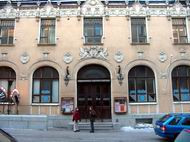
A bit about the background of Yo-Talo, which is short for "Ylioppilastalo" (Student Union House), an old Jugendstil house from the early 20th century. Yo-Talo's bar is called "Pankki" ("Bank"); the name coming from the building's original purpose as an office of Yhdyspankki, which was built in 1901, designed by the architect Gustav Nyström, who had studied in Vienna, which influenced also the Austrian-style of Jugend (known also as Art Deco) of this building. The street level was used as a bank hall for the customers, the bank vault was located in the basement, and the luxurious upstairs apartments were spared for the high executives of the bank.
In 1912 there was revealed an embezzlement by the bank director Nils Idman, who had among all given loose credit to his personal friends. The losses in current money were about 23.5 million euros. Mr. Idman was sentenced to prison for fifteen years. Also bankrupted alongside Nils Idman was his brother Fredrik "Fedi" Idman, who had guaranteed loans for the said bank. Fedi, who was in charge of Hatanpää's Mansion, had to sell his enormous property to the City of Tampere.
The building still housed the bank until the Second World War, after which it was used as municipal offices and warehouses. The building was donated to the Tampere University's Student Union in 1967, which was the start of the now-legendary Yo-Talo club, hosting gigs for many famous rock bands and disco nights. Nowadays Yo-Talo works as a corporated restaurant, successfully run by one Mr. Timo Isomäki, the stocky Renaissance Prince-like character with curly long hair.
It's quite easy for me to find my way to Yo-Talo, since I only live two blocks from there, I've got a VIP card entitling me to jump the long Saturday night queue of punters behind the door and get in free (yes, before I got the card I've spent many chilling winter night hours quieing up) and they sell me cheap bewerages! But in my defense I've got to say that I've worked to receive my VIP status, unlike some people who've just been lucky to know the right people... Bastards. Namely, I've DJed many a night at Yo-Talo; with Club Telex and some other events.
What kind of people usually frequent Yo-Talo, then? Students, of course, but increasingly teenyboppers and local B-boys. I'm old enough to remember the old school of the Yo-Talo goers of post-punk generation and the heyday of old Suomirock; the current uniform of which were the black second-hand jackets and jeans. Today it's mostly watered-down MTV/R&B style, nothing too flashy or sexy though, or the recycled "ironic" 70s/80s gear of indie pop fans, often bought second-hand from the UFF shops (Scandinavian counterpart to UK's Oxfam).
In the mid-to-late 1990s the Britpop style and bands were popular at Yo-Talo, but since the Tampere Britpoppers got too old (or moved to Helsinki), the emphasis has moved to hip hop/R&B styles or whatever the indie kids are into these days: the NME-celebrated bands of the new wave of garage rock or punk-funk or (God forbid) a sort of electroclash style. But anything by The Smiths or Depeche Mode is bound to fill the Yo-Talo dancefloor even these days.
As for me, I'm quite content with my outsider position among these elfish teenyboppers and little white B-boys of Yo-Talo. Sipping my beer or cider alone somewhere in the youthful crowd of the whiz bang pow kids, watching their silly drunken antics. Sometimes I might meet a friend to talk to but these days more often than not I'm there just on my own, as "Just Another Fucking Observer". I guess the kids are thinking that this funny-looking old geezer in tinted aviator spectacles, black combat fatigues and electro T-shirts is always there, like as part of the furniture, but I don't mind.
The good thing about Yo-Talo is that it's always relatively peaceful there; you don't get any old drunks vomiting all over you or wasting your time with some incomprehensible babble, or any latent psychopaths on amphetamine trying to beat you up, since those people frequent just the other bars in Tampere.
The Yo-Talo's programme is usually just the same: during the week days band nights or various clubs dedicated to DJ music; every Saturday a disco night, which follow each other weekly approximately in this order: Alternative Night by DJs Henkka & Mikko, Pauli Kallio's Rhythm and Groove (old soul, funk and new R&B), Bigpop with DJs Sami and Riku (a.k.a. Tampere's drum'n'bass king Infekto) and the latest newcomer, OK Pop with DJs Antti Lähde and Antti Koivumäki, who replaced the Britpop-run Pop-Disko with DJs Tero and Jani (towards the end Tero and Jani got increasingly arrogant; giggling drunk to themselves and competing on how cheesy one could go, with the trashiest hit songs of the yesteryear: Don Johnson's 'Heartbeat', 'Together We Are Strong' by Julio Iglesias and Pia Zadora, and so on).
Other DJs don't usually make much of a fuss of themselves; only Sami and Riku are willing to provide some sort of a "show": towards the end of the night they take their shirts off and do a wild dance standing over the DJ booth, shouting to the people to raise their hands; often the sleeves of 12-inch records as their headgear (alcohol probably has something to contribute to this extraordinary performance). It's silly, to say the least, but the people -- who are by this time piss-drunk -- seem to go nuts every time; especially when these DJs play crap yesteryear's hits like Europe's 'Final Countdown'.
The thing with Yo-Talo's disco nights is that when you have frequented them for a while, you'll find out that the DJs always play pretty much the same songs, without daring to divert from the "formula" or "playlist" and taking the risk of draining the dancefloor, so sometimes it feels they might as well replace the DJs with a jukebox filled to the brim with all the crowd-pleasing "hits", such as Beyoncé's 'Crazy In Love' or Outkast's 'Hey Ya'. And The Smiths. This playing it for safe used to really irritate me, but I'm beyond caring now. (See: Discophrenia.)
I don't know: maybe I'm too old for this club shit, but on the other hand I don't have much else in my life to spend my weekend evenings with. For me it's obligatory socializing since I very much tend to be of a loner type: anything to avoid cabin fever and becoming too strange on your own. So, Yo-Talo is my easy option there. I used to bother about it -- shouldn't I get a life finally, and leave this whole scene behind -- but I guess now I'm beyond all care.
Saturday, September 04, 2004
Trappings Of An Ego
When you're young, you think you're immortal. One day you will find it's not exactly so. My failing health has made that notion painfully clear since the last couple of months and drained me of some of my simple-minded vitality. Perhaps that relentless need to keep pushing on is one of the reasons to my recent ailments: in the way of psychosomatic symptoms. I'm a combination of physical frailty and a sort of mental vitality, I think.
I'm afraid to say I'm a bit of a narcissistic personality, though I can't claim to draw attention to myself through my pretty face, handsome body, my person or my external habitus, but through the things I do. I'm very much a "you are what you do and anything else doesn't matter" person. That's probably because of my upbringing, the environment I grew up in, and so on. There was (and is) a certain pressure around me all the time to be ambitious, to "do things in life" but on the other way, to conform. One grows up under conflicting forces, each of them pushing in different directions; the result being one becomes a cracked personality, slightly at least. And if one intends to stay "whole", there seems to be no other option than "The Great Refusal". The refusal not to conform, the refusal to follow no other path which is not of one's own choosing only, the refusal not to do things because "everyone else" is doing them. And that refusal can make one's life very hard, though admittedly, interesting too. Double bind, double bind, double bind.
One of the basic traits of my personality is, I think, that I thrive on people's admiration, and feel crushed if I receive any negative feedback or no attention at all. Yes, another ego trap. That's probably a major reason why I stopped my academic studies: I felt like a total nobody at the university. I only managed to get some positive attention with my extracurricular activities: when I started pHinnWeb.
Let me tell here about Finnish culture. Here in Finland being modest, not boasting or making a fuss of oneself, is considered a virtue. Which is to cause certain friction with today's international culture of emphasizing the meaning of the individual's virtues; in other words, the current "Me Me Me" cult of business and entertainment! No wonder I feel awkward all the time when I ought to be doing "PR" for myself, and on the other hand, when the domestic culture around me doesn't exactly accept that sort of behaviour. Another double bind.
I think I'm a very utilitaristic person; I just can't "hang out" with people and talk niceties with them unless I can feel it serves a certain purpose. Otherwise I get bored, become uninterested. Are people there for me just to be used, for different purposes serving myself; do they not have any meaning to me just as themselves? It is a very grim thought, but I can't get rid of it. Sometimes I feel there's something very unhuman in me: as if I was only some sort of a machine, which has to keep rolling on for a certain goal, and everything else along the road would be just a vehicle to reach that goal...
Again, do not think that I would accept here submitting to the role of a typical psychobabble therapy talk victim. I know I possess a strong tendency to introspection, to psychoanalyze myself all the time (which can get tedious, I admit); perhaps that constant need to reassess myself is there to save me from the worst excesses of selfishness, being ego-centred, narcissism, of becoming an unfeeling psychopathic monster. Perhaps...
I only wish now I was in a better physical health. Gentlemen don't talk about their health problems, but then, I guess I'm not a gentleman (add big smiley here).
I'm afraid to say I'm a bit of a narcissistic personality, though I can't claim to draw attention to myself through my pretty face, handsome body, my person or my external habitus, but through the things I do. I'm very much a "you are what you do and anything else doesn't matter" person. That's probably because of my upbringing, the environment I grew up in, and so on. There was (and is) a certain pressure around me all the time to be ambitious, to "do things in life" but on the other way, to conform. One grows up under conflicting forces, each of them pushing in different directions; the result being one becomes a cracked personality, slightly at least. And if one intends to stay "whole", there seems to be no other option than "The Great Refusal". The refusal not to conform, the refusal to follow no other path which is not of one's own choosing only, the refusal not to do things because "everyone else" is doing them. And that refusal can make one's life very hard, though admittedly, interesting too. Double bind, double bind, double bind.
One of the basic traits of my personality is, I think, that I thrive on people's admiration, and feel crushed if I receive any negative feedback or no attention at all. Yes, another ego trap. That's probably a major reason why I stopped my academic studies: I felt like a total nobody at the university. I only managed to get some positive attention with my extracurricular activities: when I started pHinnWeb.
Let me tell here about Finnish culture. Here in Finland being modest, not boasting or making a fuss of oneself, is considered a virtue. Which is to cause certain friction with today's international culture of emphasizing the meaning of the individual's virtues; in other words, the current "Me Me Me" cult of business and entertainment! No wonder I feel awkward all the time when I ought to be doing "PR" for myself, and on the other hand, when the domestic culture around me doesn't exactly accept that sort of behaviour. Another double bind.
I think I'm a very utilitaristic person; I just can't "hang out" with people and talk niceties with them unless I can feel it serves a certain purpose. Otherwise I get bored, become uninterested. Are people there for me just to be used, for different purposes serving myself; do they not have any meaning to me just as themselves? It is a very grim thought, but I can't get rid of it. Sometimes I feel there's something very unhuman in me: as if I was only some sort of a machine, which has to keep rolling on for a certain goal, and everything else along the road would be just a vehicle to reach that goal...
Again, do not think that I would accept here submitting to the role of a typical psychobabble therapy talk victim. I know I possess a strong tendency to introspection, to psychoanalyze myself all the time (which can get tedious, I admit); perhaps that constant need to reassess myself is there to save me from the worst excesses of selfishness, being ego-centred, narcissism, of becoming an unfeeling psychopathic monster. Perhaps...
I only wish now I was in a better physical health. Gentlemen don't talk about their health problems, but then, I guess I'm not a gentleman (add big smiley here).
Thursday, August 26, 2004
Some pHinnMilk Comics Collage Scans From 2003
I found from my archives some collages I made last year but got to scan only now for the pHinnMilk Comics site (as usual, not for children):
http://www.phinnweb.org/phinnmilk/comics/2003/marquisdedadazen.html
http://www.phinnweb.org/phinnmilk/comics/2003/11-33.html
http://www.phinnweb.org/phinnmilk/comics/2003/haluansieluni.html
http://www.phinnweb.org/phinnmilk/comics/2003/pornotamperei.html
http://www.phinnweb.org/phinnmilk/comics/2003/prophecy.html
http://www.phinnweb.org/phinnmilk/comics/2003/superlipstick.html
http://www.phinnweb.org/phinnmilk/comics/2003/aileenwuornos.html
http://www.phinnweb.org/phinnmilk/comics/2003/abusestartsathome.html
http://www.phinnweb.org/phinnmilk/comics/2003/glowofcrime.html
http://www.phinnweb.org/phinnmilk/comics/2003/happyday.html
http://www.phinnweb.org/phinnmilk/comics/2003/lindatelevangelista.html
http://www.phinnweb.org/phinnmilk/comics/2003/marquisdedadazen.html
http://www.phinnweb.org/phinnmilk/comics/2003/11-33.html
http://www.phinnweb.org/phinnmilk/comics/2003/haluansieluni.html
http://www.phinnweb.org/phinnmilk/comics/2003/pornotamperei.html
http://www.phinnweb.org/phinnmilk/comics/2003/prophecy.html
http://www.phinnweb.org/phinnmilk/comics/2003/superlipstick.html
http://www.phinnweb.org/phinnmilk/comics/2003/aileenwuornos.html
http://www.phinnweb.org/phinnmilk/comics/2003/abusestartsathome.html
http://www.phinnweb.org/phinnmilk/comics/2003/glowofcrime.html
http://www.phinnweb.org/phinnmilk/comics/2003/happyday.html
http://www.phinnweb.org/phinnmilk/comics/2003/lindatelevangelista.html
On Anger And Being Pressure-Cooked
I've earlier expressed here how much I'm into Birdy's net diary/blog. Here are some excerpts of Birdy's recent net column on anger, freely translated from Finnish. I think she hits the nail on the head here, on the feelings of anger and how society sees it better to suppress them the best it can. There's a lot of latent violence in this society; a lot of people who live from day to day like being constantly pressure-cooked. Showing one's anger or aggression is not encouraged in most social situations, which is all good to maintain society's day-to-day consistence, but those feelings considered negative seem to be only swept away under the carpet, making the occasional outbursts of violence even worse. The ancient Greek used to hold as their maxim "Know thyself"; and one's dark side is also something we have to deal with, perhaps even more often than we realise. A lot of anger is childish, of course; undergoings of the feelings of hurt egos, but there is also anger that is justified: in the face of unfair social situations and one's being subjected power games; in the face of oppression and unequality.
"Being angry does not make anyone a Satanic hound of darkness or a destructive psychopath. Instead, the people who deny their own feelings of anger make me scared. When that soup keeps brewing and growing inside a high pressure kettle, one becomes a walking time bomb."
"An angry person is angry. The one who denies one's anger can't accept the feelings of anger in him/herself, not to talk about the other person's anger: an angry person is to an anger-denier a mad and destructive being. Being angry is demonised. An angry person is seen nearly as a monster, whereas one's own angry behaviour is seen as something of a Mother Theresa or a Dalai Lama. Ms. Jekyll feels like she's encountering Ms. Hyde."
"How can a child learn to handle the feelings of anger and express those in a correct way, if s/he doesn't have any healthy example to follow? How is the well-being of a person in a society, where any anger should be suppressed and kept under wraps?"
"Being angry is energetic and normal, and how to control it is an important skill. Being angry protects and destroys, depending exactly on how well one can handle it. Denying it won't improve one's skills to handle it. The passive aggression is the worst bane of human relationships: brooding, keeping silent, stealthy retort, 'forgetting', and other funny ways to vent out that hatred that can't be expressed openly. Passive aggression is also one's rising above, from which position one can handle one's angry neighbour like a little kid who has pooped on the floor -- at same time reinforcing one's own 'goodness', which is in reality merely arrogance."
"For many people conflict or being angry is like a plague, best avoided. Either sacrifing oneself with ongoing concessions (which causes the martyr syndrome and bitterness) or rising above, in other words avoiding." One should "understand that the opposite of love is not being angry but being indifferent".
"Being angry does not make anyone a Satanic hound of darkness or a destructive psychopath. Instead, the people who deny their own feelings of anger make me scared. When that soup keeps brewing and growing inside a high pressure kettle, one becomes a walking time bomb."
"An angry person is angry. The one who denies one's anger can't accept the feelings of anger in him/herself, not to talk about the other person's anger: an angry person is to an anger-denier a mad and destructive being. Being angry is demonised. An angry person is seen nearly as a monster, whereas one's own angry behaviour is seen as something of a Mother Theresa or a Dalai Lama. Ms. Jekyll feels like she's encountering Ms. Hyde."
"How can a child learn to handle the feelings of anger and express those in a correct way, if s/he doesn't have any healthy example to follow? How is the well-being of a person in a society, where any anger should be suppressed and kept under wraps?"
"Being angry is energetic and normal, and how to control it is an important skill. Being angry protects and destroys, depending exactly on how well one can handle it. Denying it won't improve one's skills to handle it. The passive aggression is the worst bane of human relationships: brooding, keeping silent, stealthy retort, 'forgetting', and other funny ways to vent out that hatred that can't be expressed openly. Passive aggression is also one's rising above, from which position one can handle one's angry neighbour like a little kid who has pooped on the floor -- at same time reinforcing one's own 'goodness', which is in reality merely arrogance."
"For many people conflict or being angry is like a plague, best avoided. Either sacrifing oneself with ongoing concessions (which causes the martyr syndrome and bitterness) or rising above, in other words avoiding." One should "understand that the opposite of love is not being angry but being indifferent".
Wednesday, August 25, 2004
Stagnation
There's a sense of overall stagnation in the air, just everywhere I look. Or maybe it's just me. It seems I'm somehow out of touch with most of the things. I'm too tired to amuse myself with the cheap thrills my so called peers occupy their times with. All these artists and musicians (I'm not going to mention any names here); little self-centered, narcissistic cartoon characters, whose little worlds revolve around their own little navels they consider their precious Axis Mundi. And am I just all the same? No, I'm not searching new friends with a talk like this. Often I wonder if these people just secretly loathe me, but playing a smooth, nice guy with a permanent smile glued on my face is just not me. I'm awkward, moody, reticent, nervous and sweat a lot. I smell secret age discrimination. No sweet young thing or a golden boy charming everyone. Narcissism is a disease, and my own special brand of that is not just better or worse than the one I see in those people. They talk smooth and sweet like a bunch of new era Mephistos, but how can I be sure they are not just talking with forked tongues; ready to stab me in the back when the right occasion arises?
Perhaps I'm just paranoid, a control freak who's afraid I'm kicked out of their little sandboxes, cast out from their little games. Perhaps I'm only reflecting my own fears and frustations on them. So, what's the point in playing the game? Ego is a burden.
And talking about stagnation, I think the whole music scene is undergoing a period of one. They still recycle 20-25 year old genres and styles, and it's the biggest thing that's happening in the alternative music now. White, pale middle-class Fenno-Ugric kids in Finland are happy with their shallow, empty, washed-out domestic hiphop sounds, think they're black gangstas living in American inner-city ghettos or wear dreadlocks and try to toast in Finnish about the virtues of eating your vegetables; girls want to be like those Afro-American soul goddesses they see on MTV and do R&B dance routines around their handbags in their expensive sleeveless tops and stretch jeans. The experimental scene has disappeared up in its own rear, gazing intently on their laptops like some crystal balls and miking up their own buttholes for some new interesting acoustics.
What is there for me to do except to wait? Buried in my concrete bunker which sees no light of day; reading, writing, thinking, sleeping, waiting.
Waiting.
Waiting.
Waiting.
Perhaps I'm just paranoid, a control freak who's afraid I'm kicked out of their little sandboxes, cast out from their little games. Perhaps I'm only reflecting my own fears and frustations on them. So, what's the point in playing the game? Ego is a burden.
And talking about stagnation, I think the whole music scene is undergoing a period of one. They still recycle 20-25 year old genres and styles, and it's the biggest thing that's happening in the alternative music now. White, pale middle-class Fenno-Ugric kids in Finland are happy with their shallow, empty, washed-out domestic hiphop sounds, think they're black gangstas living in American inner-city ghettos or wear dreadlocks and try to toast in Finnish about the virtues of eating your vegetables; girls want to be like those Afro-American soul goddesses they see on MTV and do R&B dance routines around their handbags in their expensive sleeveless tops and stretch jeans. The experimental scene has disappeared up in its own rear, gazing intently on their laptops like some crystal balls and miking up their own buttholes for some new interesting acoustics.
What is there for me to do except to wait? Buried in my concrete bunker which sees no light of day; reading, writing, thinking, sleeping, waiting.
Waiting.
Waiting.
Waiting.
Tuesday, August 24, 2004
Of Psychopathological Cult Leaders
What makes one person to have "charisma" and the other person not? Why will some people gather blind followers around them? And what about the dark side of these charming manipulators? I have known some people like these myself. I try not to be like these people, but sometimes there's a grim suspicion...
From http://www.fwselijah.com/psychopa.htm:
1. Glibness/Superficial charm
Glibness is a hallmark of psychopaths. They are able to use language effortlessly to beguile, confuse, and convince. They are captivating storytellers. They exude self-confidence and are able to spin a web that intrigues others and pulls them into the psychopath's life. Most of all, they are persuasive. Frequently they have the capacity to destroy their critics verbally or disarm them emotionally.
2. Manipulative and Conning
Cult leaders do not recognize the individuality or rights of others, which makes all self-serving behaviors permissible. The hallmark of the psychopath is the psychopathic maneuver; which is essentially interpersonal manipulation "based on charm. The manipulator appears to be helpful, charming, even ingratiating or seductive, but is covertly hostile, domineering....[The victim] is perceived as an aggressor, competitor, or merely as an instrument to be used....The manipulation inevitably becomes the end-all and is no longer qualified by the reality principle." In other words, there are no checks on the psychopath's behavior--anything goes. The Psychopath divides the world into suckers, sinners, and himself. He discharges powerful feelings of terror and rage by dominating and humiliating his victims. He is particularly successful when, through an overlay of charm, he makes an ally of his victim--a process sometimes described as emotional vampirism or emotional terrorism. Examples of this type of manipulation are plentiful in the literature of Jonestown and other cultic groups. It is especially prevalent in the one-on-one cultic relationship, where there is direct involvement with the manipulator.
3. Grandiose Sense of Self
The cult leader enjoys tremendous feelings of entitlement. He believes everything is owed to him as a right. Preoccupied with his own fantasies, he must always be the center of attention. He presents himself as the "Ultimate One" enlightened, a vehicle of God, a genius, the leader of humankind, and sometimes even the most humble of humble. He has an insatiable need for adulation and attendance. His grandiosity may also be a defense against inner emptiness, depression, and a sense of insignificance. Paranoia often accompanies the grandiosity, reinforcing the isolation of the group and the need for protection against a perceived hostile environment. In this way, he creates an us-versus-them mentality.
4. Pathological Lying
Psychopaths lie coolly and easily, even when it is obvious they are being untruthful. It is almost impossible for them to be consistently truthful about either a major or minor issue. They lie for no apparent reason, even when it would seem easier and safer to tell the truth. This is sometimes called "crazy lying." Confronting their lies may provoke an unpredictably incense rage or simply a Buddha-like smile.
Another form of lying common among cult leaders is known as pseudologica fantastica, an extension of pathological lying. Leaders tend to create a complex belief system, often about their own powers and abilities, in which they themselves sometimes get caught up. "It is often difficult to determine whether the lies are an actual delusional distortion of reality or are expressed with the conscious or unconscious intent to deceive. These manipulators are rarely original thinkers. Plagiarists and thieves, they seldom credit the true originators of ideas, often co-opting authorship. They are extremely convincing, forceful in the expression of their views, and talented at passing lie detector tests. For them, objective truth does not exist. The only "truth" is whatever will best achieve the outcome that meets their needs. This type of opportunism is very difficult to understand for those who are not psychopaths. For this reason, followers are more apt to invent or go along with all kinds of explanations and rationales for apparent inconsistencies in behavior "I know my guru must have had a good reason for doing this." "He did it because he loves me even though it hurts."
5. Lack of Remorse, Shame, or Guilt
At the core of the psychopath is a deep-seated rage which is split off (i.e, psychologically separated from the rest of the self) and repressed. Some researchers theorize that this is caused by feeling abandoned in infancy or early childhood. Whatever the emotional or psychological source, psychopaths see those around them as objects, targets, or opportunities, not as people. They do not have friends, they have victims and accomplices-and the latter frequently end as victims. For psychopaths, the ends always justify the means. Thus there is no place for feelings of remorse, shame, or guilt. Cult leaders feel justified in all their actions since they consider themselves the ultimate moral arbiter. Nothing gets in their way.
6. Shallow Emotions
While they may display outbursts of emotion, more often than not they are putting on a calculated response to obtain a certain result. They rarely reveal a range of emotions, and what is seen is superficial at best, pretended at worst. Positive feelings of warmth, joy, love, and compassion are more feigned than experienced. They are unmoved by things that would upset the normal person, while outraged by insignificant matters. They are bystanders to the emotional life of others, perhaps envious and scornful of feelings they cannot have or understand. In the end, psychopaths are cold, with shallow emotions, living in a dark world of their own.
Hiding behind the "mask of sanity," the cult leader exposes feelings only insofar as they serve an ulterior motive. He can witness or order acts of utter brutality without experiencing a shred of emotion. He casts himself in a role of total control, which he plays to the hilt. What is most promised in cults--peace, joy, enlightenment, love, and security are goals that are forever out of reach of the leader, and thus also the followers. Since the leader is not genuine, neither are his promises
7. Incapacity for Love
As the "living embodiment of God's love," the leader is tragically flawed in being unable to either give or receive love. Love substitutes are given instead. A typical example might be the guru's claim that his illness or misfortune (otherwise inconsistent with his enlightened state) is caused by the depth of his compassion for his followers, whereby he takes on their negative karma. Not only are devotees supposed to accept this as proof of his love but also are expected to feel guilt for their failings! It becomes impossible for members to disprove this claim once they have accepted the beliefs of the group.
The leader's tremendous need to be loved is accompanyied by an equally strong disbelief in the love offered him by his followers; hence, the often unspeakably cruel and harsh testing of his devotees. Unconditional surrender is an absolute requirement. In one cult, for example, the mother of two small children was made to tell them nightly that she loved her leader more than them. Later, as a test of her devotion, she was asked to give up custody of her children in order to be allowed to stay with her leader. The guru's love is never tested; it must be accepted at face value.
8. Need for Stimulation
Thrill-seeking behaviors, often skirting the letter or spirit of the law, are common among psychopaths. Such behavior is sometimes justified as preparation for martyrdom "I know I don't have long to live; therefore my time on this earth must be lived to the fullest." "Surely even I am entitled to have fun or sin a little." This type of behavior becomes more frequent as the leader deteriorates emotionally and psychologically--a common occurrence.
Cult leaders live on the edge, constantly testing the beliefs of their followers, often with increasingly bizarre behaviors, punishments, and rules. Other mechanisms of stimulation come in the form of unexpected, seemingly spontaneous outbursts, which usually take the form of verbal abuse and sometimes physical punishment. The psychopath has a cool indifference to things around him, yet his icy coldness can quicky turn into rage, vented on those around him.
9. Callousness/lack of empathy
Psychopaths readily take advantage of others, expressing utter contempt for anyone else's feelings. Someone in distress is not important to them. Although intelligent, perceptive, and quite good at sizing people up, they make no real connections with others. They use their "people skills" to exploit, abuse, and wield power.
Psychopaths are unable to empathize with the pain of their victims. Meanwhile, part of the victims' denial system is the inability to believe that someone they love so much could consciously and callously hurt them. It therefore becomes easier to rationalize the leader's behavior as necessary for the general or individual "good." The alternative for the devotee would be to face the sudden and overwhelming awareness of being victimized, deceived, used. Such a realization would wound the person's deepest sense of self, so as a means of self-protection the person denies the abuse. When and if the devotee becomes aware of the exploitation, it feels as though a tremendous evil has been done, a spiritual rape.
10. Poor Behavioral Controls/Impulsive Nature
Like small children, many psychopaths have difficulty regulating their emotions. Adults who have temper tantrums are frightening to be around. Rage and abuse, alternating with token expressions of love and approval, produce an addictive cycle for both abuser and abused, as well as create a sense of hopelessness in the latter. This dynamic has also been recognized in relation to domestic abuse and the battering of women. The cult leader acts out with some regularity--often privately, sometimes publicly--usually to the embarrassment and dismay of his followers and other observers. He may act out sexually, aggressively, or criminally, frequently with rage. Who could possibly control someone who believes himself to be all-powerful, all-knowing, and entitled to every wish, someone who has no sense of personal boundaries, no concern for the impact on those around him? Generally this aberrant behavior is a well-kept secret, known only to a few disciples. The others only see perfection. These tendencies are related to the psychopath's need for stimulation and inability to tolerate frustration, anxiety, and depression. Often a leader's inconsistent behavior needs to be rationalized by either the leader or the follower in order to maintain internal consistency. It is often regarded as divinely inspired and further separates the empowered from the powerless.
11. Early Behavior Problems/juvenile delinquency
Psychopaths frequently have a history of behavioral and academic difficulties. They often "get by" academically, conning other students and teachers. Encounters with juvenile authorities are frequent. Equally prevalent are difficulties in peer relationships and developing and keeping friends, marked control problems, and other aberrant behaviors such as stealing, fire setting, and cruelty to others.
12. Irresponsibility/Unreliability
Not concerned about the consequences of their behavior, psychopaths leave behind them the wreckage of others' lives and dreams. They may be totally oblivious or indifferent to the devastation they inflict on others, something which they regard as neither their problem nor their responsibility.
Psychopaths rarely accept blame for their failures or mistakes. Scape goating is common, blaming followers, those outside the group, a member's family, the government, Satan--anyone and everyone but the leader. The blaming may follow a ritualized procedure such as a trial, "hot seat" denunciation, or public confession (either one-on-one or in front of the group). Blame is a powerful reinforcer of passivity and obedience, producing guilt, shame, terror, and conformity in the followers.
13. Promiscuous Sexual behavior/infidelity
Promiscuity, child sexual abuse, polygamy, rape, and sexual acting out of all sorts are frequently practiced by cult leaders. Conversely, there is often stringent sexual control of the followers through such tactics as enforced celibacy, arranged marriages, forced breakups and divorces, removal of children from their parents, forced abortions or mandated births. For psychopaths, sex is primarily a control and power issue.
Along with this behavior comes vast irresponsibility not only for the followers' emotions but also for their lives. In one cult, for example, multiple sexual relations were encouraged even while one of the top leaders was known to be HIV positive. This kind of negligence toward others is not uncommon in the psychopath's world.
Marital fidelity is rare in the psychopath's life. There are usually countless reports of extramarital affairs and sexual predation upon adult and child members of both sexes. The sexual behavior of the leader may be kept hidden from all but the inner circle or may be part of accepted group sexual practices. In any case, due to the power imbalance between leader and followers, sexual contact is never truly consensual and is likely to have damaging consequences for the follower.
14. Lack of realistic life plan/parasitic lifestyle
The psychopath tends to move around a lot, making countless efforts at "starting over while seeking out Fertile new ground to exploit. One day he may appear as a rock musician, the next a messiah; one day a used car salesman, the next the founder of a mass self-transformation program; one day a college professor, the next the new "Lenin" bringing revolution to America.
The flip side of this erratic life planning is the all-encompassing promise for the future that the cult leader makes to his followers. Many groups claim as their goal world domination or salvation at the Apocalypse. The leader is the first to proclaim the utopian nature of the group, which is usually simply another justification for irrational behavior and stringent controls.
The leader's sense of entitlement is often demonstrated by the contrast between his luxurious lifestyle and the impoverishment of his followers. Most cult leaders arc supported by gifts and donations from their followers, who may be pressured to turn over much of their income and worldly possessions to the group. Slavery, enforced prostitution, and a variety of illegal acts for the benefit of the leader are common in a cult milieu. This type of exploitation aptly demonstrates Lifton's third point of idealization from below and exploitation from above.
Psychopaths also tend to be preoccupied with their own health while remaining totally indifferent to the suffering of others. They may complain of being "burned out" due to the burden of "caring for" their followers, sometimes stating they do not have long to live, instilling fear and guilt in their devotees and encouraging further servitude. they are highly sensitive to their own pain and tend to be hypochondriacs, which often conflicts with their public image of superhuman self-control and healing abilities.
According to them, the illnesses they don't get are due to their powers, while the ones they do get are caused by their "compassion" in taking on their disciples' karma or solving the group's problems. This of course is another guru trick.
15. Criminal or entrepreneurial versatility
Cult leaders change their image and that of the group as needed to avoid prosecution and litigation, to increase income, and to recruit a range of members. Cult leaders have an innate ability to attract followers who have the skills and connections that the leaders lack. The longevity of the group is dependent on the willingness of leadership to adapt as needed and preserve the group. Frequently, when illegal or immoral activities are exposed to the public, the cult leader will relocate, sometimes taking followers with him. He will keep a low profile, only to resurface later with a new name, a new front group, and perhaps a new twist on the scam.
See also:
Without Conscience
From http://www.fwselijah.com/psychopa.htm:
1. Glibness/Superficial charm
Glibness is a hallmark of psychopaths. They are able to use language effortlessly to beguile, confuse, and convince. They are captivating storytellers. They exude self-confidence and are able to spin a web that intrigues others and pulls them into the psychopath's life. Most of all, they are persuasive. Frequently they have the capacity to destroy their critics verbally or disarm them emotionally.
2. Manipulative and Conning
Cult leaders do not recognize the individuality or rights of others, which makes all self-serving behaviors permissible. The hallmark of the psychopath is the psychopathic maneuver; which is essentially interpersonal manipulation "based on charm. The manipulator appears to be helpful, charming, even ingratiating or seductive, but is covertly hostile, domineering....[The victim] is perceived as an aggressor, competitor, or merely as an instrument to be used....The manipulation inevitably becomes the end-all and is no longer qualified by the reality principle." In other words, there are no checks on the psychopath's behavior--anything goes. The Psychopath divides the world into suckers, sinners, and himself. He discharges powerful feelings of terror and rage by dominating and humiliating his victims. He is particularly successful when, through an overlay of charm, he makes an ally of his victim--a process sometimes described as emotional vampirism or emotional terrorism. Examples of this type of manipulation are plentiful in the literature of Jonestown and other cultic groups. It is especially prevalent in the one-on-one cultic relationship, where there is direct involvement with the manipulator.
3. Grandiose Sense of Self
The cult leader enjoys tremendous feelings of entitlement. He believes everything is owed to him as a right. Preoccupied with his own fantasies, he must always be the center of attention. He presents himself as the "Ultimate One" enlightened, a vehicle of God, a genius, the leader of humankind, and sometimes even the most humble of humble. He has an insatiable need for adulation and attendance. His grandiosity may also be a defense against inner emptiness, depression, and a sense of insignificance. Paranoia often accompanies the grandiosity, reinforcing the isolation of the group and the need for protection against a perceived hostile environment. In this way, he creates an us-versus-them mentality.
4. Pathological Lying
Psychopaths lie coolly and easily, even when it is obvious they are being untruthful. It is almost impossible for them to be consistently truthful about either a major or minor issue. They lie for no apparent reason, even when it would seem easier and safer to tell the truth. This is sometimes called "crazy lying." Confronting their lies may provoke an unpredictably incense rage or simply a Buddha-like smile.
Another form of lying common among cult leaders is known as pseudologica fantastica, an extension of pathological lying. Leaders tend to create a complex belief system, often about their own powers and abilities, in which they themselves sometimes get caught up. "It is often difficult to determine whether the lies are an actual delusional distortion of reality or are expressed with the conscious or unconscious intent to deceive. These manipulators are rarely original thinkers. Plagiarists and thieves, they seldom credit the true originators of ideas, often co-opting authorship. They are extremely convincing, forceful in the expression of their views, and talented at passing lie detector tests. For them, objective truth does not exist. The only "truth" is whatever will best achieve the outcome that meets their needs. This type of opportunism is very difficult to understand for those who are not psychopaths. For this reason, followers are more apt to invent or go along with all kinds of explanations and rationales for apparent inconsistencies in behavior "I know my guru must have had a good reason for doing this." "He did it because he loves me even though it hurts."
5. Lack of Remorse, Shame, or Guilt
At the core of the psychopath is a deep-seated rage which is split off (i.e, psychologically separated from the rest of the self) and repressed. Some researchers theorize that this is caused by feeling abandoned in infancy or early childhood. Whatever the emotional or psychological source, psychopaths see those around them as objects, targets, or opportunities, not as people. They do not have friends, they have victims and accomplices-and the latter frequently end as victims. For psychopaths, the ends always justify the means. Thus there is no place for feelings of remorse, shame, or guilt. Cult leaders feel justified in all their actions since they consider themselves the ultimate moral arbiter. Nothing gets in their way.
6. Shallow Emotions
While they may display outbursts of emotion, more often than not they are putting on a calculated response to obtain a certain result. They rarely reveal a range of emotions, and what is seen is superficial at best, pretended at worst. Positive feelings of warmth, joy, love, and compassion are more feigned than experienced. They are unmoved by things that would upset the normal person, while outraged by insignificant matters. They are bystanders to the emotional life of others, perhaps envious and scornful of feelings they cannot have or understand. In the end, psychopaths are cold, with shallow emotions, living in a dark world of their own.
Hiding behind the "mask of sanity," the cult leader exposes feelings only insofar as they serve an ulterior motive. He can witness or order acts of utter brutality without experiencing a shred of emotion. He casts himself in a role of total control, which he plays to the hilt. What is most promised in cults--peace, joy, enlightenment, love, and security are goals that are forever out of reach of the leader, and thus also the followers. Since the leader is not genuine, neither are his promises
7. Incapacity for Love
As the "living embodiment of God's love," the leader is tragically flawed in being unable to either give or receive love. Love substitutes are given instead. A typical example might be the guru's claim that his illness or misfortune (otherwise inconsistent with his enlightened state) is caused by the depth of his compassion for his followers, whereby he takes on their negative karma. Not only are devotees supposed to accept this as proof of his love but also are expected to feel guilt for their failings! It becomes impossible for members to disprove this claim once they have accepted the beliefs of the group.
The leader's tremendous need to be loved is accompanyied by an equally strong disbelief in the love offered him by his followers; hence, the often unspeakably cruel and harsh testing of his devotees. Unconditional surrender is an absolute requirement. In one cult, for example, the mother of two small children was made to tell them nightly that she loved her leader more than them. Later, as a test of her devotion, she was asked to give up custody of her children in order to be allowed to stay with her leader. The guru's love is never tested; it must be accepted at face value.
8. Need for Stimulation
Thrill-seeking behaviors, often skirting the letter or spirit of the law, are common among psychopaths. Such behavior is sometimes justified as preparation for martyrdom "I know I don't have long to live; therefore my time on this earth must be lived to the fullest." "Surely even I am entitled to have fun or sin a little." This type of behavior becomes more frequent as the leader deteriorates emotionally and psychologically--a common occurrence.
Cult leaders live on the edge, constantly testing the beliefs of their followers, often with increasingly bizarre behaviors, punishments, and rules. Other mechanisms of stimulation come in the form of unexpected, seemingly spontaneous outbursts, which usually take the form of verbal abuse and sometimes physical punishment. The psychopath has a cool indifference to things around him, yet his icy coldness can quicky turn into rage, vented on those around him.
9. Callousness/lack of empathy
Psychopaths readily take advantage of others, expressing utter contempt for anyone else's feelings. Someone in distress is not important to them. Although intelligent, perceptive, and quite good at sizing people up, they make no real connections with others. They use their "people skills" to exploit, abuse, and wield power.
Psychopaths are unable to empathize with the pain of their victims. Meanwhile, part of the victims' denial system is the inability to believe that someone they love so much could consciously and callously hurt them. It therefore becomes easier to rationalize the leader's behavior as necessary for the general or individual "good." The alternative for the devotee would be to face the sudden and overwhelming awareness of being victimized, deceived, used. Such a realization would wound the person's deepest sense of self, so as a means of self-protection the person denies the abuse. When and if the devotee becomes aware of the exploitation, it feels as though a tremendous evil has been done, a spiritual rape.
10. Poor Behavioral Controls/Impulsive Nature
Like small children, many psychopaths have difficulty regulating their emotions. Adults who have temper tantrums are frightening to be around. Rage and abuse, alternating with token expressions of love and approval, produce an addictive cycle for both abuser and abused, as well as create a sense of hopelessness in the latter. This dynamic has also been recognized in relation to domestic abuse and the battering of women. The cult leader acts out with some regularity--often privately, sometimes publicly--usually to the embarrassment and dismay of his followers and other observers. He may act out sexually, aggressively, or criminally, frequently with rage. Who could possibly control someone who believes himself to be all-powerful, all-knowing, and entitled to every wish, someone who has no sense of personal boundaries, no concern for the impact on those around him? Generally this aberrant behavior is a well-kept secret, known only to a few disciples. The others only see perfection. These tendencies are related to the psychopath's need for stimulation and inability to tolerate frustration, anxiety, and depression. Often a leader's inconsistent behavior needs to be rationalized by either the leader or the follower in order to maintain internal consistency. It is often regarded as divinely inspired and further separates the empowered from the powerless.
11. Early Behavior Problems/juvenile delinquency
Psychopaths frequently have a history of behavioral and academic difficulties. They often "get by" academically, conning other students and teachers. Encounters with juvenile authorities are frequent. Equally prevalent are difficulties in peer relationships and developing and keeping friends, marked control problems, and other aberrant behaviors such as stealing, fire setting, and cruelty to others.
12. Irresponsibility/Unreliability
Not concerned about the consequences of their behavior, psychopaths leave behind them the wreckage of others' lives and dreams. They may be totally oblivious or indifferent to the devastation they inflict on others, something which they regard as neither their problem nor their responsibility.
Psychopaths rarely accept blame for their failures or mistakes. Scape goating is common, blaming followers, those outside the group, a member's family, the government, Satan--anyone and everyone but the leader. The blaming may follow a ritualized procedure such as a trial, "hot seat" denunciation, or public confession (either one-on-one or in front of the group). Blame is a powerful reinforcer of passivity and obedience, producing guilt, shame, terror, and conformity in the followers.
13. Promiscuous Sexual behavior/infidelity
Promiscuity, child sexual abuse, polygamy, rape, and sexual acting out of all sorts are frequently practiced by cult leaders. Conversely, there is often stringent sexual control of the followers through such tactics as enforced celibacy, arranged marriages, forced breakups and divorces, removal of children from their parents, forced abortions or mandated births. For psychopaths, sex is primarily a control and power issue.
Along with this behavior comes vast irresponsibility not only for the followers' emotions but also for their lives. In one cult, for example, multiple sexual relations were encouraged even while one of the top leaders was known to be HIV positive. This kind of negligence toward others is not uncommon in the psychopath's world.
Marital fidelity is rare in the psychopath's life. There are usually countless reports of extramarital affairs and sexual predation upon adult and child members of both sexes. The sexual behavior of the leader may be kept hidden from all but the inner circle or may be part of accepted group sexual practices. In any case, due to the power imbalance between leader and followers, sexual contact is never truly consensual and is likely to have damaging consequences for the follower.
14. Lack of realistic life plan/parasitic lifestyle
The psychopath tends to move around a lot, making countless efforts at "starting over while seeking out Fertile new ground to exploit. One day he may appear as a rock musician, the next a messiah; one day a used car salesman, the next the founder of a mass self-transformation program; one day a college professor, the next the new "Lenin" bringing revolution to America.
The flip side of this erratic life planning is the all-encompassing promise for the future that the cult leader makes to his followers. Many groups claim as their goal world domination or salvation at the Apocalypse. The leader is the first to proclaim the utopian nature of the group, which is usually simply another justification for irrational behavior and stringent controls.
The leader's sense of entitlement is often demonstrated by the contrast between his luxurious lifestyle and the impoverishment of his followers. Most cult leaders arc supported by gifts and donations from their followers, who may be pressured to turn over much of their income and worldly possessions to the group. Slavery, enforced prostitution, and a variety of illegal acts for the benefit of the leader are common in a cult milieu. This type of exploitation aptly demonstrates Lifton's third point of idealization from below and exploitation from above.
Psychopaths also tend to be preoccupied with their own health while remaining totally indifferent to the suffering of others. They may complain of being "burned out" due to the burden of "caring for" their followers, sometimes stating they do not have long to live, instilling fear and guilt in their devotees and encouraging further servitude. they are highly sensitive to their own pain and tend to be hypochondriacs, which often conflicts with their public image of superhuman self-control and healing abilities.
According to them, the illnesses they don't get are due to their powers, while the ones they do get are caused by their "compassion" in taking on their disciples' karma or solving the group's problems. This of course is another guru trick.
15. Criminal or entrepreneurial versatility
Cult leaders change their image and that of the group as needed to avoid prosecution and litigation, to increase income, and to recruit a range of members. Cult leaders have an innate ability to attract followers who have the skills and connections that the leaders lack. The longevity of the group is dependent on the willingness of leadership to adapt as needed and preserve the group. Frequently, when illegal or immoral activities are exposed to the public, the cult leader will relocate, sometimes taking followers with him. He will keep a low profile, only to resurface later with a new name, a new front group, and perhaps a new twist on the scam.
See also:
Without Conscience
Saturday, August 21, 2004
VH-1 UK All-Time Worst No.1s
VH-1 UK All-Time Worst No.1s
1 - Cliff Richard 'Millennium Prayer'
2 - Mr Blobby 'Mr Blobby'
3 - Teletubbies 'Teletubbies Say Eh-oh!'
4 - Aqua 'Barbie Girl'
5 - Eamon 'F**k It (I Don't Want You Back)'
6 - Las Ketchup 'The Ketchup Song (Asereje)'
7 - Blazin' Squad 'Crossroads'
8 - Bob The Builder 'Can We Fix It'
9 - Frankee 'F.U.R.B (F U Right Back)'
10 - Peter Andre 'Mysterious Girl'
11 - Gareth Gates 'Unchained Melody'
12 - Will Young & Gareth Gates 'The Long And Winding Road / Suspicious Minds'
13 - Joe Dolce Music Theatre 'Shuddap You Face'
14 - DJ Otzi 'Hey Baby'
15 - Afroman 'Because I Got High'
16 - Will Young 'Light My Fire'
17 - Mariah Carey & Westlife 'Against All Odds'
18 - Bombalurina 'Itsy Bitsy Teeny Weeny Yellow Polka Dot Bikini'
19 - DJ Casper 'Cha Cha Slide'
20 - Busted 'Who's David'
21 - Manchester United 1994 Football Squad 'Come On You Reds'
22 - St Winifred's School Choir 'There's No-one Quite Like Grandma'
23 - Hear'Say 'Pure And Simple'
24 - Vanilla Ice 'Ice Ice Baby'
25 - Vengaboys 'We're Going To Ibiza'
26 - Hanson 'Mmmbop'
27 - Michelle McManus 'All This Time'
28 - Whigfield 'Saturday Night'
29 - Spitting Image 'The Chicken Song'
30 - B*Witched 'C'est La Vie'
31 - Billie 'Because We Want To'
32 - Chris de Burgh 'The Lady In Red'
33 - Kylie Minogue I Should Be So Lucky'
34 - Baz Luhrmann 'Everybody's Free (To Wear Sunscreen)'
35 - McFly 'Five Colours In Her Hair'
36 - Vengaboys 'Boom Boom Boom Boom'
37 - 2 Unlimited 'No Limit'
38 - Sam & Mark 'With A Little Help From My Friends /
Measure Of A Man'
39 - So Solid Crew '21 Seconds'
40 - Cliff Richard 'Mistletoe & Wine'
41 - The Firm 'Star Trekkin'
42 - Gary Barlow 'Forever Love'
43 - Geri Halliwell 'It's Raining Men'
44 - A1 'Take On Me'
45 - Mr Oizo 'Flat Beat'
46 - Bob The Builder 'Mambo No 5'
47 - Eiffel 65 'Blue (Da Ba Dee)'
48 - Five and Queen 'We Will Rock You'
49 - Girls Aloud 'Sound Of The Underground'
50 - Nick Berry 'Every Loser Wins'
51 - Rednex 'Cotton Eye Joe'
52 - Spice Girls 'Holler'
53 - Steps Tragedy'
54 - Aqua 'Doctor Jones'
55 - Glenn Medeiros 'Nothing's Gonna Change My Love For You'
56 - Doop 'Doop'
57 - Geri Halliwell 'Bag It Up'
58 - Robson Green & Jerome Flynn 'Unchained Melody'
59 - Babylon Zoo 'Spaceman'
60 - Lionel Richie 'Hello'
61 - A1 'Same Old Brand New You'
62 - Simpsons 'Do The Bartman'
63 - LMC V U2 'Take Me To The Clouds Above'
64 - Take That featuring Lulu 'Relight my Fire'
65 - Chef 'Chocolate Salty Balls (PS I Love You)'
66 - Cliff Richard 'Saviour's Day'
67 - DJ Pied Piper 'Do You Really Like It'
68 - Europe 'The Final Countdown'
69 - Gina G 'Ooh Aah... Just A Little Bit'
70 - Kylie Minogue & Jason Donovan 'Especially For
You'
71 - Barbra Streisand 'Woman In Love'
72 - Color Me Badd 'I Wanna Sex You Up'
73 - Hale & Pace 'The Stonk'
74 - Martine McCutcheon 'Perfect Moment'
75 - Goombay Dance Band 'Seven Tears'
76 - Shaggy 'Oh Carolina'
77 - Tight Fit 'The Lion Sleeps Tonight'
78 - Billie 'Girlfriend'
79 - Bluebells 'Young At Heart'
80 - Emma Bunton 'What Took You So Long'
81 - Nena '99 Red Balloons'
82 - Right Said Fred 'Deeply Dippy'
83 - Steps 'Stomp'
84 - Wamdue Project 'King Of My Castle'
85 - Ace Of Base 'All That She Wants'
86 - David Bowie & Mick Jagger 'Dancing in the Streets'
87 - Enya 'Orinoco Flow'
88 - New Kids On The Block 'You Got It (The Right Stuff)'
89 - Outhere Brothers 'Boom Boom Boom'
90 - O1ide & Neutrino 'Bound 4 Da Reload (Casualty)'
91 - Paul McCartney & Stevie Wonder 'Ebony And Ivory'
92 - Spacedust 'Gym & Tonic'
93 - B*Witched 'Blame It On The Weatherman'
94 - Bucks Fizz 'Making Your Mind Up'
95 - Cliff Richard & The Young Ones 'Living Doll'
96 - Falco 'Rock Me Amadeus'
97 - B*Witched 'Rollercoaster'
98 - Tiffany 'I Think We're Alone Now'
99 - Jason Donovan 'Too Many Broken Hearts'
100 - Hear'Say 'The Way To Your Love'
1 - Cliff Richard 'Millennium Prayer'
2 - Mr Blobby 'Mr Blobby'
3 - Teletubbies 'Teletubbies Say Eh-oh!'
4 - Aqua 'Barbie Girl'
5 - Eamon 'F**k It (I Don't Want You Back)'
6 - Las Ketchup 'The Ketchup Song (Asereje)'
7 - Blazin' Squad 'Crossroads'
8 - Bob The Builder 'Can We Fix It'
9 - Frankee 'F.U.R.B (F U Right Back)'
10 - Peter Andre 'Mysterious Girl'
11 - Gareth Gates 'Unchained Melody'
12 - Will Young & Gareth Gates 'The Long And Winding Road / Suspicious Minds'
13 - Joe Dolce Music Theatre 'Shuddap You Face'
14 - DJ Otzi 'Hey Baby'
15 - Afroman 'Because I Got High'
16 - Will Young 'Light My Fire'
17 - Mariah Carey & Westlife 'Against All Odds'
18 - Bombalurina 'Itsy Bitsy Teeny Weeny Yellow Polka Dot Bikini'
19 - DJ Casper 'Cha Cha Slide'
20 - Busted 'Who's David'
21 - Manchester United 1994 Football Squad 'Come On You Reds'
22 - St Winifred's School Choir 'There's No-one Quite Like Grandma'
23 - Hear'Say 'Pure And Simple'
24 - Vanilla Ice 'Ice Ice Baby'
25 - Vengaboys 'We're Going To Ibiza'
26 - Hanson 'Mmmbop'
27 - Michelle McManus 'All This Time'
28 - Whigfield 'Saturday Night'
29 - Spitting Image 'The Chicken Song'
30 - B*Witched 'C'est La Vie'
31 - Billie 'Because We Want To'
32 - Chris de Burgh 'The Lady In Red'
33 - Kylie Minogue I Should Be So Lucky'
34 - Baz Luhrmann 'Everybody's Free (To Wear Sunscreen)'
35 - McFly 'Five Colours In Her Hair'
36 - Vengaboys 'Boom Boom Boom Boom'
37 - 2 Unlimited 'No Limit'
38 - Sam & Mark 'With A Little Help From My Friends /
Measure Of A Man'
39 - So Solid Crew '21 Seconds'
40 - Cliff Richard 'Mistletoe & Wine'
41 - The Firm 'Star Trekkin'
42 - Gary Barlow 'Forever Love'
43 - Geri Halliwell 'It's Raining Men'
44 - A1 'Take On Me'
45 - Mr Oizo 'Flat Beat'
46 - Bob The Builder 'Mambo No 5'
47 - Eiffel 65 'Blue (Da Ba Dee)'
48 - Five and Queen 'We Will Rock You'
49 - Girls Aloud 'Sound Of The Underground'
50 - Nick Berry 'Every Loser Wins'
51 - Rednex 'Cotton Eye Joe'
52 - Spice Girls 'Holler'
53 - Steps Tragedy'
54 - Aqua 'Doctor Jones'
55 - Glenn Medeiros 'Nothing's Gonna Change My Love For You'
56 - Doop 'Doop'
57 - Geri Halliwell 'Bag It Up'
58 - Robson Green & Jerome Flynn 'Unchained Melody'
59 - Babylon Zoo 'Spaceman'
60 - Lionel Richie 'Hello'
61 - A1 'Same Old Brand New You'
62 - Simpsons 'Do The Bartman'
63 - LMC V U2 'Take Me To The Clouds Above'
64 - Take That featuring Lulu 'Relight my Fire'
65 - Chef 'Chocolate Salty Balls (PS I Love You)'
66 - Cliff Richard 'Saviour's Day'
67 - DJ Pied Piper 'Do You Really Like It'
68 - Europe 'The Final Countdown'
69 - Gina G 'Ooh Aah... Just A Little Bit'
70 - Kylie Minogue & Jason Donovan 'Especially For
You'
71 - Barbra Streisand 'Woman In Love'
72 - Color Me Badd 'I Wanna Sex You Up'
73 - Hale & Pace 'The Stonk'
74 - Martine McCutcheon 'Perfect Moment'
75 - Goombay Dance Band 'Seven Tears'
76 - Shaggy 'Oh Carolina'
77 - Tight Fit 'The Lion Sleeps Tonight'
78 - Billie 'Girlfriend'
79 - Bluebells 'Young At Heart'
80 - Emma Bunton 'What Took You So Long'
81 - Nena '99 Red Balloons'
82 - Right Said Fred 'Deeply Dippy'
83 - Steps 'Stomp'
84 - Wamdue Project 'King Of My Castle'
85 - Ace Of Base 'All That She Wants'
86 - David Bowie & Mick Jagger 'Dancing in the Streets'
87 - Enya 'Orinoco Flow'
88 - New Kids On The Block 'You Got It (The Right Stuff)'
89 - Outhere Brothers 'Boom Boom Boom'
90 - O1ide & Neutrino 'Bound 4 Da Reload (Casualty)'
91 - Paul McCartney & Stevie Wonder 'Ebony And Ivory'
92 - Spacedust 'Gym & Tonic'
93 - B*Witched 'Blame It On The Weatherman'
94 - Bucks Fizz 'Making Your Mind Up'
95 - Cliff Richard & The Young Ones 'Living Doll'
96 - Falco 'Rock Me Amadeus'
97 - B*Witched 'Rollercoaster'
98 - Tiffany 'I Think We're Alone Now'
99 - Jason Donovan 'Too Many Broken Hearts'
100 - Hear'Say 'The Way To Your Love'
Friday, August 20, 2004
Culture Is The New Politics
"Since politics have left the realm of visions by becoming a management of economics, culture has to replace politics by taking its visionary spirit. That's why art is so important today. Artists have to take the responsibility to change unified minds and to give them back a visionary feeling of politics in the original sense: the matter of the singular citizen in correspondence to society's interest. Culture is not luxury, culture is the new politics in opposition to pure economics."
- Felix Kubin in his interview to The Wire magazine, September 2004
- Felix Kubin in his interview to The Wire magazine, September 2004
Friday, August 13, 2004
Jori Hulkkonen On The State Of Club Culture
Jori Hulkkonen starts as a new columnist for the Nyt weekend supplement of Helsingin Sanomat, the largest daily newspaper in Finland. Here is his first column.
For non-Finnish readers, it's about the stagnation of club culture: Jori argues that the people who used to be club regulars have reached their middle-ages and would rather stay home with their own families than go clubbing any more, and "for the new generation hiphop, r&b and the so called new coming of rock music are more fascinating that the club circus run by the thirty-somethings".
I think this is quite symptomatic for this age: we have reached an era that could be called "post-techno" or "post-rave"; it seems that there is no more similar culture of rave/techno/clubs that was prevalent about ten or fifteen years ago. There does exist some sort of new generation of ravers/clubbers with their popular genres of "kiksu"/"polkka" (= as trance variants are called in Finland), but for me that culture is just a pale shadow or a sort of bloodless re-tread of what it used to be in the early-to-mid-90s. And it's true that young kids in Finland are probably more interested these days in hiphop, r&b or Jamaica sounds (reggae/dancehall), or even retro styles of funk and soul.
Probably much more interesting things in electronic music are happening elsewhere, in what could be called "post-techno" (IDM-glitch-noise-minimal-experimental-illbient-postlounge-lowercase sound-etc., even "post-rock" variants -- new music becoming influenced by the yesteryear experimentations -- different new mutations of electro & techno and so on. And how about drum'n'bass?) But the 90s type rave/techno culture of "PLUR", "Peace, Love & Pancakes"/Love Parade/Mayday, etc. is dead and gone when we have reached the year of 2004; killed by commerciality, drugs peddlers, thieving magpie media having found new interests like new rock bands recycling old styles, and of course pure boredom; and something else is busy taking their place now.
For non-Finnish readers, it's about the stagnation of club culture: Jori argues that the people who used to be club regulars have reached their middle-ages and would rather stay home with their own families than go clubbing any more, and "for the new generation hiphop, r&b and the so called new coming of rock music are more fascinating that the club circus run by the thirty-somethings".
I think this is quite symptomatic for this age: we have reached an era that could be called "post-techno" or "post-rave"; it seems that there is no more similar culture of rave/techno/clubs that was prevalent about ten or fifteen years ago. There does exist some sort of new generation of ravers/clubbers with their popular genres of "kiksu"/"polkka" (= as trance variants are called in Finland), but for me that culture is just a pale shadow or a sort of bloodless re-tread of what it used to be in the early-to-mid-90s. And it's true that young kids in Finland are probably more interested these days in hiphop, r&b or Jamaica sounds (reggae/dancehall), or even retro styles of funk and soul.
Probably much more interesting things in electronic music are happening elsewhere, in what could be called "post-techno" (IDM-glitch-noise-minimal-experimental-illbient-postlounge-lowercase sound-etc., even "post-rock" variants -- new music becoming influenced by the yesteryear experimentations -- different new mutations of electro & techno and so on. And how about drum'n'bass?) But the 90s type rave/techno culture of "PLUR", "Peace, Love & Pancakes"/Love Parade/Mayday, etc. is dead and gone when we have reached the year of 2004; killed by commerciality, drugs peddlers, thieving magpie media having found new interests like new rock bands recycling old styles, and of course pure boredom; and something else is busy taking their place now.
Tuesday, August 10, 2004
In The Meanwhile
I don't have much to write to this blog these days, so if you're interested in what else I'm up to, check out pHinnWeb's own mailing list for my latest rumbles:
http://groups.yahoo.com/group/phinnweb/
http://groups.yahoo.com/group/phinnweb/
Monday, July 26, 2004
Slavic Walkmen does Underground Disco
It's my birthday today. So does time pass by, we'll get a bit older, and blaah blaah. I'm not that much into celebrating since there's not much to celebrate. Just trying to take it easy. A day like another day; no cause for things like nostalgia or melancholy or sadness of getting old (I've had some miserable birthdays in my past, so I'm always a bit afraid of this particular day).
So, last Saturday I was DJing at a party called "Slavic Walkmen does Underground Disco party" at Klubi. They had a nice foam machine on the outdoors terrace ejuculating all over. Very cute, like some 60s psychedelic freak-out party. There were these huge puffs of foam floating all over people. One of my favourite episodes of Space: 1999, called 'Space Brain', had a similar scene; astronauts cavorting in the middle of this huge foam, in fact part of the brain of this weird gossamer-like space organism. It seemed like the whole town was going to be drowned in foam before too long. It was getting near midnight and I was slowly getting drunk and waiting for my turn to play. It sounded to me like the guest stars Janne and El Allu were playing quite a lot 70ish "Love Boat" style of disco. Cheese galore. There was one of these freaks prancing around, a guy with a jacket and a blonde-dyed crop. First he did some threatening-looking shadow-boxing with his friends, then he took off all his clothes, and jumped up to the DJ stage to strut his, erm, thing. Unnecessary to say, the guy was thrown out before he was able to do his male stripper routine to the full. I also heard that the same person had been pissing on the ladies' room sink before that. On Friday night night the same guy hurled a can of sangria over one of the performers' laptop at Swäg. Well, it's the spirit of underground, isn't it? Gotta love these freaks.
I had to admit I was a bit at loss with this evening, so I had to do my best with the little disco-orientated music I've got in my collection. My old favourite, the early-90s rave classic, Jaydee's hypnotic Hammond jam 'Plastic Dreams', went really well with the 2004 audience too, even in its full 10 minutes length. At the end of night these shapelessly foam-covered half-naked bodies were dancing around on stage just in front of DJ desk, but it was a bit too testosterone-filled to my own tastes and in fact more like some Francis Bacon painting than any beautiful Ibiza dream (one person's dream can be other person's nightmare). And our little blonde gonzoid friend managed to make reappearance somehow, though gladly stayed away from yours truly (after the Vaasa heckler experience last winter I'm more than ready to forget my pacifist principles with these people). But what the heck, it was all in the name of good clean fun. Perhaps I expected myself more drillbient, scary and distorted sonic attacks from Slavic Walkmen and less glam baila baila, but that's probably for some other occasion. Thanks to Aleks and Ville for setting this up, and everyone who were there.
p(H)laylist 240704
Dead Or Alive: You Spin Me Around Like A Record
Sly and the Family Stone: Dance To The Music (Disco mix)
S'Express: Theme From S'Express
Sylvester: Be With You
Parallax Corporation: Lift-Off
I-f: Space Invaders Are Smoking Grass
Adult.: Nausea (Mega-Blend)
Dave Clarke feat. Chicks on Speed: What Was Her Name? (LFO mix)
Jaydee: Plastic Dreams
---
Cerrone: Supernature
Prince: Dirty Mind
Joyrex: Popcorn
So, last Saturday I was DJing at a party called "Slavic Walkmen does Underground Disco party" at Klubi. They had a nice foam machine on the outdoors terrace ejuculating all over. Very cute, like some 60s psychedelic freak-out party. There were these huge puffs of foam floating all over people. One of my favourite episodes of Space: 1999, called 'Space Brain', had a similar scene; astronauts cavorting in the middle of this huge foam, in fact part of the brain of this weird gossamer-like space organism. It seemed like the whole town was going to be drowned in foam before too long. It was getting near midnight and I was slowly getting drunk and waiting for my turn to play. It sounded to me like the guest stars Janne and El Allu were playing quite a lot 70ish "Love Boat" style of disco. Cheese galore. There was one of these freaks prancing around, a guy with a jacket and a blonde-dyed crop. First he did some threatening-looking shadow-boxing with his friends, then he took off all his clothes, and jumped up to the DJ stage to strut his, erm, thing. Unnecessary to say, the guy was thrown out before he was able to do his male stripper routine to the full. I also heard that the same person had been pissing on the ladies' room sink before that. On Friday night night the same guy hurled a can of sangria over one of the performers' laptop at Swäg. Well, it's the spirit of underground, isn't it? Gotta love these freaks.
I had to admit I was a bit at loss with this evening, so I had to do my best with the little disco-orientated music I've got in my collection. My old favourite, the early-90s rave classic, Jaydee's hypnotic Hammond jam 'Plastic Dreams', went really well with the 2004 audience too, even in its full 10 minutes length. At the end of night these shapelessly foam-covered half-naked bodies were dancing around on stage just in front of DJ desk, but it was a bit too testosterone-filled to my own tastes and in fact more like some Francis Bacon painting than any beautiful Ibiza dream (one person's dream can be other person's nightmare). And our little blonde gonzoid friend managed to make reappearance somehow, though gladly stayed away from yours truly (after the Vaasa heckler experience last winter I'm more than ready to forget my pacifist principles with these people). But what the heck, it was all in the name of good clean fun. Perhaps I expected myself more drillbient, scary and distorted sonic attacks from Slavic Walkmen and less glam baila baila, but that's probably for some other occasion. Thanks to Aleks and Ville for setting this up, and everyone who were there.
p(H)laylist 240704
Dead Or Alive: You Spin Me Around Like A Record
Sly and the Family Stone: Dance To The Music (Disco mix)
S'Express: Theme From S'Express
Sylvester: Be With You
Parallax Corporation: Lift-Off
I-f: Space Invaders Are Smoking Grass
Adult.: Nausea (Mega-Blend)
Dave Clarke feat. Chicks on Speed: What Was Her Name? (LFO mix)
Jaydee: Plastic Dreams
---
Cerrone: Supernature
Prince: Dirty Mind
Joyrex: Popcorn
Thursday, July 22, 2004
Summertime Flu And Great Expectations
Great, thanks to that class reunion night, I got cold and been now suffering from flu all this week. In the middle of warmest summertime, how else. I've been trying to rest: I've got my DJ gig at Swäg on Friday, then the Underground Disco event with Slavic Walkmen on Saturday, so I've got to be OK by then; not to let my fans down. Ha ha ha. The 7th of August I'll go to Turku to play at Uuden Musiikin Festivaali. So, DJ-wise it's been busier for me than usually. I wonder if I can take this pace, but on the other hand I've got no choices: I'm still officially unemployed and I've got to try to "establish myself" the best I can with my music activities. Because It's hard for me to think that I should do an ordinary nine-to-five job, especially now when I'm getting older. The idea just devastates me. I don't think I'm that lazy, but I'm quite a lot either-or person: either I have to be 100% motivated to what I'm doing, or then I'm not motivated at all. I've done these wage jobs and I just couldn't take it. I became lazy and irresponsible. I had no spark for it. It makes life hard for you sometimes, I know. My dream: to be able to earn some sort of living with pHinnWeb/music/related activities. It's quite ironic, isn't it? That you have to work so hard just to avoid ordinary jobs, avoid being just like everyone else; being drowned by your tedious everyday existence of work, family, children...
I'm some sort of example of the guilt created by Protestant work ethics. I bear constant guilt of the fact that my university studies didn't go anywhere, that everyone was expecting great things from me, but I just couldn't do it. Because that was not how life worked out for me; there were too many personal and family mess-ups, tons of guilt, depression, shame; all in one vicious circle. My redemption was music and my Website. I had to leave all those people and their expectations behind, and it wasn't that easy. It still isn't. I compare my life to tightrope-walking. As long I just keep on going and doing my own thing, it's going to be alright and fine, but if I look down and start to think about the abyss beneath me, there's a chance that I will fall. I lead a strange, unreal life; I know having to face the reality of other people would crush me. So I just have to cope with what I've got. Keep on praying (I speak metaphorically here of course since I'm not that religious person; a sort of agnostic, I guess) and believing in my Guardian Angel (ditto).
Besides having cold, my stomach has been upside down for over a month now. I have to take crap a couple of times a day, and it often comes out nearly liquid, like diarrhea. I guess drinking bucket-loads of coffee for years and eating all sorts of unhealthy crap has done it (plus all psychosomatic hardships I've been through, I guess): my guts are fucked. Sorry if this is disgusting for you, but does anyone read these ramblings anyway...?
I'm some sort of example of the guilt created by Protestant work ethics. I bear constant guilt of the fact that my university studies didn't go anywhere, that everyone was expecting great things from me, but I just couldn't do it. Because that was not how life worked out for me; there were too many personal and family mess-ups, tons of guilt, depression, shame; all in one vicious circle. My redemption was music and my Website. I had to leave all those people and their expectations behind, and it wasn't that easy. It still isn't. I compare my life to tightrope-walking. As long I just keep on going and doing my own thing, it's going to be alright and fine, but if I look down and start to think about the abyss beneath me, there's a chance that I will fall. I lead a strange, unreal life; I know having to face the reality of other people would crush me. So I just have to cope with what I've got. Keep on praying (I speak metaphorically here of course since I'm not that religious person; a sort of agnostic, I guess) and believing in my Guardian Angel (ditto).
Besides having cold, my stomach has been upside down for over a month now. I have to take crap a couple of times a day, and it often comes out nearly liquid, like diarrhea. I guess drinking bucket-loads of coffee for years and eating all sorts of unhealthy crap has done it (plus all psychosomatic hardships I've been through, I guess): my guts are fucked. Sorry if this is disgusting for you, but does anyone read these ramblings anyway...?
Tuesday, July 20, 2004
True And False Blended Together
"He was dignity distorted, bravery become knavery, sanctimoniousness masking sin. He was a mirror, jeering at the subject it reflected. Yet so muted were the jeers, so delicate the inaccuracies of delineation, that they evaded detection. True and false were blended together. The false was merely an extended shadow of the true."
- Jim Thompson: A Swell Looking Babe
- Jim Thompson: A Swell Looking Babe
Class Reunion
"They hurt you at home and they hit you at school
They hate you if you're clever and despise a fool
Till you're so fucking crazy you can't follow their rules
[...]
When they've tortured and scared you for 20 odd years
then they expect you to pick a career
When you can't really function, you're so full of fear"
- John Lennon: 'Working Class Hero'
Last Saturday I had a class reunion meeting with the people I spent nine years of my formative years with, at the Haihara Primary School and at the Kaukajärvi Upper Level Comperehensive School (Junior High School); both schools adjunct in the same building smack in the middle of Kaukajärvi, a suburb of Tampere where I grew up. Nine years, from the age of seven to that of fifteen. You can guess for me this meeting was an emotionally charged one, though I managed to keep it at bay, under my (more or less) businesslike shell.
To be honest, back in the time when it all ended after nine years of basic schooling and three additional years at the Hervanta High School, I was more than happy to get out of the grindmill. And the period I spent later on at the university was basically nothing more than returning to school: don't think for yourself, follow orders, submit to the self-serving idiots who run the system, be nothing. I bless every day out of the school, out of any sort of educational system.
That early phase of life was for me filled with shame, confusion, ignorance, loneliness; the feelings of being constantly misunderstood, miscast, mistreated. And now I was back with these people I shared the awkward years with. The same people who used to mock me and give me a hard time, but whom I also managed to treat like a bastard from time to time. Children can be cruel to each other since they're not yet hindered by the constraints of having been conditioned into the rules of the so called civilization; into socialization and other crap like that. In other words, children have not yet learned how to mask their despisal and scorn under the safe armour of politeness and superficial courtesy like adults do.
Not to talk about the teachers. I can't help it but that's one profession I've got it hard to feel too much sympathy for. I'm aware of the fact that many teachers do important work but still have it hard and don't receive the respect or financial reward that ought to be their due, but still, I've had such a hard time in the hands of these people that often it's difficult for me to care for the hardships teachers and other professional educators have to go through. I've had my share of petty tyrants who did their best to terrorize the children -- though during our worst puberty years it also was vice versa -- or teachers who were just plain incompetent. I am not going to mention any names here, but it was inevitable this meeting would also bring up these sore memories. It disgusts me and makes me furious to think how some of these same people were, and are, considered the very pillars of society: children can't do much to fight back. It starts to sound like "We don't need no education" in Pink Floyd's The Wall, doesn't it? Probably the dislike of teachers and the school system is an archetypal experience.
Anyway, I went to this reunion knowing I had to meet up with my past. And I had to whet my curiosity; it can't be denied that often I've been thinking of whatever happened to these people, how they grew up, what became of them. Well, my curiosity was satisfied: most of them were now married, with children, having jobs, running their own businesses, some of them living abroad. Some had lost hair and gained weight. Some looked older than their age, some younger. Some of them wore signs of hard-lived life on their faces. The girls I used to have a fleeting adolescent crush with were still cute, bar a wrinkle or two around the eyes. There were some sad and tragic stories of our contemporaries who had passed by prematurely, some by their own hand -- and less sad stories of new ones being born: these people I remember as kids having children of their own. I felt like a freak, the odd one out: but not exactly in a bad way. In fact, I was happy I had found my own niche too, not copying or replicating anyone else's life.
It was not that bad in the end; it was really nice to meet these people after so much time had passed by, but I don't claim I wouldn't have felt uneasy about the whole thing. I felt uneasy as hell, as you would feel around people who once made you feel clumsy, stupid, ugly, embarrassed, out of place. All that needling and picking on; the mocking words still ringing in one's ears after all these years. And how much pain you managed to cause yourself? Some people you once really hated but now had to be cool and polite with, like nothing had ever happened. Thinking they were only dumb and immature children then -- just like yourself. You can forgive but can you forget?
My class reunion images
More:
My maths anxiety
Kaukajärvi
More Kaukajärvi images
They hate you if you're clever and despise a fool
Till you're so fucking crazy you can't follow their rules
[...]
When they've tortured and scared you for 20 odd years
then they expect you to pick a career
When you can't really function, you're so full of fear"
- John Lennon: 'Working Class Hero'
Last Saturday I had a class reunion meeting with the people I spent nine years of my formative years with, at the Haihara Primary School and at the Kaukajärvi Upper Level Comperehensive School (Junior High School); both schools adjunct in the same building smack in the middle of Kaukajärvi, a suburb of Tampere where I grew up. Nine years, from the age of seven to that of fifteen. You can guess for me this meeting was an emotionally charged one, though I managed to keep it at bay, under my (more or less) businesslike shell.
To be honest, back in the time when it all ended after nine years of basic schooling and three additional years at the Hervanta High School, I was more than happy to get out of the grindmill. And the period I spent later on at the university was basically nothing more than returning to school: don't think for yourself, follow orders, submit to the self-serving idiots who run the system, be nothing. I bless every day out of the school, out of any sort of educational system.
That early phase of life was for me filled with shame, confusion, ignorance, loneliness; the feelings of being constantly misunderstood, miscast, mistreated. And now I was back with these people I shared the awkward years with. The same people who used to mock me and give me a hard time, but whom I also managed to treat like a bastard from time to time. Children can be cruel to each other since they're not yet hindered by the constraints of having been conditioned into the rules of the so called civilization; into socialization and other crap like that. In other words, children have not yet learned how to mask their despisal and scorn under the safe armour of politeness and superficial courtesy like adults do.
Not to talk about the teachers. I can't help it but that's one profession I've got it hard to feel too much sympathy for. I'm aware of the fact that many teachers do important work but still have it hard and don't receive the respect or financial reward that ought to be their due, but still, I've had such a hard time in the hands of these people that often it's difficult for me to care for the hardships teachers and other professional educators have to go through. I've had my share of petty tyrants who did their best to terrorize the children -- though during our worst puberty years it also was vice versa -- or teachers who were just plain incompetent. I am not going to mention any names here, but it was inevitable this meeting would also bring up these sore memories. It disgusts me and makes me furious to think how some of these same people were, and are, considered the very pillars of society: children can't do much to fight back. It starts to sound like "We don't need no education" in Pink Floyd's The Wall, doesn't it? Probably the dislike of teachers and the school system is an archetypal experience.
Anyway, I went to this reunion knowing I had to meet up with my past. And I had to whet my curiosity; it can't be denied that often I've been thinking of whatever happened to these people, how they grew up, what became of them. Well, my curiosity was satisfied: most of them were now married, with children, having jobs, running their own businesses, some of them living abroad. Some had lost hair and gained weight. Some looked older than their age, some younger. Some of them wore signs of hard-lived life on their faces. The girls I used to have a fleeting adolescent crush with were still cute, bar a wrinkle or two around the eyes. There were some sad and tragic stories of our contemporaries who had passed by prematurely, some by their own hand -- and less sad stories of new ones being born: these people I remember as kids having children of their own. I felt like a freak, the odd one out: but not exactly in a bad way. In fact, I was happy I had found my own niche too, not copying or replicating anyone else's life.
It was not that bad in the end; it was really nice to meet these people after so much time had passed by, but I don't claim I wouldn't have felt uneasy about the whole thing. I felt uneasy as hell, as you would feel around people who once made you feel clumsy, stupid, ugly, embarrassed, out of place. All that needling and picking on; the mocking words still ringing in one's ears after all these years. And how much pain you managed to cause yourself? Some people you once really hated but now had to be cool and polite with, like nothing had ever happened. Thinking they were only dumb and immature children then -- just like yourself. You can forgive but can you forget?
My class reunion images
More:
My maths anxiety
Kaukajärvi
More Kaukajärvi images
Saturday, July 17, 2004
Friday, July 16, 2004
The Fear of Weakness
Those people who are most concerned with weakness or one showing any signs of weakness; those with any sort of pseudo-Nietzschean "superman" trappings; those who openly despise the people they consider "weak" -- I think deep inside they're themselves the ones who are the most fragile. It's a typical paradox of the Taoist nature: every phenomenon contains its exact opposite. Because there is nothing more fearsome to the one admiring strength and force than to admit one's own weakness, the horrifying idea that one might after all be vulnerable and mere mortal -- just like the rest.
Nazis are the best example here: they idealized strength, physical force and the aesthetic beauty of their so called superior Aryan race, and their greatest despisal and fear was directed towards those who were deemed "inferior" in their fallacious viewpoints: those of non-Aryan, non-Nordic, non-white peoples; those races or human types who were "ugly" or even physically deformed; i.e., who did not meet their narrowly defined aesthetic ideals, or simply those who were "weak". But how were the greatest leaders of the Nazis themselves? Not exactly the perfect specimen of the physically superior master race themselves: look any time at the photographs of Himmler, Göring, Göbbels or even Hitler himself. Weak jaws, pointed noses, men small in stature, skinny or over-weight. Grotesque small men with oversized neuroses turning into delusions of grandeur; weak little men whose greatest fear was weakness itself. Schizoid daydreamers and psychopathological utopists dreaming of the muscular and handsome "men of action". Nazi Germany was basically a Tom of Finland type of homoerotic masturbation fantasy; an adolescent superhero power fantasy that couldn't last. Instead of Superman (a comics character created by two Jewish schoolboys!) it was just a little kid in tights and cape jumping off the window before his parents could stop him, actually thinking he could fly. The outcome of this thoughtless game: millions of dead or crippled for life physically and mentally; half the world in ruins.
The other side of the totalitarian coin: the Soviet Communism. Enter the Stakhanovian Worker Superhero of Socialist Realism. The same muscular worker/soldier heroism, the strong jaw pointing upwards and fierce eyes gazing fearlessly into the shining future of the forthcoming utopia. But there was not to be any Utopia, only a dying Dystopia.
And now over half a century has passed, and what is left is only the Capitalist Dream. The dream of endless growth, increasing profits and returns with no end in sight. The Homo Economicus is the Superman of our own days. Welfare state and social security are for the weak only; nothing that our "self-made" neo-liberalist Supermen and Superwomen would need. The prevailing myth of our time is that of a self-made millionaire/billionaire. Lifestyles of the rich and famous. It would be all too easy to predict the eventual collapse of capitalism, in the way they did away with fascism and communism. The system that will lose its dynamism and ability to renew, regenerate itself will only lead to entropy. The strong will have nightmares every night of their own weakness creeping up to them. "And the meek shall inherit the Earth."
Nazis are the best example here: they idealized strength, physical force and the aesthetic beauty of their so called superior Aryan race, and their greatest despisal and fear was directed towards those who were deemed "inferior" in their fallacious viewpoints: those of non-Aryan, non-Nordic, non-white peoples; those races or human types who were "ugly" or even physically deformed; i.e., who did not meet their narrowly defined aesthetic ideals, or simply those who were "weak". But how were the greatest leaders of the Nazis themselves? Not exactly the perfect specimen of the physically superior master race themselves: look any time at the photographs of Himmler, Göring, Göbbels or even Hitler himself. Weak jaws, pointed noses, men small in stature, skinny or over-weight. Grotesque small men with oversized neuroses turning into delusions of grandeur; weak little men whose greatest fear was weakness itself. Schizoid daydreamers and psychopathological utopists dreaming of the muscular and handsome "men of action". Nazi Germany was basically a Tom of Finland type of homoerotic masturbation fantasy; an adolescent superhero power fantasy that couldn't last. Instead of Superman (a comics character created by two Jewish schoolboys!) it was just a little kid in tights and cape jumping off the window before his parents could stop him, actually thinking he could fly. The outcome of this thoughtless game: millions of dead or crippled for life physically and mentally; half the world in ruins.
The other side of the totalitarian coin: the Soviet Communism. Enter the Stakhanovian Worker Superhero of Socialist Realism. The same muscular worker/soldier heroism, the strong jaw pointing upwards and fierce eyes gazing fearlessly into the shining future of the forthcoming utopia. But there was not to be any Utopia, only a dying Dystopia.
And now over half a century has passed, and what is left is only the Capitalist Dream. The dream of endless growth, increasing profits and returns with no end in sight. The Homo Economicus is the Superman of our own days. Welfare state and social security are for the weak only; nothing that our "self-made" neo-liberalist Supermen and Superwomen would need. The prevailing myth of our time is that of a self-made millionaire/billionaire. Lifestyles of the rich and famous. It would be all too easy to predict the eventual collapse of capitalism, in the way they did away with fascism and communism. The system that will lose its dynamism and ability to renew, regenerate itself will only lead to entropy. The strong will have nightmares every night of their own weakness creeping up to them. "And the meek shall inherit the Earth."
Savage Night
"I was through, wasted up. I wasn't living; I was just going through the motions.
Life is remembering, I guess. If you've lost interest, if everything is that same shade of grey, the kind you see when you look into light with your eyes closed, if nothing seems worth storing away, either as bad or good, reward or retribution, then you may keep going for a while. And you don't remember.
[...]
I snapped out of it then, and came back to life. You have to at a time like that whether you want or not."
Jim Thompson: Savage Night
Life is remembering, I guess. If you've lost interest, if everything is that same shade of grey, the kind you see when you look into light with your eyes closed, if nothing seems worth storing away, either as bad or good, reward or retribution, then you may keep going for a while. And you don't remember.
[...]
I snapped out of it then, and came back to life. You have to at a time like that whether you want or not."
Jim Thompson: Savage Night
Thursday, July 15, 2004
Lapua
On Tuesday we paid a visit with my brother to our grandfather, who lives in Lapua. Lapua is a small town (pop. approximately 13,000) situated in the region of Southern Pohjanmaa (Ostrobothnia is the ancient Latin name for the region). I was born in Lapua myself, though I have lived in Tampere since I was one year old, after my father came to study at the University of Tampere.
The town of Lapua, despite its small size, plays quite a part in Finnish history. Locals are deeply religious, conservative and patriotic Protestants, and the town was the place where the fiercely anti-Communist, right-wing "Lapuan Liike" movement was born in the 1930s, headed by one Vihtori Kosola. Other well-known Lapua natives are, among all, Finnish ex-Prime Minister Anneli Jäätteenmäki (who had to resign in the stir of controversy in an affair called "Iraqgate"), the notorious artist Teemu Mäki (still best known from his art video where he slaughtered a living cat), and the actor Esko Nikkari, also familiar from Aki Kaurismäki's films. It's obvious Lapua is known for people who like to make ripples. Lapua is also the home for the world-famous Lapua Ammunition Factory. In 1976 there was an explosion at the factory that took the lives of 40 people. From Pohjanmaa there was a large immigrant movement to America in the nineteenth century (when the great starvation years took place) and early twentieth century, so I have some distant relatives also in the New World.
Despite the bold reputation of Pohjanmaa people, my grandfather Aarne Rautio is a kind and modest man; even a saint-like person if I've ever known one. I feel guilty that I don't visit him as often as I should, especially now when he became a widower in 2001. My grandmother Helvi Rautio was the strong-willed matriach of our family. She was from the Finnish region of Savo and was married during the war to my grandfather. The relocation from Savo to Pohjanmaa did not take place without any friction. In Finland there's some tribal mistrust between people of different provinces and regions, and for example, the people of Savo are often especially maligned as being crooked and self-serving people, though dynamic, humorous and playful too. And the Pohjanmaa people are considered very proud, bold, straightforward, patriotic, conservative, with a lot of entrepreneur spirit -- and stiff.
Before she died, my grandmother often told me her hard-time stories about how she was mistreated in the Rautio family in the 1940s and 50s, by her mother-in-law et al. I think those experiences made my grandmother a bit hardened and bitter person, though she and my grandfather always treated me like a little prince. When I was a child, I spent many summers and holidays with my grandparents in Lapua and they grew very fond of and attached to me. They lived in a house in the middle of forest of Rautakorpi, and it was all quite secluded. There were rarely any visitors, and I spent a lot alone with my own games, reading books and watching their small black and white TV that got its power from a car accumulator: they didn't have any electricity and used gas for cooking and to light up the place. Now it feels very idyllic, but I often wonder if all that seclusion didn't have some effect at least of me becoming more a loner type than a socializing one. Nevertheless, those are my memories, things that were to make me what I am now.
It is said that the notorious puukkojunkkari ("knife fighter") Antti Rannanjärvi would also bear some relation to our family. Puukkojunkkarit, or Häjyt, were a bunch of rogues who terrorized the Pohjanmaa region in the 19th century. Especially restless was the decade of the 1850s. Antti Rannanjärvi's best known associate was a man called Antti Isotalo. Nowadays these people have become similar "folk heroes" in Finland as the outlaws in the Wild West of America are now considered.
Antti Rannanjärvi & Antti Isotalo, the original gangstas
Isotalon Antti ja Rannanjärvi
ne jutteli kaharen kesken:
:;: Tapa sinä Kauhavan ruma vallesmanni,
niin minä nain sen komian lesken. :;:
Isotalon Antti oli ensimmäänen
ja Rannanjärvi oli toinen
:;: Pukkilan Jaska se Kauhavalla,
oli kolmas samanmoinen. :;:
Sitten on piru, sanoi Rannanjärvi
jos minä miestä pelkään
:;: Tervaspampulla kuonon päälle,
ja teräksellä selkään. :;:
Vaasan veri ei vapise
eikä Kauhavan rauta ruostu
:;: niskasta kiinni ja puukkolla selkähän
jonsei muutoin suostu :;:
Ensin portahat särjettiin
ja sitten vasta muuri,
:;: Isoo-Antti se erellä meni,
joka joukosta oli suurin. :;:
Ei saa laulaa Rannanjärvestä,
Rannanjärvi on kuollu.
:;: Rannanjärven hauralle,
on marmorikivi tuotu. :;:
The town of Lapua, despite its small size, plays quite a part in Finnish history. Locals are deeply religious, conservative and patriotic Protestants, and the town was the place where the fiercely anti-Communist, right-wing "Lapuan Liike" movement was born in the 1930s, headed by one Vihtori Kosola. Other well-known Lapua natives are, among all, Finnish ex-Prime Minister Anneli Jäätteenmäki (who had to resign in the stir of controversy in an affair called "Iraqgate"), the notorious artist Teemu Mäki (still best known from his art video where he slaughtered a living cat), and the actor Esko Nikkari, also familiar from Aki Kaurismäki's films. It's obvious Lapua is known for people who like to make ripples. Lapua is also the home for the world-famous Lapua Ammunition Factory. In 1976 there was an explosion at the factory that took the lives of 40 people. From Pohjanmaa there was a large immigrant movement to America in the nineteenth century (when the great starvation years took place) and early twentieth century, so I have some distant relatives also in the New World.
Despite the bold reputation of Pohjanmaa people, my grandfather Aarne Rautio is a kind and modest man; even a saint-like person if I've ever known one. I feel guilty that I don't visit him as often as I should, especially now when he became a widower in 2001. My grandmother Helvi Rautio was the strong-willed matriach of our family. She was from the Finnish region of Savo and was married during the war to my grandfather. The relocation from Savo to Pohjanmaa did not take place without any friction. In Finland there's some tribal mistrust between people of different provinces and regions, and for example, the people of Savo are often especially maligned as being crooked and self-serving people, though dynamic, humorous and playful too. And the Pohjanmaa people are considered very proud, bold, straightforward, patriotic, conservative, with a lot of entrepreneur spirit -- and stiff.
Before she died, my grandmother often told me her hard-time stories about how she was mistreated in the Rautio family in the 1940s and 50s, by her mother-in-law et al. I think those experiences made my grandmother a bit hardened and bitter person, though she and my grandfather always treated me like a little prince. When I was a child, I spent many summers and holidays with my grandparents in Lapua and they grew very fond of and attached to me. They lived in a house in the middle of forest of Rautakorpi, and it was all quite secluded. There were rarely any visitors, and I spent a lot alone with my own games, reading books and watching their small black and white TV that got its power from a car accumulator: they didn't have any electricity and used gas for cooking and to light up the place. Now it feels very idyllic, but I often wonder if all that seclusion didn't have some effect at least of me becoming more a loner type than a socializing one. Nevertheless, those are my memories, things that were to make me what I am now.
It is said that the notorious puukkojunkkari ("knife fighter") Antti Rannanjärvi would also bear some relation to our family. Puukkojunkkarit, or Häjyt, were a bunch of rogues who terrorized the Pohjanmaa region in the 19th century. Especially restless was the decade of the 1850s. Antti Rannanjärvi's best known associate was a man called Antti Isotalo. Nowadays these people have become similar "folk heroes" in Finland as the outlaws in the Wild West of America are now considered.
Antti Rannanjärvi & Antti Isotalo, the original gangstas
Isotalon Antti ja Rannanjärvi
ne jutteli kaharen kesken:
:;: Tapa sinä Kauhavan ruma vallesmanni,
niin minä nain sen komian lesken. :;:
Isotalon Antti oli ensimmäänen
ja Rannanjärvi oli toinen
:;: Pukkilan Jaska se Kauhavalla,
oli kolmas samanmoinen. :;:
Sitten on piru, sanoi Rannanjärvi
jos minä miestä pelkään
:;: Tervaspampulla kuonon päälle,
ja teräksellä selkään. :;:
Vaasan veri ei vapise
eikä Kauhavan rauta ruostu
:;: niskasta kiinni ja puukkolla selkähän
jonsei muutoin suostu :;:
Ensin portahat särjettiin
ja sitten vasta muuri,
:;: Isoo-Antti se erellä meni,
joka joukosta oli suurin. :;:
Ei saa laulaa Rannanjärvestä,
Rannanjärvi on kuollu.
:;: Rannanjärven hauralle,
on marmorikivi tuotu. :;:
Tuesday, July 13, 2004
Lavatanssit
10 July 2004,
Lavatanssit, Nokia, Finland
Lavatanssit was an electronic music event and barbeque party taking place at a sports lodge in the middle of forest near the town of Nokia. Driving there, we picked up two Dutch hitch-hikers, who wanted to see Nokia, so they could tell at home that they had been there. They were duly explained that the town of Nokia these days doesn't have anything to do with the famous international mobile phone manufacturer, although the original Nokia industries (car tyres, televisions and rubber boots!) started there. Instead, the Dutch guys were invited to this party. I don't know what they made of it: it was raining nearly all the time and the place in the woods was quite murky. But crazy young Finns seemed to enjoy themselves. The sports lodge "main arena" was indoors, and Sami Koivikko and Virta performed there. In a kind of outdoors tent of transparent plastic I played a sort of "Best of pHinn" set of electro, etc., while killing off mosquitos. An interesting experience.
Images from Lavatanssit:
1
2
3
4
5
pHinn playlist:
Cybotron: Techno City
Octagon Man: Vidd
Double Dutch: ?
Pan sonic: Kierto
New York City Survivors: Sirkkeli
Freddy Fresh: ?
John Carpenter: Assault On Precinct 13 - Main Theme
Drexciya: You Don't Know
Front 242: Commandomix
Terence Fixmer: Warm
Club Telex Noise Ensemble: CTNE (Andrew Duke's Halifax to Montreal mix)
I-f: Shadow of a Clown
(Imatran Voima?)
Underground Resistance: Electronic Warfare (Voc)
Kraftwerk: Numbers
Aux 88: Electro/Techno (Microknox edit)
Model 500: Time Space Transmat
Adonis: No Way Back
Herbie Hancock: Rockit
DJ Nasty: Closet Freak
(Imatran Voima?)
Dexter: Intruder
Tackhead: Mind at the End of Tether
?: Beethoven Street Symphony(?)
Lavatanssit, Nokia, Finland
Lavatanssit was an electronic music event and barbeque party taking place at a sports lodge in the middle of forest near the town of Nokia. Driving there, we picked up two Dutch hitch-hikers, who wanted to see Nokia, so they could tell at home that they had been there. They were duly explained that the town of Nokia these days doesn't have anything to do with the famous international mobile phone manufacturer, although the original Nokia industries (car tyres, televisions and rubber boots!) started there. Instead, the Dutch guys were invited to this party. I don't know what they made of it: it was raining nearly all the time and the place in the woods was quite murky. But crazy young Finns seemed to enjoy themselves. The sports lodge "main arena" was indoors, and Sami Koivikko and Virta performed there. In a kind of outdoors tent of transparent plastic I played a sort of "Best of pHinn" set of electro, etc., while killing off mosquitos. An interesting experience.
Images from Lavatanssit:
1
2
3
4
5
pHinn playlist:
Cybotron: Techno City
Octagon Man: Vidd
Double Dutch: ?
Pan sonic: Kierto
New York City Survivors: Sirkkeli
Freddy Fresh: ?
John Carpenter: Assault On Precinct 13 - Main Theme
Drexciya: You Don't Know
Front 242: Commandomix
Terence Fixmer: Warm
Club Telex Noise Ensemble: CTNE (Andrew Duke's Halifax to Montreal mix)
I-f: Shadow of a Clown
(Imatran Voima?)
Underground Resistance: Electronic Warfare (Voc)
Kraftwerk: Numbers
Aux 88: Electro/Techno (Microknox edit)
Model 500: Time Space Transmat
Adonis: No Way Back
Herbie Hancock: Rockit
DJ Nasty: Closet Freak
(Imatran Voima?)
Dexter: Intruder
Tackhead: Mind at the End of Tether
?: Beethoven Street Symphony(?)
Wang Lei
Wang Lei (CHINA), Oreia, Toiminto, DJ Aleks, DJ Art Barfuncle, DJ pHinn
8 July 2004, Mental Alaska @ Telakka, Tampere, Finland
The night was started by the set of Oreia. Smooth melodic ambient/IDM soundscapes with a touch of soul/funky keyboard licks. Then Toiminto played another of his excellent sets of disturbed beats and sounds combined with suave electronic-ah; "the sound of 2004" as the DJ Slave To The Beat put it. Both these local guys need a recording contract now. I mean it.
In the meanwhile, the James Hetfield-lookalike Art Barfuncle (aka Arttu P.) played from vinyls some of the most disturbed DJ sounds I've ever heard. Twisted V/Vmish acid polka from outer space. Or something.
The main performer, Wang Lei, then hit the jackpot. I've heard his album containing some tasty dub sounds combined to samples of Chinese music, but it didn't prepare me for this that was one of the most energetic sets I've ever heard. Press info compared Mr. Wang's music to Autechre and Prefuse 73, but I think those descriptions were a bit misleading, since this music putting together dub, breakbeats, drum'n'bass and even a taste of acid was clearly made for dancing, not just nodding off to in your bedroom. Wang Lei moved behind his gear and Sherman Filter Bank fluently like Bruce Lee, Shaolin monk or a dancer from Beijing's opera or a master Chinese chef. The relentless, head-banging rhythms created a mystical, tribal ritual; this clearly would have required a dancefloor which a venue like Telakka couldn't provide, since the rhythm just swept one along. Some people danced, nevertheless. Alongside Pan sonic at Tampere Biennale, the best live act I've seen this year, hands down.
pHinn's playlist 080704:
James: Jam J (Sabres of Paradise mix)
Max Romeo & The Upsetters: One Step Forward
The Orb: Towers of Dub
---
Perrey & Kingsley: One Note Samba
Dean Elliot: Lonesome Road
DAT Politics: The Way
A. Alpha & Citizen Omega: Toinen loppuunpaluu
Porter Ricks: Redundance 6
Frank Zappa & The Mothers of Invention: Nasal Retentive Calliope Music
Noise Production: Somewhere In Germany (excerpt)
Joe Meek & The Blue Men: March of the Dribcots
Raymond Scott: Bufferin (Original)
Team Doyobi: You Have The Power
Martin Denny: Quiet Village
Señor Coconut Y Su Conjunto: Showroom Dummies
Schneider TM vs. Kpt. Michi.Gan: The Light 3000
Aphex Twin: Bike Pump Meets Bucket
The Sabres of Paradise: Bubble & Slide (Nightmares On Wax mix)
Bandulu: Agent Jah
8 July 2004, Mental Alaska @ Telakka, Tampere, Finland
The night was started by the set of Oreia. Smooth melodic ambient/IDM soundscapes with a touch of soul/funky keyboard licks. Then Toiminto played another of his excellent sets of disturbed beats and sounds combined with suave electronic-ah; "the sound of 2004" as the DJ Slave To The Beat put it. Both these local guys need a recording contract now. I mean it.
In the meanwhile, the James Hetfield-lookalike Art Barfuncle (aka Arttu P.) played from vinyls some of the most disturbed DJ sounds I've ever heard. Twisted V/Vmish acid polka from outer space. Or something.
The main performer, Wang Lei, then hit the jackpot. I've heard his album containing some tasty dub sounds combined to samples of Chinese music, but it didn't prepare me for this that was one of the most energetic sets I've ever heard. Press info compared Mr. Wang's music to Autechre and Prefuse 73, but I think those descriptions were a bit misleading, since this music putting together dub, breakbeats, drum'n'bass and even a taste of acid was clearly made for dancing, not just nodding off to in your bedroom. Wang Lei moved behind his gear and Sherman Filter Bank fluently like Bruce Lee, Shaolin monk or a dancer from Beijing's opera or a master Chinese chef. The relentless, head-banging rhythms created a mystical, tribal ritual; this clearly would have required a dancefloor which a venue like Telakka couldn't provide, since the rhythm just swept one along. Some people danced, nevertheless. Alongside Pan sonic at Tampere Biennale, the best live act I've seen this year, hands down.
pHinn's playlist 080704:
James: Jam J (Sabres of Paradise mix)
Max Romeo & The Upsetters: One Step Forward
The Orb: Towers of Dub
---
Perrey & Kingsley: One Note Samba
Dean Elliot: Lonesome Road
DAT Politics: The Way
A. Alpha & Citizen Omega: Toinen loppuunpaluu
Porter Ricks: Redundance 6
Frank Zappa & The Mothers of Invention: Nasal Retentive Calliope Music
Noise Production: Somewhere In Germany (excerpt)
Joe Meek & The Blue Men: March of the Dribcots
Raymond Scott: Bufferin (Original)
Team Doyobi: You Have The Power
Martin Denny: Quiet Village
Señor Coconut Y Su Conjunto: Showroom Dummies
Schneider TM vs. Kpt. Michi.Gan: The Light 3000
Aphex Twin: Bike Pump Meets Bucket
The Sabres of Paradise: Bubble & Slide (Nightmares On Wax mix)
Bandulu: Agent Jah
Monday, July 05, 2004
The Gutter
We tend to reflect our own lives to those of other people's. My own is like living next to the gutter and trying desperately not to fall in. Just trying to survive. Therefore I tend to see things perhaps too bleak, always preparing myself for the next catastrophe. But just to stay out of the gutter. I've seen in my life too many people to fall in. I just try to keep awake in the world of sleep-walkers.
Saturday, July 03, 2004
Mistah Brando, He Dead
You were the Wild One. You rode the Streetcar Called Desire. You danced the Last Tango in Paris. You were the Godfather. You were Colonel Kurtz. You were a legend, myth and icon. But were you happy?
Marlon Brando 1924-2004
CNN Obituary
BBC News
Marlon Brando 1924-2004
CNN Obituary
BBC News
Thursday, July 01, 2004
Veikko Ennala
Veikko Ennala (1922-1991) was the poet laureate of Finnish gutter journalism. He gained his reputation writing from 1966 onwards to the Hymy ("The Smile") magazine of the publisher mogul Urpo Lahtinen. Hymy epitomized sensation journalism in Finland, and Veikko Ennala was the magazine's brightest star.
Verbally highly talented, Ennala grasped in his feature stories, interviews and columns such subjects and topics that had been hitherto taboos in the conservative, chaste climate of postwar Finland, but which were now becoming quickly unveiled in the social and political tumult and ongoing sexual revolution of the 1960s. The time was just ripe for this sort of unflinching approach, and the sales of Hymy soared with Veikko Ennala's quasi-sociological but clearly sensationalist, pseudo-sexological but shamelessly voyeurist accounts of the seedy side of Finnish life.
There is a derogative Finnish term sosiaaliporno ("social porn") describing this sort of sensational journalism disguised as being of "human interest" but in fact turning one into a Peeping Tom secretly feasting on the horrid living conditions of the people dwelling "on the wrong side of the tracks": social and economic unjustice, exploitation of the weak, alcoholism, addictions, mental disturbances, sexual perversions and the general tragedy of life becoming just a freak show run by the yellow press for the rubberneckers and the morbidly curious.
I'm now working on a little site on Veikko Ennala, who enjoys a posthumous cult reputation here in Finland. Perhaps he represents for a young generation a time long lost, both wilder and more innocent than these days.
Verbally highly talented, Ennala grasped in his feature stories, interviews and columns such subjects and topics that had been hitherto taboos in the conservative, chaste climate of postwar Finland, but which were now becoming quickly unveiled in the social and political tumult and ongoing sexual revolution of the 1960s. The time was just ripe for this sort of unflinching approach, and the sales of Hymy soared with Veikko Ennala's quasi-sociological but clearly sensationalist, pseudo-sexological but shamelessly voyeurist accounts of the seedy side of Finnish life.
There is a derogative Finnish term sosiaaliporno ("social porn") describing this sort of sensational journalism disguised as being of "human interest" but in fact turning one into a Peeping Tom secretly feasting on the horrid living conditions of the people dwelling "on the wrong side of the tracks": social and economic unjustice, exploitation of the weak, alcoholism, addictions, mental disturbances, sexual perversions and the general tragedy of life becoming just a freak show run by the yellow press for the rubberneckers and the morbidly curious.
I'm now working on a little site on Veikko Ennala, who enjoys a posthumous cult reputation here in Finland. Perhaps he represents for a young generation a time long lost, both wilder and more innocent than these days.
Subscribe to:
Posts (Atom)