Leena Krohn (b. 1947) is a fascinating Finnish writer whose works combining science fiction, fantasy, philosophical, metaphysical and ethical issues could well be compared with those of Jorge Luis Borges or Philip K. Dick. She has written both for grown-up readers and children. And indeed, many of her stories have the mood of a melancholic fairytale, where unexplainable and sad things happen with a surreal dream logic. Krohn often reflects on current culture with an essayist's mind, even with a satirical bite and ever-surprising flashes of irreverent humour, and deals with such "on-the-edge" issues as artificial intelligence, cryogenics, transhumanism, apocalypticism and so on. My favourite Finnish writer, hands down.
The novel Tainaron ("Tainaron - Mail from another city", 1985) consists of a series of letters sent beyond the sea from a city of insects. Umbra (1990) has as its protagonist a doctor who accepts perfectly ordinary and thoroughly unusual patients into his Burnt-out Aid Clinic while compiling a burgeoning archive of paradoxes. The Finlandia Prize-winning Matemaattisia olioita ("Mathematical beings", 1992) creates a new genre, the essay novel, an intensive investigation of human identity and the basis of choice. Krohn's collection of essays Kynä ja kone ("The pen and the machine", 1996) is a meditation on age-old issues -- art, philosophy, physics, morals -- and their chances and application in an increasingly technological world. Pereat mundus (1999) is a 'novel' constructed of miniature prose pieces devoted to the philosophy and fear of ending: the end of the world, the millennium, humanity, nature, employment, literature, play, love... In Unelmakuolema ("A Dream Death", 2004) the writer puts forward people's paradoxical desire to live forever and die for good. The idea of eternity as a consciousness with neither beginning nor end is comforting -- the dead are still among us -- but it is also terrifying.
You can read here her Tainaron in English.
Also:
The Son of the Chimera from Pereat Mundus.
The writer introduction in English
An interview in English
More
Thursday, March 17, 2005
Wednesday, March 16, 2005
An Individual In Confrontation With The World, Pt. 1
On another morning of his misery, Sebastian looked back on his life. "The swine...!" he thought to himself. He was due to have an appointment with his employment counsellor. They were going to point him to a job, or at least training; to polish the bleak employment statistics at least for his part. "Yeah, right", he thought.
What choice did he have? He had dropped out of university; he couldn't take the stiff world of academia, the pomposity and biting sarcasm of professors, competing factions of faculties, ongoing tedious theorizing completely alien to life. He didn't need any theories tasting of paper and dust; he wanted something to grasp, something that was alive and breathing.
He didn't need that cold, detached look on life where everything was arranged and preserved in neat little boxes called theories; and above all, because university always represented for him his father, a senior lecturer living in another town; with his new wife that Sebastian detested. It was easy to say Sebastian and his father were estranged. Father sent him money for Christmases and birthdays, and occasional postcards from holidays. Every time Sebastian duly sent his father an e-mail to thank and perhaps formally tell some news of his ongoing "projects", but that was about all communication between Sebastian and his father.
Sebastian's mother, a heavy person both physically and mentally, never spared her words in telling Sebastian what an unfeeling, convoluted and selfish person Sebastian's father had been, still was. Then she started to grill Sebastian again on his lack of academic success. This was something Sebastian had heard about a thousand times before. Or then mother would start to ruminate on the past once again and wallow in her guilt.
Sebastian thought of the human waste on the streets; after all, he was not that far away from those miserable wretches. Maybe he would even be one of them one day. How many shortcomings would it take for a person to end up there?
He felt deep hatred and anger; fear too, when he had to consider his options. Educational system had let him down. Working life seemed to be based on draining an individual empty. A brief stint in the army made him realize the shallowness of democracy which has to be maintained with such means that deprive an individual of human dignity. People like him seemed to be on their way to a total dead end.
2
What choice did he have? He had dropped out of university; he couldn't take the stiff world of academia, the pomposity and biting sarcasm of professors, competing factions of faculties, ongoing tedious theorizing completely alien to life. He didn't need any theories tasting of paper and dust; he wanted something to grasp, something that was alive and breathing.
He didn't need that cold, detached look on life where everything was arranged and preserved in neat little boxes called theories; and above all, because university always represented for him his father, a senior lecturer living in another town; with his new wife that Sebastian detested. It was easy to say Sebastian and his father were estranged. Father sent him money for Christmases and birthdays, and occasional postcards from holidays. Every time Sebastian duly sent his father an e-mail to thank and perhaps formally tell some news of his ongoing "projects", but that was about all communication between Sebastian and his father.
Sebastian's mother, a heavy person both physically and mentally, never spared her words in telling Sebastian what an unfeeling, convoluted and selfish person Sebastian's father had been, still was. Then she started to grill Sebastian again on his lack of academic success. This was something Sebastian had heard about a thousand times before. Or then mother would start to ruminate on the past once again and wallow in her guilt.
Sebastian thought of the human waste on the streets; after all, he was not that far away from those miserable wretches. Maybe he would even be one of them one day. How many shortcomings would it take for a person to end up there?
He felt deep hatred and anger; fear too, when he had to consider his options. Educational system had let him down. Working life seemed to be based on draining an individual empty. A brief stint in the army made him realize the shallowness of democracy which has to be maintained with such means that deprive an individual of human dignity. People like him seemed to be on their way to a total dead end.
2
Tuesday, March 15, 2005
Ugly Guys With Beautiful Girls by Sparks
Ugly guys with beautiful girls. You always know what the story is. Beautiful girls with ugly guys. What do they take us for anyway? What do they take us for anyway?
Ugly guys with beautiful girls. Ugly guys with beautiful girls.
As they walk down the street arm in arm, I see them and once again feel the need to ask myself the question, the question that has weighed heavily on me of late. How is it possible that a guy and a girl so dissimilar in physical appearance, there being such a disparity in how attractive each is, be nonetheless in what would appear to be some sort of relationship?
It ain't done with smoke and mirrors. It ain't done with smoke and mirrors. It ain't done with smoke and mirrors.
Ugly guys with beautiful girls. Ugly guys with beautiful girls. Ugly guys with beautiful girls.
How do we explain this? An attraction of opposites? No, that theory has been refuted by many experts in the fields of human psychology. A much greater attraction seems
to come from one more similar to oneself. Personality, perhaps? Without intending to sound judgmental, I would say that he doesn't look like what was once called a "live wire" or "the life of the party". He appears rather expressionless. His movements are stiff and even awkward. Perhaps he is a person of some intellect -- an expert in science, the arts, political theory. No, I think not. See how well-tailored his clothes are, how well cut his hair is.
It ain't done with smoke and mirrors. It ain't done with smoke and mirrors. It ain't done with smoke and mirrors.
Ugly guys with beautiful girls. Ugly guys with beautiful girls. Ugly guys with beautiful girls.
I must confess to you, my listeners, that I have been a little less than honest in pretending I had no answers to my previous questions. You see, I lost someone very dear to me, someone very beautiful, to someone much like him.
Ah, you ask, surely there must have been other areas where you were deficient and he was not. No, I don't believe so. My shortcomings were of an economic nature. He was rich. I was not.
You see, I underestimated the appeal to her of things -- imported things on wheels, large things with manicured lawns and Olympic swimming pools, things to wear around
her neck that would glisten in the night light. Things. Still, I am not bitter. Rather, I am an observer who saw firsthand how life may not be fair. Would things have turned out differently between me and her had I moved up the corporate ladder quicker, been born of more noble stock, or done better on one of our journeys to Las Vegas? Perhaps. In fact, I'm certain of it. Things would have turned out differently between me and her. I know this now. It ain't done with smoke and mirrors.
Ugly guys with beautiful girls. You always know what the story is.
- The Sparks (a.k.a. Ron Mael & Russell Mael)
Monday, March 14, 2005
Martin Denny R.I.P.
Martin Denny
10 April 1911 - 2 March 2005
martindenny.com
10 April 1911 - 2 March 2005
Martin Denny, who created "exotica" music in the 1950s and lived to see it enjoy renewed worldwide popularity as "lounge music" and "tiki culture," has died at his Hawaii Kai residence. He was 93.
Christina Denny, his daughter and primary caregiver, said that her father "passed peacefully at 9 p.m." and that he had been "ready to go."
"With the passing of Martin Denny, the world has lost one of its great popular musicians," said Michael Largarticha, Musicians Association of Hawaii president.
"He created a sound that remains unique to this day, an entire genre of music which Martin described as a fusion of Asian, South Pacific, American jazz, Latin American and classical."
martindenny.com
Chaos and Panic by the DJ Turntables
I'm slowly returning back from the Twilight Zone of my flu, hoping to function normally by the end of the week. I still get the sweats, coughs and some green slime, but swallowing doesn't hurt any more, and it seems I have by now recovered from the worst. As a personal health tip, I've noticed eating very spicy foods helps when you're having a cold: for the last days I've been having chicken with Indian rice and Tikka Masala sauce.
Well, having to DJ when you're sick is always a drag, but I've got a principle that if I have promised beforehand to do a gig, I will also keep my promise if I can only stay on my two feet, my mind and body are focused enough for the job, and my condition doesn't exactly require staying tightly in bed or a medical treatment at hospital.
It wasn't easy, though, on Saturday when I was due to play a gig at a club taking place at Laterna, an atmospheric venue slightly reminiscing old pre-Revolution Russian style. The club was called Hehku ("The Glow"), and it was arranged in conjunction with Tampere International Short Film Festival, which is a large event held here every March.
I played two mini-sets: one early in the night for the nearly-empty floor, then another later on when there were a bit more crowd. But alas! People didn't get exactly warmed-up to my old-school electro; obviously I should have played "harder" ravey and trancey sound, as it was obvious when the crowd got only warmed-up when I spinned 'Area 5' by Sem with its synth loops a bit more reminiscing of trance. Then I got this drunken guy insisting me to spew out smoke out of smoke machine to the dance floor, and I nearly panicked trying to find the right button, while simultaneously trying to get the next record to play, and some girl also at the same time asking me to put on more bass... dealing with some exhausting punters with their irritating requests, whines and whatever is always hard and stressing for me even when I'm in a better physical condition, since I'm not technically such a virtuoso DJ, and I've got to use all my concentration on just keeping my set together. Just then I don't need any extra shit from people! In situations like this my aggressive, animal-pushed-into-a-corner panic/flight/attack reaction unfortunately takes over, and I swear to God that I just would have liked to kick the shit out of that guy. But fortunately my civilization-trained impulse control usually keeps me from committing massacres in situations like this, and I just tried to yell to the guy with my croaking flu voice that he should get the lightning man in his hands to help with that confounding smoke machine, since I'm just a DJ... well, another DJ gig for me feeling fucked-up amidst total chaos.
Later, I found out that I in fact knew the guy in question. Well, basically a nice person, but usually when I meet him at some club, he's drunk and fucked up beyond all recognition, trying to explain me something totally incomprehensible in his drunken slur. And whenever you happen meet people like this sober, they're usually very faint and feeble, as if apologizing for every inch of their existence, far from their previous manic and intoxicated incarnations. This total change in personality has always made me wonder about people like these: are some people's normal every-day personalities so totally repressed that they require this manic inebriation to release them out of their mental cells...? As if in the story of Mr. Hyde and Dr. Jekyll. Well, I guess I'm repressed too, but I think I've learned to handle my dark side a bit better by now...
Well, having to DJ when you're sick is always a drag, but I've got a principle that if I have promised beforehand to do a gig, I will also keep my promise if I can only stay on my two feet, my mind and body are focused enough for the job, and my condition doesn't exactly require staying tightly in bed or a medical treatment at hospital.
It wasn't easy, though, on Saturday when I was due to play a gig at a club taking place at Laterna, an atmospheric venue slightly reminiscing old pre-Revolution Russian style. The club was called Hehku ("The Glow"), and it was arranged in conjunction with Tampere International Short Film Festival, which is a large event held here every March.
I played two mini-sets: one early in the night for the nearly-empty floor, then another later on when there were a bit more crowd. But alas! People didn't get exactly warmed-up to my old-school electro; obviously I should have played "harder" ravey and trancey sound, as it was obvious when the crowd got only warmed-up when I spinned 'Area 5' by Sem with its synth loops a bit more reminiscing of trance. Then I got this drunken guy insisting me to spew out smoke out of smoke machine to the dance floor, and I nearly panicked trying to find the right button, while simultaneously trying to get the next record to play, and some girl also at the same time asking me to put on more bass... dealing with some exhausting punters with their irritating requests, whines and whatever is always hard and stressing for me even when I'm in a better physical condition, since I'm not technically such a virtuoso DJ, and I've got to use all my concentration on just keeping my set together. Just then I don't need any extra shit from people! In situations like this my aggressive, animal-pushed-into-a-corner panic/flight/attack reaction unfortunately takes over, and I swear to God that I just would have liked to kick the shit out of that guy. But fortunately my civilization-trained impulse control usually keeps me from committing massacres in situations like this, and I just tried to yell to the guy with my croaking flu voice that he should get the lightning man in his hands to help with that confounding smoke machine, since I'm just a DJ... well, another DJ gig for me feeling fucked-up amidst total chaos.
Later, I found out that I in fact knew the guy in question. Well, basically a nice person, but usually when I meet him at some club, he's drunk and fucked up beyond all recognition, trying to explain me something totally incomprehensible in his drunken slur. And whenever you happen meet people like this sober, they're usually very faint and feeble, as if apologizing for every inch of their existence, far from their previous manic and intoxicated incarnations. This total change in personality has always made me wonder about people like these: are some people's normal every-day personalities so totally repressed that they require this manic inebriation to release them out of their mental cells...? As if in the story of Mr. Hyde and Dr. Jekyll. Well, I guess I'm repressed too, but I think I've learned to handle my dark side a bit better by now...
Saturday, March 12, 2005
Mind at the End of Its Tether

The end of everything we call life is close at hand and cannot be evaded. Ours is a closed universe, yet we need something beyond it... Man must go steeply up or down and the odds seem to be all in favour of his going down and out. If he goes up, then so great is the adaptation demanded of him that he must cease to be a man. Ordinary man is at the end of his tether. Only a small, highly adaptable minority of the species can possibly survive... Adapt or perish, now as ever, is nature's inexorable imperative.
- H.G. Wells: Mind at the End of Its Tether
One of the purposes of this blog is to combine both what is personal and what is common level. I usually speak from my own daily experience, more or less limited, but still hope there would be something touching the universal nerve too; and it wouldn't be too much personal (and exhibitionist?) navel-gazing and washing the dirty laundry of my own. My apologies to the reader if I'm not successful there, and my sincerest joy if there's something someone else manages to relate to.
This is something I won't get tired of repeating, but I really think our culture is on the brink of collapse. This collapse might mean the end and destruction of all civilisation as we know it; in other words, the apocalypse; or it might mean the new beginning for us. Of course, I'd like it to be the latter, but we should really take into account both these possibilities, lest we start to congratulate ourselves for possessing a skill of accurately foreseeing the future.
There is an increasing gap between the wealthy and the poor, only accelerated by the prevailing right-wing and neo-conservative political thinking, which results in such things as giving more benefits to the rich by reducing their taxes, and on the other hand, taking those benefits off from those not-that-well-to-do. Will the downtrodden masses in the long run stay content in their apathy, brainwashed by TV and entertainment, and nourished by junk food; or are we facing the threat of another major malcontent uprising before too long?
This negative development is further implemented by the rise of citizen surveillance and control, even downright tyranny, with the increasing police state-like features in the wake of post-9/11. The ever-continuing economic growth is the credo #1 of our time: the resulting rat race leading only to the workers' increasing mental ill-being and the rapid deplection of ecological resources. Our culture is schizophrenic, seemingly intent on tearing itself apart.
H.G. Wells' last book, Mind At The End of Its Tether (1945), expressed the science fiction writer's pessimism about mankind's future prospects, after having witnessed two world wars and the dropping of atom bomb on Hiroshima; in Wells' view:
Homo Sapiens in his present form is played out. The stars in their courses have turned against him and he has to give place to some other animal better adopted to face the fate that closes in more swiftly upon mankind. ... The cinema sheet [i.e. screen] stares us in the face... Our loves, our hates, our wars and battles are no more than phantasmagoria dancing on that fabric, themselves as unsubstantiated as a dream. ... There is no way through the impasse. It will be the Dark Ages over again, a planetary instead of a European Dark Ages.
Since 1945, other remarkable thinkers have repeated Wells' ideas, and even outgrown his pessimism. H.G. Wells represented the tradition which had started in the age of Enlightenment, believing that science and demolition of superstition (including traditional religion) would wipe away all mankind's problems, and finally lead us to a secular "Kingdom of Heaven on Earth". However, something went badly wrong with this dream. Science and so called rational thinking proved to be not that omnipotent. Something was seriously missing from this equation.
Unlike the traditional leftist critics who mostly concentrate on the materialist facts, personally I'd like to emphasize a "spiritualist" point of view that I think our culture is seriously lacking. And by "spiritualism" I don't mean the dogmatic, fundamentalist religion shared both by the so called "born-again", prayers-back-to-schools neo-conservatives of the Bible Belt USA, or, let's-blow-them-and-ourselves-to-smithereens-on-our-way-to-Paradise Islamist bigots.
Since I think both Jesus and Karl Marx have seen their best days by now (great theory, bad realization), we seriously have to consider what this "New Spiritualism" would mean for us in the situation we find ourselves in. By this I don't mean any New Age type of gibberish that reduces any potentially meaningful ideas into the property of charlatans and marketplace trinkets. By this I'd rather mean a totally new type of "syncretism" (of the Brazilian style which effortlessly assimilates Christianity with both African and Native American natural religions) which would take into account what is common and shared (and not divisive) in all existing spiritual beliefs found from all over the world, and give them a working practical and "exoteric" (as opposite to "esoteric") outlook.
Let me explain a bit my own personal position: it is hard for me to accept as such "the historical materialism" which is preached (and I don't use this word accidentally) by the traditional forms of socialism, since I would find a world devoid of anything but its material level only cold, dead, and meaningless. Again, I subscribe to Jung's idea of man being basically a religious creature (and if that bodes ill for you, you can replace the world "religious" here with "spiritual"). As an obvious form of substitution, in the atheist Soviet Union religious icons were replaced by the all-present images of Marx, Lenin and Stalin. Sigmund Freud thought all human activity was sublimation for sex; with Jung, replace sex with religion.
On the other hand, I'm too much of a Doubting Thomas, or a sort of a skeptic, to accept the dogmas of an organized religion as we know it. I do my best to respect the beliefs of these people (and there are good folks among them, not just narrow-minded bigots), but there's too much of an incongruency between my intelligence, and the acceptance of and following the blind faith just like a child. If someone asks me, I describe myself as an agnostic, but this description is far from satisfactory for me. Robert Anton Wilson calls himself a "transcendental agnostic", and I quite like the sound of it.
Furthermore, what I also disagree with major organized religions, is their discorporeal tendency to see flesh as something sinful and bad. Is it so hard to accept the fact that we are both angel-like creatures of soul, and, come to this world from "between urine and feces"? Not to mention the very biological way every one of us has received their corporeal origins with...?
Well, I'm getting a bit far from where I started. I'm merely trying to define my own position here, and outline some possible ideas on how to help in our current socio-economic-spiritual crisis. I don't provide any answers here, only tons of questions. These ideas are admittedly more or less vague, and I don't claim to be any great or original thinker (far from it, I'm afraid), but these are only my furtive efforts to shape into words some thoughts that have been lingering in me quite a long time now.
Take away the pragmatic level, and you're merely left as another utopian daydreamer. Neglect the spiritual level and you remain trapped in cold materialism (consumerism in its capitalistic reincarnation). Too much emotionalism, and you pave way for another anti-intellectual tyranny. Too much intellect, and you throw the soul away in dishwater. Truly, the road is not easy.
Friday, March 11, 2005
Eclectro Lounge 5
So, for Eclectro Lounge 5, yesterday night, I was totally zombiefied because of my flu. Probably a lot of it was caused by the stress, and both physical and mental exhaustion: of having to worry again if there will be people this time or not, and so on. Gladly, it seemed people had this time just received their monthly wages, student subsidiaries, dole money and so on, because the place was, if not totally packed, just crowded enough (since the entry is free, our fee is paid from the alcohol sales during the night; and if there are no people buying booze, we don't get paid either). You see, the local club culture runs on the purchase power (aargh!) of students, and whether they have money this time of month or not.
Since I was so pissed off because the bad success of our previous nights, I decided to scrap all this cute-cute glamour stuff altogether, and had created for the night some (not-so-)nice and provocative B/W posters around this old artwork of mine; with such slogans as "Are you another faceless pro$titute for capitali$m?", "No more $lave Mu$ick" (psy-whatever-trance, Goa, Ibiza, superstar DJs and other commercial bullshit), and so on. For the other poster I wrote by hand (the "chicken stratch" style) the slogan "Capitalism leads to destruction!", and used this nice image from Risto Jarva's 1970 film Bensaa suonissa ("Gas in the veins"). And I added the epitaph "TAMPERE CLUB CULTURE IS DEAD" to all posters.
Naïve and childish, of course, but I had a helluva fun making these posters.
And the DJ sets went surprisingly well too, though it must have been quite schizophrenic: Pop Group's 'We Are All Prostitutes' next to Donna Summer's 'I Feel Love'. We decided not to have any guest DJs any more, and it seems we are going to continue these regular clubs only to the end of March, since it seems a hellish pain to do all that promotion myself, and worry if people will be there or not.
Here's the playlist.
Since I was so pissed off because the bad success of our previous nights, I decided to scrap all this cute-cute glamour stuff altogether, and had created for the night some (not-so-)nice and provocative B/W posters around this old artwork of mine; with such slogans as "Are you another faceless pro$titute for capitali$m?", "No more $lave Mu$ick" (psy-whatever-trance, Goa, Ibiza, superstar DJs and other commercial bullshit), and so on. For the other poster I wrote by hand (the "chicken stratch" style) the slogan "Capitalism leads to destruction!", and used this nice image from Risto Jarva's 1970 film Bensaa suonissa ("Gas in the veins"). And I added the epitaph "TAMPERE CLUB CULTURE IS DEAD" to all posters.
Naïve and childish, of course, but I had a helluva fun making these posters.
And the DJ sets went surprisingly well too, though it must have been quite schizophrenic: Pop Group's 'We Are All Prostitutes' next to Donna Summer's 'I Feel Love'. We decided not to have any guest DJs any more, and it seems we are going to continue these regular clubs only to the end of March, since it seems a hellish pain to do all that promotion myself, and worry if people will be there or not.
Here's the playlist.
The Miskatonic Acid Test
I just got this mysterious message from a gentleman called Rob MacKenzie; probably his interest was raised by pHinnWeb's Beyond The Calico Wall page, dedicated to 1960s psychedelic garage rock (for me, the best rock'n'roll ever made):
I'm writing to spread the word about The Miskatonic Acid Test, a very ambitious feature length movie which is currently filming in Maine and Massachusetts, USA. The film combines psychedelic rock (influenced by groups like the Elevators, Watchband, Stooges, etc.) with cosmic horror concepts pioneered by the writer H.P. Lovecraft, mixing in a good bit of philosophy, antiwar politics, and humor along the way. It's going to be a gas... and did I mention the psychedelic rock?
Here's the outline: in 1969 a group of students at Miskatonic University in witch-haunted Arkham, Massachusetts decided to emulate the West Coast and put on their own sort of "happening", where "music and atmosphere could combine to create an alteration of consciousness", with the clandestine help of a little LSD. Or maybe a lot. Unfortunately, the professor they chose to serve as faculty adviser on the project had an agenda of his own; see, he was a philosophy professor, one who specialized in the "study of Evil", and one who saw the Miskatonic Acid Test as an opportunity for a little experiment. As the music and drugs reached their peak he ascended the stage and began to read incantations from the dread Necronomicon... and soon everybody learned a lesson about "cosmic consciousness"... they learned that some things are cosmic, and, unfortunately for us, they are also conscious.
The official site at http://miskatonic.americanentropy.com has more on the film, including set photos, a "teaser" trailer, an early script draft, and - just added! - the first of many soundtrack downloads, "Where the Sun Touches the Sky" by The Conqueror Wyrms.
A bit about me... I'm Dark Lord Rob, the writer and director of the film (I also play Professor Firth, the evil philosophy professor). Before this I was founder and bass player for the well-regarded 80's/90's garage/psych combo The Not Quite ("a major band" - Pulsebeat; "classic psychedelia by any standards" - Freakbeat; "One of the strongest bands in the genre" - Knights of Fuzz). After the band evaporated I turned my hand to writing, creating the Electric Druid website, which evolved into American Entropy.com, where literally dozens of projects are evolving - novels, screenplays, teleplays, and, um, other. The Miskatonic Acid Test will be my first film... a lifelong dream achieved.
Also in the all-star cast is Chris Horne, formerly with garage legends The Brood.
If this sounds like an exciting concept, I hope you'll take a moment to have a look and a listen on the website. If you like what you see/hear, I hope you'll help spread the word about the movie (with a link, news blurb, or just by telling your friends) so that we can start building some momentum and make this film an event. Thanks!
Dark Lord Rob
American Entropy Productions
http://americanentropy.com
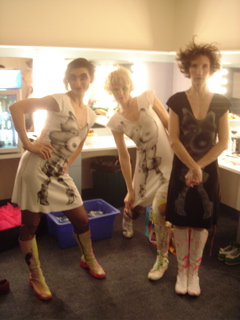
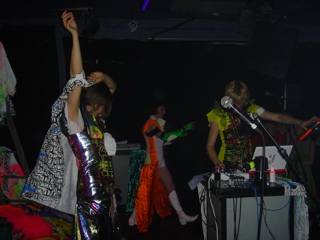
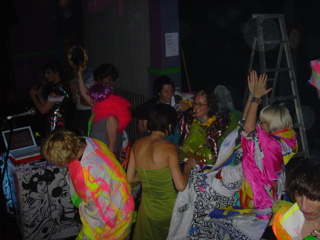
More CoS pics from Australia
Again, via Alex of Chicks on Speed...
Backstage Metro Sydney!
CoS in Adelaide
Alex's mum, Nanan and Valda:
1
2
Backstage Metro Sydney!
CoS in Adelaide
Alex's mum, Nanan and Valda:
1
2
A Fever Dream
I spent the early week sticking Eclectro Lounge's posters on bulletin boards. On Wednesday I felt the first symptoms of flu coming, and on Wednesday night fever rised. I was so hot that one could have probably fried eggs on my skin. I shivered under three blankets, and was probably a bit delirious since I had strangest sensations; half asleep, half awake. Time was lingering on painfully as if in slow motion; I had to rationalize my every thought and movement as if they were not self-evident any more: more like fragmented instead of the every-day normal, "automatic" state of continuum -- now I'm moving my hand, now I rise from the sofa, now I walk from the point x to the point y. It was all a bit like being drugged. From cold shivers my teeth started chattering against each other, and soon I realised it was rhythmic and accelerating as in shaman's drumming, probably meant to be trance-inducing. I was wondering if I was going to have an out-of-body experience.
Then, I don't know what happened but soon I dreamt (if that's the right word for my state of mind) of being back in the suburb Kaukajärvi of my childhood, and strangely I met myself as a child; a little boy in his flared trousers living in his fantasy world. And the most peculiar thing was that I was both myself as a child and as an adult, feeling as if being in a sort of "double exposure". It took place at the street of Järvikatu, near the pub called Kivitasku, where I used to buy Space: 1999 Trading Cards from a kiosk.
Me as a little boy was scared and lonely. Me as a grown-up tried to consolate this little boy, telling I was him, coming from the future the little boy was always dreaming about. I told him the future of 2005 was not exactly the sci-fi world of space stations, moonbases, and interstellar adventures (not at least yet), but fantastic in other ways such as with the Internet, mobile phones and so on (this probably sounds naïve now but remember I was not in my normal state of mind, it was more like being in the middle of fairy tale); there was not going to be a nuclear war (not at least by 2005), and everything was going to be fine in his life despite of all hard times he'd be through. I took him by the hand, and we flew over Kaukajärvi. And that's about all of it.
Then, I don't know what happened but soon I dreamt (if that's the right word for my state of mind) of being back in the suburb Kaukajärvi of my childhood, and strangely I met myself as a child; a little boy in his flared trousers living in his fantasy world. And the most peculiar thing was that I was both myself as a child and as an adult, feeling as if being in a sort of "double exposure". It took place at the street of Järvikatu, near the pub called Kivitasku, where I used to buy Space: 1999 Trading Cards from a kiosk.
Me as a little boy was scared and lonely. Me as a grown-up tried to consolate this little boy, telling I was him, coming from the future the little boy was always dreaming about. I told him the future of 2005 was not exactly the sci-fi world of space stations, moonbases, and interstellar adventures (not at least yet), but fantastic in other ways such as with the Internet, mobile phones and so on (this probably sounds naïve now but remember I was not in my normal state of mind, it was more like being in the middle of fairy tale); there was not going to be a nuclear war (not at least by 2005), and everything was going to be fine in his life despite of all hard times he'd be through. I took him by the hand, and we flew over Kaukajärvi. And that's about all of it.
Wednesday, March 09, 2005
Chicks on Speed Touring USA... Maybe In 4 Years
Recently a Chicks on Speed fan from the USA asked from the Chix: "I was wondering if you could tell me when there will be a possiblity to see the Chix in Los Angeles before Bush kills us all?".
And Alex of CoS answered:
And Alex of CoS answered:
Hello there,
Sorry, we cannot save you, you should evacuate the USA as soon as you can!
To answer your question, when we will come back to the USA:
Never, we had the worst experience going through LA recently, on our trip to Australia, first they fingerprinted us, then photographed us and then locked us in a jail-like room for three hours, with CNN propaganda and chips.
It's not so inviting, and we didn't even have any intentions on entering the "holy" land.
Sorry, I don't think we will come back whilst Bush is in POWER!
Get out now!
x
Alex
Tuesday, March 08, 2005
Astrological Ponderings
The planetary processes are modified by the twelve signs by virtue of their elements. There are four elements: fire, earth, air and water. Each is further differentiated by being expressed in one of the three ways: cardinal, fixed or mutable. At this point it is enough to know that the fire signs [Aries, Leo, Sagittarius] work most happily through action; the earth signs [Capricorn, Taurus, Virgo] through practical manifestation; the air signs [Aquarius, Gemini, Libra] through mentality; and the water signs [Pisces, Cancer, Scorpio] through the emotional nature.
-Alice O. Howell
My own star sign is Leo, a fire sign ruled by the Sun. I'm born on the 26th of July, which means there is also a strong Cancer influence (an emotional personal type); meaning for a Leo I'm a bit more of modest temperament that my star sign usually is. (I don't know my rising sign, which would be quite interesting to find out.)
Anyway, I feel being both blessed and cursed by being a Leo; which means I crave for attention and people's acceptance. When I get people's admiration, I just shine, but when I feel only neglected by people, I'm totally down. In psychological terms one could call this just plain narcissism, but I feel there's something much more involved there.
I've always found it hard to develop a healthy sense of self-esteem; free from either of any trappings of delusions of grandeur, or, lying down in the depths of my miserable self-pity. Nevertheless, I'm a strong believer in the old maxim of "Know thyself", and both undergoing personal therapy and studying on my own a bit of psychology -- and also some more "esoteric" arts -- have helped me considerably in understanding myself better.
A major guide on my own road here has been the ideas and writings of C.G. Jung, the master of combining both modern psychology and ancient esoteric thinking -- which are not so far from each other as one might suppose. Recently, I found from library American astrologer Alice O. Howell's book Jungian Symbolism in Astrology, which I have now read with great interest. You may smirk at astrology and horoscopes, but I think astrology is something that should not be understood as any logical science in the modern sense, but more as an art of intuitively trying to understand the human nature. Basically, star signs can be considered another set of Jungian archetypes, or indications of different personality types. (Also, Jung's idea of synchronicity, a set of meaningful coincidences, has always interested me a lot. Well, how about this for one synchronicity: also Dr. Jung's own birthday was the 26th of July; finding this out felt really meaningful to me.)
After my own recent personal shortcomings it really struck a nerve when I read from Howell's book the following passage of the positive and negative aspects of the Sun signs including my star sign, Leo, because those descriptions fit in perfectly with my own situation and state of mind:
How, you may ask, can the nature of the Sun be negative? It becomes negative through excess or weakness, when it is out of balance. In nature, the result is aridity, heat, drought, and barren desert -- a fierce, blinding and destructive heat. Or, it can be pale, wan, cold, vapid, and listless. The parallels in the psyche are the destructive aspects of tyranny, obsessive will, and the inflation and subsequent corruption of power and unbridled anger; or the cold cruelty and heartlessness of someone locked in a sunless inner world. One does not know whom to feel sorrier for -- such a person or those around him or her.
[...]
The nature of the Sun in Aries is to lead and in Leo to rule. When life conspires to permit this in a constructive way, good things happen. But whenever this energy is frustrated, a complex is set up: the need to be recognized becomes imperative and the person becomes dominated by a subversive insistence which causes troubles in relationships and triggers anger, resentment, and sometimes downright hostility. This, in turn, interferes with the success and achievement the Sun is craving for.
Reading this helped me immensely in understanding my anger and frustration. I'm probably at my best (hope I don't sound like a typical pompous Leo now) when I feel my unfettered ambition is let reign freely; but when this is, for one reason or another, hindered, my asocial, dark side easily becomes prevalent; expressed either by bouts of anger, or just as resigned sadness and melancholy, even depression.
When I was a child, more often than not, I was overwhelmed by the feelings of being neglected or misunderstood, just like the "Invisible Child" in Tove Jansson's fairytale. I became a loner, but to my fortune I had a vivid fantasy life, and I loved books and reading, so I always had a private world of my own where to retreat.
However, my social development was lacking, and even these days I find it easier to communicate with people by any other means than an actual face-to-face conversation. These means are music, art and writing.
And this is quite interesting since it fits perfectly in with Leary's and Wilson's theory of the Eight-Circuit Model of Consciousness, where the idea is that we compensate our missing attributes with others in their stead; i.e. a person missing social skills tends to compensate, for example, by developing his/her intellectual faculties.
Probably my whole pHinnWeb "empire" acts as a huge compensation for my missing "real life" communication skills. Dealing with social situations still confuses me, and I'm afraid my combination of shyness and moodiness (caused by the inner conflicts mentioned above) is often misinterpreted as arrogance and hostility. I have always been "the weird one". Still, I have always somehow managed to bypass this by other means -- which I have found very, very lucky.
Monday, March 07, 2005
Chicks on Speed Pics From Australia
Via Alex of Chicks on Speed, here are fresh pics from their March 2005 What Is Music Australian tour:
Forum Melbourne: What Is Music
Mari's new place; in the garden eating figs off the tree
Mari, Marion and Alex
Chix live in Adelaide:
1
2
3
4
5
6
PS.
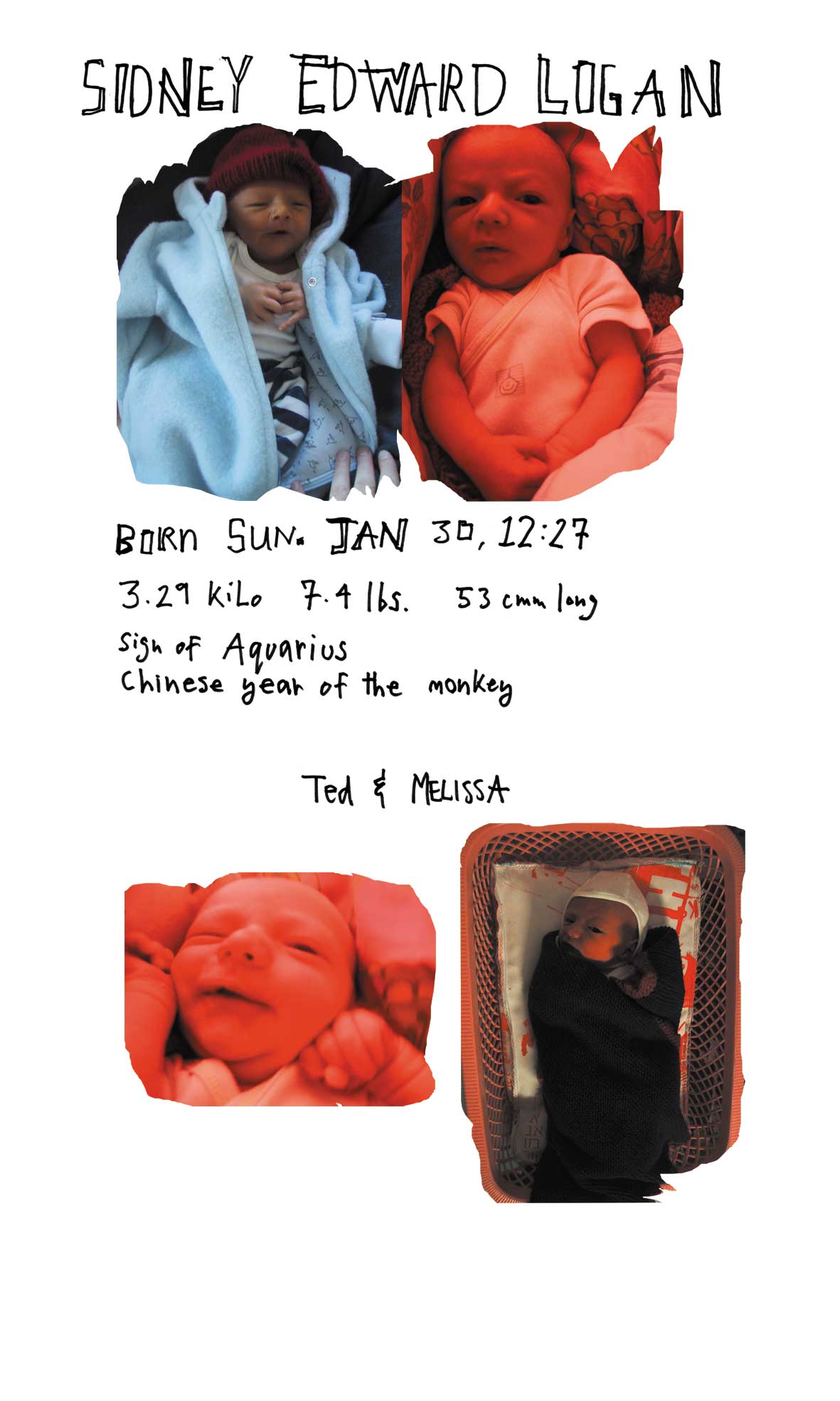
Here is also a pic of Melissa and Ted's baby. pHinnWeb congratulates!
Forum Melbourne: What Is Music
Mari's new place; in the garden eating figs off the tree
Mari, Marion and Alex
Chix live in Adelaide:
1
2
3
4
5
6
PS.
Here is also a pic of Melissa and Ted's baby. pHinnWeb congratulates!
Juri comments...
Juri wrote as a comment to my latest jeremiad:
Well, thanks for encouragement, but I'm not "going" anywhere, and certainly am not going to stop whatever I'm doing. It will only re-surface somewhere else even if one project stopped. Pitbulls are not the cutest dogs in the world, but once they get their teeth on something, they won't easily let go. However, it's always nice to whine.
I would hate to see you go, so try to hang on in there! Keep these words in mind - it's something Henri Langlois of Cinematheque Francaise said -, there will be three people in the first Carl Th. Dreyer retrospective, thirteen in the next and thirty in the third. And so on. Keep on doing the good deeds! That's the most important thing. What you do is far more important than what those trendy hedonists do or even dream of doing.
In another words: koeta kestää!
Well, thanks for encouragement, but I'm not "going" anywhere, and certainly am not going to stop whatever I'm doing. It will only re-surface somewhere else even if one project stopped. Pitbulls are not the cutest dogs in the world, but once they get their teeth on something, they won't easily let go. However, it's always nice to whine.
Pentti Haanpää on Economy
Finnish novelist Pentti Haanpää (1905-1955) was in his lifetime a controversial character, whose leftist-leaning writings were not seen favourably in the nationalist-militarist Finland of the time. (Harri Teikka chose his writer pseudonym as tribute to a character called Pate Teikka in Haanpää's Noitaympyrä ("Witch Circle")). In 1933 Pentti Haanpää wrote (and was subsequently fined for his troubles):
More on Haanpää (in Finnish)
Talousjärjestelmä on muka luonnonilmiö, jumalainen koneisto, jonka toimintaan valtiovalta ei saa sekaantua. Tätä saarnaavat juuri ne piirit, virkakunta, pankit ja yhtymät, jotka juuri valtiovallan sekaantumisen kautta ovat saaneet yhteiskunnassa kadehdittavat olot, vapaudet ja väljyydet.
("The economic system is supposedly a natural phenomenon, a divine machinery with which government can't meddle. This is preached exactly by those circles, bureaucracy, banks and corporations who have gained their enviable status in society, their freedom and elbowroom, just through the government meddling.")
More on Haanpää (in Finnish)
Saturday, March 05, 2005
How To Cope With Disappointments
On Friday I felt like collapsing. I would probably had burst into tears, if I had still only known how to cry (this is no joke, I haven't actually cried since 1987). It was as if I had been collecting in me this large amount of energy, tension, and it had been suddenly drained out of me. Feeling totally alone in a hostile world, dodging blows directed at me. The experience of disappointment and all my efforts being in vain was just so overbearing. Feeling misunderstood and being somehow out of touch, and certainly not for the first time in my life. "Something's happening here, but you don't know what it is, Mr. Jones." One should think that when one gets older, one will learn to cope with disappointments easier, but I don't know about that.
I remember this boy in my class at school: he was something of an athlete, and was reduced to tears every time his team lost in a football game; so intense was his concentration, devotion and willingness to win the game. Others found his reaction peculiar and even a bit funny: after all, it was just a game. I am a bit like that boy myself: I put myself in totally, and can't comprehend if someone else gives less than 100 percent. I suppose it's right to say I'm an extreme personality: either I don't bother at all, and am lazy and careless, or then I will push myself to the limits. Maybe the solution for me too lies in the realisation that it is all just a game. One can take it or leave it, win it or lose it, but life goes on nevertheless. Back to the Great Laughter?
I remember this boy in my class at school: he was something of an athlete, and was reduced to tears every time his team lost in a football game; so intense was his concentration, devotion and willingness to win the game. Others found his reaction peculiar and even a bit funny: after all, it was just a game. I am a bit like that boy myself: I put myself in totally, and can't comprehend if someone else gives less than 100 percent. I suppose it's right to say I'm an extreme personality: either I don't bother at all, and am lazy and careless, or then I will push myself to the limits. Maybe the solution for me too lies in the realisation that it is all just a game. One can take it or leave it, win it or lose it, but life goes on nevertheless. Back to the Great Laughter?
Friday, March 04, 2005
Eclectro Lounge 4
Also last night's Eclectro Lounge 4 was pretty much what I was afraid of: just a handful of people coming in on Thursday night. A handful but not enough. Here is the playlist.
I'm afraid to say I'm a bit of a manic-depressive, reacting quite strongly to personal losses like people not coming to my club after all work I had done; and after having a couple of beers that night, I felt my depression getting just deeper, gloomy thoughts criscrossing my mind. Think of this: you spend days sticking posters to bulletin boards in cold winter weather and freezing your fingers (I already wrote about this), and generally working your arse off to promote the club, just to meet up with people's indifference and face their absence. You feel most of your efforts are only futile in the end. When Mika took me home in his Lada after the night, tons of destructive/self-destructive thoughts bombed my brain, and I was already thinking that I would tell everyone just to fuck off on pHinnWeb's mailing list the following day.
But that's just alcohol talking, and usually after having slept over night, my aggressive booze thoughts have evaporated. Anyway, if I had maintained my late night state of mind, it is something along these that I might have written (but didn't):
During my "career" in music I have seen more than my share of self-serving and greedy egotists, who only want to get paid, get laid and get stoned, and clueless partygoers enjoying their ephemeral pleasures.
These people are lazy, self-indulgent and selfish bastards; a bunch of unindependent herd animals who only chase after the latest trend or what is deemed fashionable in media at the time.
People are freeloaders who only want to enjoy the fruits of other people's labour but are not themselves willing to work or make sacrifices themselves to gain the end result.
Probably most people I wanted to come to my club stayed at home with their Playstations, their bongs and playing with their unmentioned body parts.
So why should I care or see the trouble for little shits like these?
And so on. And so on. To be continued.
So, this is what I might have written but didn't. Gee, I'm such a bitter man. I can hardly wait for my senior years as a grumpy old tosser, whining all day in my shabby armchair, babbling about "good old times" and threatening little kids with my walking stick on my walk to bingo.
I'm afraid to say I'm a bit of a manic-depressive, reacting quite strongly to personal losses like people not coming to my club after all work I had done; and after having a couple of beers that night, I felt my depression getting just deeper, gloomy thoughts criscrossing my mind. Think of this: you spend days sticking posters to bulletin boards in cold winter weather and freezing your fingers (I already wrote about this), and generally working your arse off to promote the club, just to meet up with people's indifference and face their absence. You feel most of your efforts are only futile in the end. When Mika took me home in his Lada after the night, tons of destructive/self-destructive thoughts bombed my brain, and I was already thinking that I would tell everyone just to fuck off on pHinnWeb's mailing list the following day.
But that's just alcohol talking, and usually after having slept over night, my aggressive booze thoughts have evaporated. Anyway, if I had maintained my late night state of mind, it is something along these that I might have written (but didn't):
During my "career" in music I have seen more than my share of self-serving and greedy egotists, who only want to get paid, get laid and get stoned, and clueless partygoers enjoying their ephemeral pleasures.
These people are lazy, self-indulgent and selfish bastards; a bunch of unindependent herd animals who only chase after the latest trend or what is deemed fashionable in media at the time.
People are freeloaders who only want to enjoy the fruits of other people's labour but are not themselves willing to work or make sacrifices themselves to gain the end result.
Probably most people I wanted to come to my club stayed at home with their Playstations, their bongs and playing with their unmentioned body parts.
So why should I care or see the trouble for little shits like these?
And so on. And so on. To be continued.
So, this is what I might have written but didn't. Gee, I'm such a bitter man. I can hardly wait for my senior years as a grumpy old tosser, whining all day in my shabby armchair, babbling about "good old times" and threatening little kids with my walking stick on my walk to bingo.
Thursday, March 03, 2005
Ego and Self by C.G. Jung
C.G. Jung writes in his Memories, Dreams and Reflections:
Jung went on later to define his "personality No. 2" as the Self, the part that apprehended "the One", the oneness of all living creatures and the universe. Whereas the "personality No. 1", the ego, perceived the objective world which arises through the process of duality, "the Two".
Somewhere deep in the background I always knew that I was two persons. One was the son of my parents, who went to school and was less intelligent, attentive, hard-working, decent, and clean than many other boys. The other was grown-up -- old, in fact -- skeptical, mistrustful, remote from the world of men, but close to nature, the earth, the sun, the moon, the weather, all living creatures, and above all close to the night, to dreams, and to whatever "God" worked directly in him. I put "God" in quotation marks here. For nature seemed, liked myself, to have been set aside by God as non-divine, although created by Him as an expression of Himself. Nothing could persuade me that "in the image of God" applied only to man. In fact, it seemed to me that the high mountains, the rivers, the lakes, trees, flowers, and animals far better exemplified the essence of God than men with their ridiculous clothes, their meanness, vanity, mendacity, and abhorrent egotism -- all qualities with which I was only too familiar from myself, that is, from personality No. 1, the schoolboy of 1890. Besides his world there existed another realm, like a temple in which everyone who entered became transformed and suddenly overpowered by a vision of the whole cosmos, so that he could only marvel and admire, forgetful of himself. Here lived the "Other" who knew God as a hidden, personal, and at the same time suprapersonal secret. Here nothing separated man from God; indeed, it was as though the human mind looked down upon creation simultaneously with God.
What I am here unfolding, sentence by sentence, is something I was then not conscious of in any articulate way, though I sensed it with an overpowering premonition and intensity of feeling. At such time I knew that I was worthy of myself, that I was my true self. As soon as I was alone, I could pass over into this state. I therefore sought the peace and solitude of this "Other", personality No. 2.
The play and counterplay between personalities No. 1 and No. 2, which has run through my whole life, has nothing to do with a "split" or dissociation in the ordinary medical sense. On the contrary, it is played out in every individual. In my life, No. 2 has been of prime importance, and I have always tried to make room for anything that wanted to come to me from within. He is a typical figure, but he is perceived only by the very few. Most people's conscious understanding is not sufficient to realise that he is also what they are.
Jung went on later to define his "personality No. 2" as the Self, the part that apprehended "the One", the oneness of all living creatures and the universe. Whereas the "personality No. 1", the ego, perceived the objective world which arises through the process of duality, "the Two".
Wednesday, March 02, 2005
Mika Taanila's Optical Sound
Talking about Mika Taanila (who also made the documentary on Erkki Kurenniemi), his latest short film, Optical Sound, will be
featured at the Tampere International Short Film Festival, 9-13 March 2005.
---
OPTICAL SOUND
Finland / Suomi
2005
Experimental // 6 min // 35 mm // col., b&w
Director: Mika Taanila
Script: Mika Taanila
Photography: Jussi Eerola
Sound: Olli Huhtanen
Editing: Mika Taanila
Music: Emmanuel Madan, [The User], Thomas McIntosh
Production: Kinotar Oy
Contact: Hannes Vartiainen
Office technology becomes quickly outdated. Old tools turn into
musical instruments of the future. The film is based on a composition
for twelve dot matrix printers by the Canadian [The User].
---
More
featured at the Tampere International Short Film Festival, 9-13 March 2005.
Optical Sound (2005) is based on the live performance of the Symphony for 12 Dot Matrix Printers by the Canadian artist duo [The User]. The film inter-cuts close-ups of the mechanical parts of the printers performing the piece, taken from surveillance cameras placed inside the machines, with images of the ASCII files' score being played, which has been photocopied straight onto clear film without the use of a camera. These live images are contrasted with time-lapse footage of large modern office blocks shot from the streets, at dawn and dusk, in Helsinki.
[The User] says of Symphony for 12 Dot Matrix Printers, "Nowadays technology defines our relationship to our surroundings. Whether it's about communication, making music, or producing food, the tools; phone, record player, genetic engineering; have a crucial role in the process and the result itself."
Taanila says of Optical Sound: "Our senses are used to the grey noise of technology that floats among us all the time. Its time, for a change, to LISTEN to that technology! Optical Sound focuses the attention of the spectator on the presence of technology. The film is critical of the `brilliance' of technology; intentional mis-use of technology becomes art. While contemporary technology is trying its best to be smooth, invisible and fast, the film makes it visible and
plays around with it."
---
OPTICAL SOUND
Finland / Suomi
2005
Experimental // 6 min // 35 mm // col., b&w
Director: Mika Taanila
Script: Mika Taanila
Photography: Jussi Eerola
Sound: Olli Huhtanen
Editing: Mika Taanila
Music: Emmanuel Madan, [The User], Thomas McIntosh
Production: Kinotar Oy
Contact: Hannes Vartiainen
Office technology becomes quickly outdated. Old tools turn into
musical instruments of the future. The film is based on a composition
for twelve dot matrix printers by the Canadian [The User].
---
More
A New Futuro House Site
There's a new Website at http://www.futuro-house.net/, dedicated to the plastic Futuro house designed by Finnish architect Matti Suuronen in late 1960s, and immortalised by film director Mika Taanila in his 1998 Futuro - A New Stance For Tomorrow.
The Futuro House site includes the following statement on its Mission page:
Like Eero Aarnio's Globe Chair, Futuro is truly both a Finnish design classic and a quintessential 1960s pop culture artifact. But however, as the Futuro film press release notes put it, these futuristic dreams were short-lived:
The Futuro House site includes the following statement on its Mission page:
"This site is dedicated to locating and documenting, with as much information as possible, all of the remaining Futuro Houses throughout the world. First with old information that’s out there, then with your help, updated photos and histories.
If you are a current owner, past owner, neighbour, or whatever please contact me with whatever information you have. Let's gather and record history together."
Like Eero Aarnio's Globe Chair, Futuro is truly both a Finnish design classic and a quintessential 1960s pop culture artifact. But however, as the Futuro film press release notes put it, these futuristic dreams were short-lived:
"The 1973 oil crisis shattered the optimistic illusions about continuous economic growth and the infallibility of technology. The price of plastic climbed drastically, and the production of Futuro became unprofitable. Although the innovative Futuro attracted plenty of attention around the world, and production and sales licences were sold to 24 different countries, it never fulfilled the expectations of its commercial potential.
Tuesday, March 01, 2005
Yum Yum! Kevin Blechdom's New Record Cover
Here is Kevin Blechdom's new record cover (via Alex of Chicks on Speed). Warning: not for vegetarians (or other people with weak stomachs)!
The Beatles' notorious "Butcher" cover just pales in comparison, don't you think...?
The Beatles' notorious "Butcher" cover just pales in comparison, don't you think...?
pHinnWeb March 2005 Chart
Here is pHinnWeb's March 2005 Chart for the records I've purchased/listened (mostly latter) during the last month.
So again, most are records borrowed from the excellent music department of Metso, Tampere's Main Library. You Americans reading this might not get it, but here in the "socialist hellhole" (authentic comment from the good old US of A) of Finland, it is still totally free to borrow records of all major musical artists and genres from public libraries, which has facilitated me to fill in the gaps of my musical education. And unlike downloading, it is totally legal too.
So again, most are records borrowed from the excellent music department of Metso, Tampere's Main Library. You Americans reading this might not get it, but here in the "socialist hellhole" (authentic comment from the good old US of A) of Finland, it is still totally free to borrow records of all major musical artists and genres from public libraries, which has facilitated me to fill in the gaps of my musical education. And unlike downloading, it is totally legal too.
Monday, February 28, 2005
Disinformation Chameleon
Disinformation is the name of the game, the ultimate artistic strategy. To confuse and to deceive. To mess up people's preconceptions. To reveal media's games as what they are: shallow and fey. To turn derision into your own advantage. If the territory is hostile, to survive in it as a chameleon.
The Great Laughter
Unless we see as the meaning of life life itself, it is not hard to see all our existence and toils ultimately meaningless. Let's face it: life is tragic; personal fullfilment and social justice often hard to be found. In the end, there are only two ways to resolve life's existential meaninglessness: to let one be usurped by it, and choose self-destruction, OR, learn to laugh about it. To see life as a game it is. Every comedy of holds its portion of tragedy, and vice versa.
Mikhail Bakhtin wrote that laughter "overcomes fear, for it knows no inhibitions, no limitations. Its idiom is never used by violence and authority". Steven W. Gilbert: "Divine laughter is helpless laughter. The recognition that all social constructions are but frail, weak, and finally ineffectual in face of the inevitable regenerative force and movement of the material life force, located ridiculously (ridiculous only when you think about it) in the lower bodily stratum, calls forth an irrepressible belly laugh".
Harry Haller of Hesse's Steppenwolf was redeemed when he learned to laugh at himself. "When you laugh, they can't kill you", stated Perry Farrell on one of Porno For Pyros records.
This Great Laughter will release us, it is our ultimate salvation.
Mikhail Bakhtin wrote that laughter "overcomes fear, for it knows no inhibitions, no limitations. Its idiom is never used by violence and authority". Steven W. Gilbert: "Divine laughter is helpless laughter. The recognition that all social constructions are but frail, weak, and finally ineffectual in face of the inevitable regenerative force and movement of the material life force, located ridiculously (ridiculous only when you think about it) in the lower bodily stratum, calls forth an irrepressible belly laugh".
Harry Haller of Hesse's Steppenwolf was redeemed when he learned to laugh at himself. "When you laugh, they can't kill you", stated Perry Farrell on one of Porno For Pyros records.
This Great Laughter will release us, it is our ultimate salvation.
Harry Egipt Remix Contest
It seems Harry Egipt's surreal TV commercials from 1980s Soviet-Estonia I wrote about some time ago have by now reached an international cult reputation. Steven Frank has even announced a Hakkliha Remix Competition on his Website blog.
Additionally, http://reklamok.gergoke.hu/ runs Hungarian TV commercials from the years of socialism.
Harry Egipt @ BoingBoing.Net
More
Additionally, http://reklamok.gergoke.hu/ runs Hungarian TV commercials from the years of socialism.
Harry Egipt @ BoingBoing.Net
More
Saturday, February 26, 2005
Apadana Opening Night
Last night at Apadana (ex-Green Grass) again. It was the "official" opening night, with DJs Sane, Sterling (Sami of Cessna) and Kuuro Kädetön Paisti. They had gotten finally their new dance floor running. Sane said, though, that the look of the venue was a bit like "a suburban pub". It wasn't too crowded, so I suggested Sane that they should spend more efforts in advertising. Imatran Voima's Jaska a.k.a. Fresh O Lexx was there too, visiting Tampere, and hanging with Rikos guys. Anyway, actually I was there just to get from Sane my fee for Thursday's Eclectro Lounge. This month I've got less money to spend than usually, so anything extra I can get is really needed now. "We live in a material world..." Piss off, Madonna. So, I didn't spend a long time at Apadana; I hit the road and was soon home again to check BBC's interesting reggae documentary on TV1.
Friday, February 25, 2005
Eclectro Lounge 3
Last night, Eclectro Lounge #3. DJ Lasso of Tampere's Slavic Walkmen was guesting with his IDM set. A girl contributing to the goth magazine Schatten came to interview me and Mike Not, who was fighting a case of flu.
Any way, Thursday was a bit like I had been afraid of: like with many club nights I have seen, after the successful opening evening people's interest just will wane, and lesser punters will frequent. I don't know if I should have advertised more aggressively, but it's hard to do that in this town without pissing some people off, it seems (meaning so called authorities and other club organisers).
Well, I have to get some new ideas about how to get new people in. After all, it's not easy to maintain a weekly club in a smallish town (pop. ca. 200.000) like this, and on a Thursday night too.
Anyway, it was still great to see the small group of devoted there, and a lot of people from Rikos Records posse too. By the way, Rikos' other head honcho Heikki Halme a.k.a. DJ Kuuro Kädetön Paisti ("Deaf Handless Roast Beef") now lives in Tampere too, so you might expect some weird 70s Finnhits nights here! (I DJed with him at Entropy's 10 years party in Helsinki, November 2003, and his set there was just hilarious.)
Next time we will have as the guest DJ art barf-uncle a.k.a. Arttu Partinen of Tampere's Mental Alaska club and the world-renowned psy-improv-free-New Weird of Finland group Avarus. Expect a lot of weirdness à la Hawkwind, Krautrock, drone and Finnhits disco of 70s and 80s!
Eclectro Lounge #3 playlist
Eclectro Lounge #3 images by Sakke Karipuro
Any way, Thursday was a bit like I had been afraid of: like with many club nights I have seen, after the successful opening evening people's interest just will wane, and lesser punters will frequent. I don't know if I should have advertised more aggressively, but it's hard to do that in this town without pissing some people off, it seems (meaning so called authorities and other club organisers).
Well, I have to get some new ideas about how to get new people in. After all, it's not easy to maintain a weekly club in a smallish town (pop. ca. 200.000) like this, and on a Thursday night too.
Anyway, it was still great to see the small group of devoted there, and a lot of people from Rikos Records posse too. By the way, Rikos' other head honcho Heikki Halme a.k.a. DJ Kuuro Kädetön Paisti ("Deaf Handless Roast Beef") now lives in Tampere too, so you might expect some weird 70s Finnhits nights here! (I DJed with him at Entropy's 10 years party in Helsinki, November 2003, and his set there was just hilarious.)
Next time we will have as the guest DJ art barf-uncle a.k.a. Arttu Partinen of Tampere's Mental Alaska club and the world-renowned psy-improv-free-New Weird of Finland group Avarus. Expect a lot of weirdness à la Hawkwind, Krautrock, drone and Finnhits disco of 70s and 80s!
Eclectro Lounge #3 playlist
Eclectro Lounge #3 images by Sakke Karipuro
Thursday, February 24, 2005
phinnweb.com no more - please use phinnweb.org!
So, once more to everyone who may not have noticed yet: my old domain, phinnweb.com, is not updated any more, so if you want to link the site, please use the URL http://www.phinnweb.org/.
This is a frustrating situation for me, since many times search engines still get sites under phinnweb.com as their search results, and those ones contain information I haven't been able to update since April 2004.
More info and even more.
This is a frustrating situation for me, since many times search engines still get sites under phinnweb.com as their search results, and those ones contain information I haven't been able to update since April 2004.
More info and even more.
Harri Teikka's Unfinished Stories, Pt. 1

According to Schopenhauer, humour is man's only divine quality. What does that have to do with the following? I don't know, but here you can find some unfinished stories by Mr. Harri Teikka. Finnish only, sorry.
Wednesday, February 23, 2005
Jahsonic Is Amazing!
Jan, the Dutch guy who maintains the amazing Jahsonic site, has expressed on some occasions that he's keen on pHinnWeb, so I think it's time for me to return the compliment, and tell everyone to check this mind-blowing site on "art | book | culture | erotica | film | history | music | people". It's a pity I have to rely on these public access computers with so limited time to browse daily, since I could just spend hours and hours on Jahsonic site. Tons of cultural history info and loads of... hmm... juicy pictures, too! If you think I'm obsessed with pHinnWeb, you haven't seen Jahsonic.
Tuesday, February 22, 2005
Standards of Living
I watch you as you load in your groceries at supermarket, pay with your credit card. Your standards of living will kill you in a couple of decades. All that greasy, fattening, salty food and evening snacks you worked so hard to earn. Beer to sip while watching TV, to chase down potato chips. Arteries jammed, all those bypass surgeries can't save your ailing heart, a time bomb quietly ticking in your heaving chest.
I made a decision to stay out of your world, your career and your kids and your rat race, but I don't know if that will save me in the end, or will that only cause me to die lonely. You live in your own bubble, I live in mine.
Still, hope remains in my heart.
Solitude is something you (more or less) learn to live with; a hermit in urban landscape. Sharing other people's coexistence can be so hard. My basic inner conflict is, whether to seek solitude or other people's companionship. It is obvious that my life is the recovering from deep wounds inflicted a long time ago, and like a hurt animal I retreat until I feel better again, but how long will the healing take? The whole of my lifetime?
I am stronger than I was, and the vastness of uncharted territories is awaiting me. To embark on this journey, but I will I be travelling alone? Is that my karma, kismet, my role in the play of life? Or maybe the playwright is just mad -- or at least a wicked absurdist -- or as some people think, there is no playwright at all? A world devoid of meaning -- would that be so incomprehensible? As we see in nature, there does exist self-organization in all systems; "fearful symmetry" as Blake put it, so it makes one wonder. If there is a pattern, where does one fit in there?
I think I'm a selfish person, used to play alone with my toys. Will there be a way to break out of my narcissism, or will it be a closed circle of personal navelgazing? I envy people who can think in the "we" form, instead of "me me me".
I made a decision to stay out of your world, your career and your kids and your rat race, but I don't know if that will save me in the end, or will that only cause me to die lonely. You live in your own bubble, I live in mine.
Still, hope remains in my heart.
Solitude is something you (more or less) learn to live with; a hermit in urban landscape. Sharing other people's coexistence can be so hard. My basic inner conflict is, whether to seek solitude or other people's companionship. It is obvious that my life is the recovering from deep wounds inflicted a long time ago, and like a hurt animal I retreat until I feel better again, but how long will the healing take? The whole of my lifetime?
I am stronger than I was, and the vastness of uncharted territories is awaiting me. To embark on this journey, but I will I be travelling alone? Is that my karma, kismet, my role in the play of life? Or maybe the playwright is just mad -- or at least a wicked absurdist -- or as some people think, there is no playwright at all? A world devoid of meaning -- would that be so incomprehensible? As we see in nature, there does exist self-organization in all systems; "fearful symmetry" as Blake put it, so it makes one wonder. If there is a pattern, where does one fit in there?
I think I'm a selfish person, used to play alone with my toys. Will there be a way to break out of my narcissism, or will it be a closed circle of personal navelgazing? I envy people who can think in the "we" form, instead of "me me me".
Monday, February 21, 2005
Hello To All You Who Came Here Through Pinseri
I just added this blog to Pinseri, the list of Finnish blogs. Hello to all of you who came here through that.
Basically, this blog is an extension of pHinnWeb and its mailing list; dedicated to Finnish (but also international) electronic, experimental and avantgarde music, underground culture and some other interests of mine concerning pop culture in general, cinema, literature, visual arts in general, esoteric arts, and so on and so on. As you see, I'm interested in all things between heaven and earth (and below).
Here you can also read about some things that would be too off-topic and personal for the site and mailing list mentioned above. One part of this blog is my personal net diary, where I tell about my every-day life in my hometown Tampere, my dealings with underground music culture and other related things, and also a bit of personal, existential (though hopefully not too exhibitionist) soul searching... my world is not always nice and cute but not totally dark, bleak and hopeless, either. Anyway, proceed only at your own responsibility... [a biiiiig grin of a smiley here]
Basically, this blog is an extension of pHinnWeb and its mailing list; dedicated to Finnish (but also international) electronic, experimental and avantgarde music, underground culture and some other interests of mine concerning pop culture in general, cinema, literature, visual arts in general, esoteric arts, and so on and so on. As you see, I'm interested in all things between heaven and earth (and below).
Here you can also read about some things that would be too off-topic and personal for the site and mailing list mentioned above. One part of this blog is my personal net diary, where I tell about my every-day life in my hometown Tampere, my dealings with underground music culture and other related things, and also a bit of personal, existential (though hopefully not too exhibitionist) soul searching... my world is not always nice and cute but not totally dark, bleak and hopeless, either. Anyway, proceed only at your own responsibility... [a biiiiig grin of a smiley here]
Hunter S. Thompson R.I.P.
This is a great blow to me, Thompson being a great personal influence.
Gonzo.org, a Website dedicated to all things Hunter S. Thompson
Obituaries:
BBC News
CNN
Journalist and author Hunter S. Thompson, who unleashed the concept of "gonzo journalism" in books like "Fear and Loathing in Las Vegas," fatally shot himself in the head Sunday 20 February 2005 at his home near Aspen, Colorado, police and his family said.
"On Feb. 20, Dr. Hunter S. Thompson took his life with a gunshot to the head at his fortified compound in Woody Creek, Colo.," said a statement issued by Thompson's son, Juan Thompson, to the Aspen Daily News as reported by the Denver Police.
Gonzo.org, a Website dedicated to all things Hunter S. Thompson
Obituaries:
BBC News
CNN
Saturday, February 19, 2005
The Difficulties of Independent Club Promoting
Yesterday, when I was again sticking to bulletin boards posters of our next Eclectro Lounge, and thought I had done a good work of covering again the entire one side of a four-cornered poster stand with our ads, I noticed they had added a sign on the top of stand, saying that it is allowed to put there only one poster per one side of the stand -- for one event.
Probably someone working for the City of Tampere had been so much "inspired" by my tireless efforts to cover the whole side with Electro Lounge's posters, that they had to add this sign. Wankers!
Well, big-money corporations like Nokia can afford to get all the visibility they want, but if you're a small-time club promoter and want to endorse your own events you're treated almost like a criminal, just like graffiti painters. The "zero tolerance" policy in this town sometimes gets so ridiculous. In Helsinki they recently arrested some people putting their own street art stickers around the town.
Fascism is alive and well in Finland 2005.
Probably someone working for the City of Tampere had been so much "inspired" by my tireless efforts to cover the whole side with Electro Lounge's posters, that they had to add this sign. Wankers!
Well, big-money corporations like Nokia can afford to get all the visibility they want, but if you're a small-time club promoter and want to endorse your own events you're treated almost like a criminal, just like graffiti painters. The "zero tolerance" policy in this town sometimes gets so ridiculous. In Helsinki they recently arrested some people putting their own street art stickers around the town.
Fascism is alive and well in Finland 2005.
Friday, February 18, 2005
Eclectro Lounge 2
Some time ago I fussed over our first Eclectro Lounge club night at the bar Apadana (ex-Green Grass) here in Tampere (Apadana is a family business run by an Iranian guy). As it turned out, the opening night went fine, and we had a plenty of people attending and even dancing. Even though we received some complaints at times about the volume being too loud, but it was up to certain technical problems with speakers (I think); furthermore, it's often quite hard to monitor the level of floor volume when you're in the DJ booth. But all in all, everyone seemed to be satisfied with this night, so it was a good starter.
So, last night we had Eclectro Lounge 2, with DJ Sakke as a guest, playing the best of 80s Detroit techno/electro sound. Sakke is an old acquaintance of both Mika and me; last time I DJed with Sakke at July's Lavatanssit party in Nokia. I was again anxious about if people would show up or not -- I've had my share of clubs where no one came -- but gladly this was eventually another night turned out fine. Well, should be, since I worked like a slave sticking up -- or should I say "carpetbombing" -- the event ads to bulletin boards: basically, you have to add new posters there at least once a day, as I told before.
Someone either adds their own posters over your own, or then tears all your posters off, it seems. Makes you a bit paranoid, doesn't it? Like, "gee, someone must have something against me". I think I'm going to add to all future posters a small print: "This is not promotion, this is war". Since club promotion really feels like a war; a fight for the eyeballs, as they say in the marketing circles.
10 February 2005 playlist
17 February 2005 playlist
So, last night we had Eclectro Lounge 2, with DJ Sakke as a guest, playing the best of 80s Detroit techno/electro sound. Sakke is an old acquaintance of both Mika and me; last time I DJed with Sakke at July's Lavatanssit party in Nokia. I was again anxious about if people would show up or not -- I've had my share of clubs where no one came -- but gladly this was eventually another night turned out fine. Well, should be, since I worked like a slave sticking up -- or should I say "carpetbombing" -- the event ads to bulletin boards: basically, you have to add new posters there at least once a day, as I told before.
Someone either adds their own posters over your own, or then tears all your posters off, it seems. Makes you a bit paranoid, doesn't it? Like, "gee, someone must have something against me". I think I'm going to add to all future posters a small print: "This is not promotion, this is war". Since club promotion really feels like a war; a fight for the eyeballs, as they say in the marketing circles.
10 February 2005 playlist
17 February 2005 playlist
Saturday, February 12, 2005
Forniphilia
There is a form of sexual bondage that involves making furniture designed to incorporate a bound person. It is sometimes known as forniphilia (or human furniture).
The best-known example of forniphilia in art is by British artist Allen Jones who has a very famous series of sculptures called "Hat Stand and Table", made in 1969, which show semi-naked women in the roles of furniture. It's a very striking and provocative work bound to create strong reactions. According to viewer, those works can been seen in a very ambivalent way: either, as a fantasy of sexual objectification, or, a critical and ironic comment on that objectification and woman's role in society -- even though this interpretation is very problematic, as we can see.
Feminists have criticized Jones' painted and sculptured women images. In 1973 Laura Mulvey discussed in the feminist magazine Spare Rib Jones' images in relation to fetishism in the Freudian sense. Mulvey argued that Jones repeated typical fetishistic female imagery familiar from media and pop culture. She suggested that his work is not about women at all, but illustrates Jones' male fears. These images are related to fetishism in the strictly Freudian sense, and reproduce the woman as spectacle, as primarily sexual being, and as the object of a specifically masculine gaze/desire. The notion of the woman bound and restricted through shoes and clothing is addressed in Mulvey's critique of the art of Allen Jones. Mulvey writes, "The most effective fetish both constricts, and up-lifts, binds and raises, particularly high-heeled shoes, corsets and bras" (Mulvey, Laura: "You Don't Know What's Happening, Do You Mr. Jones?" in Framing Feminism, p. 128). High-heels represent heightened sexuality, yet a lack of agency in their inhibition of movement. Shackles of a sort, they place the female wearer in a position of greater vulnerability than that of the male.
In the article "Allen Jones in Retrospect: A Serpentine Review" of Block magazine (1979) Lisa Tickner discussed the imagery of women and sexuality as a reflection of social phenomena. Allen Jones represents women through sexual images and he rarely includes heads in his representations. According to Tickner, Jones associates women with "passivity, availability, narcissism, exhibitionism, physicality, and mindlessness."
Tickner discusses Jones' images in the context of the politics of representation, an understanding of how imagery operates in society. She is anxious to point to their deeper social and ideological implications rather than to reject Jones' images. She regards the artist as a "social barometer" and insists that the images are already loaded with social significance. No longer could Jones' images be treated as real women, but rather the representation of women, coded/ideologized images by cultural and social systems. The systems are negotiated in terms of the struggle between the dominant and the dominated, the exploiting and the exploited in classes, races and genders.
Tickner cannot agree with Jones' idea that his women are morally neutral and a simple matter of formal innovation and variation. Tickner is against Jones' emphasis on formal qualities of the work in the formalist tradition and she cannot accept the distinction between form and content. Tickner argues that 'sexism' cannot be distilled from the image itself -- it lies in the relation between that image and external social relations and ideologies. She states that "the exploitation of already exploitative material cannot be seen as politically neutral, whatever the artist's intentions and the use of a particular kind of sexual imagery contributes to the 'objectification', even degradation of women". (Block 1, p. 39) Therefore, Tickner argues that images cannot be ineffective, or socially neutral but they are inevitably compromised by ideological assumptions. She wants to make clear that all images, whatever the intention of the maker, enter into a public domain and are read in relation to external social relations and ideologies. Thus, Tickner's approach is meant to displace a pure formalistic treatment of art works.
No can deny these aren't very well-argumented views. However, I find both Mulvey's and Tickner's approaches somehow one-sided, since I think another possible layer of interpretation is still missing there. I'd call that an "difficulty of interpretation caused by the ambivalence or irony" where the viewer of works cannot strictly and unambiguously decide here which cultural codes these works actually bear, since they are too multi-faceted for simple and straightforward interpretations.
To add another possible layer of interpretation here, the Japanese sound artist Merzbow once said: "Most people think female bondage is a realisation of a sexist rape and violence obsession. Violence and rape -- if we consider the police, military, schools and other forms of establishment power -- are 'normal' human activities. Bondage is not a 'normal' human activity. It must be 'abnormal'. Bondage is parody and an anti-form of authority. People don't understand this point."
Therefore, the S/M-type of roleplaying games of bondage and fetishism could be seen as a carnevalistic turning upside down of the conventional power games in our hierarchy-obsessed society. It is known that in the psycho-sexual role plays of the dominatrix and the slave, "alpha male" men, those holding precious places in society, often voluntarily revert into the latter's role, to be voluntarily humiliated by their "mistresses". A man used to dominate and give orders in his every-day life receiving pleasure from the situation of being crudely embarrassed, both mentally and physically, and even losing face, something that he wouldn't be ever willing to do under normal circumstances. (See also: "The Right Man".)
Personally, I'd like to see Allen Jones' works as a comment on sexism, consumerism and fetishism; all three of them interconnected in capitalist society. The problem here is with the individual interpretation, of which sort of comment: are they actually pro or con sexism/bondage fetishism? What to make out of that? What is the artist trying to tell us? Women depicted as furniture and objects in this society: as pure pornography, which purpose is to titillate and arouse, I find this imagery far too revolting and even disturbing. It won't arouse me, and if it does, it makes me ask what the hell is wrong with me? And for being called feminist works they are far too "slick" and "sexy" (meaning here the typical commercial media imagery -- of fashion, ads and so on -- intended to please a typical masculine eye), since there can be clearly found the fetishistic imagery criticized by Mulvey and Tickner.
If we follow Merzbow's line of thinking here, we should then see Jones' work as parody or an ironic comment on woman's role in society, not as sexism, but as we have already noticed, it is not at all as simple as that, and the artist's "message" ultimately remains ambiguous. Anyway, isn't that what a work of art is supposed to: to create questions and new trains of thought in a viewer rather than to answer them in a clear-cut way. Allen Jones' work provokes and leaves a viewer enraged or puzzled, but it doesn't give answers.
Also film-maker Stanley Kubrick's controversial Clockwork Orange (1971) features a scene with Korova Milkbar and its female-shaped furniture -- inspired by Allen Jones -- which give emphasis on film's alienated worldview. In front of Alex and his "droogs" we see forming a corridor and on either side of the camera grotesque forms of artwork in a mood of futuristic nihilism -- sculpted, sleek, hygienic white-fiber glass nude furniture and statues of submissive women either kneeling or in a back-bending position on all fours as tables. Colours are absent except for the artificial orlon wigs and pubic hair.
Human Furniture @ Jahsonic
The best-known example of forniphilia in art is by British artist Allen Jones who has a very famous series of sculptures called "Hat Stand and Table", made in 1969, which show semi-naked women in the roles of furniture. It's a very striking and provocative work bound to create strong reactions. According to viewer, those works can been seen in a very ambivalent way: either, as a fantasy of sexual objectification, or, a critical and ironic comment on that objectification and woman's role in society -- even though this interpretation is very problematic, as we can see.
Feminists have criticized Jones' painted and sculptured women images. In 1973 Laura Mulvey discussed in the feminist magazine Spare Rib Jones' images in relation to fetishism in the Freudian sense. Mulvey argued that Jones repeated typical fetishistic female imagery familiar from media and pop culture. She suggested that his work is not about women at all, but illustrates Jones' male fears. These images are related to fetishism in the strictly Freudian sense, and reproduce the woman as spectacle, as primarily sexual being, and as the object of a specifically masculine gaze/desire. The notion of the woman bound and restricted through shoes and clothing is addressed in Mulvey's critique of the art of Allen Jones. Mulvey writes, "The most effective fetish both constricts, and up-lifts, binds and raises, particularly high-heeled shoes, corsets and bras" (Mulvey, Laura: "You Don't Know What's Happening, Do You Mr. Jones?" in Framing Feminism, p. 128). High-heels represent heightened sexuality, yet a lack of agency in their inhibition of movement. Shackles of a sort, they place the female wearer in a position of greater vulnerability than that of the male.
In the article "Allen Jones in Retrospect: A Serpentine Review" of Block magazine (1979) Lisa Tickner discussed the imagery of women and sexuality as a reflection of social phenomena. Allen Jones represents women through sexual images and he rarely includes heads in his representations. According to Tickner, Jones associates women with "passivity, availability, narcissism, exhibitionism, physicality, and mindlessness."
Tickner discusses Jones' images in the context of the politics of representation, an understanding of how imagery operates in society. She is anxious to point to their deeper social and ideological implications rather than to reject Jones' images. She regards the artist as a "social barometer" and insists that the images are already loaded with social significance. No longer could Jones' images be treated as real women, but rather the representation of women, coded/ideologized images by cultural and social systems. The systems are negotiated in terms of the struggle between the dominant and the dominated, the exploiting and the exploited in classes, races and genders.
Tickner cannot agree with Jones' idea that his women are morally neutral and a simple matter of formal innovation and variation. Tickner is against Jones' emphasis on formal qualities of the work in the formalist tradition and she cannot accept the distinction between form and content. Tickner argues that 'sexism' cannot be distilled from the image itself -- it lies in the relation between that image and external social relations and ideologies. She states that "the exploitation of already exploitative material cannot be seen as politically neutral, whatever the artist's intentions and the use of a particular kind of sexual imagery contributes to the 'objectification', even degradation of women". (Block 1, p. 39) Therefore, Tickner argues that images cannot be ineffective, or socially neutral but they are inevitably compromised by ideological assumptions. She wants to make clear that all images, whatever the intention of the maker, enter into a public domain and are read in relation to external social relations and ideologies. Thus, Tickner's approach is meant to displace a pure formalistic treatment of art works.
No can deny these aren't very well-argumented views. However, I find both Mulvey's and Tickner's approaches somehow one-sided, since I think another possible layer of interpretation is still missing there. I'd call that an "difficulty of interpretation caused by the ambivalence or irony" where the viewer of works cannot strictly and unambiguously decide here which cultural codes these works actually bear, since they are too multi-faceted for simple and straightforward interpretations.
To add another possible layer of interpretation here, the Japanese sound artist Merzbow once said: "Most people think female bondage is a realisation of a sexist rape and violence obsession. Violence and rape -- if we consider the police, military, schools and other forms of establishment power -- are 'normal' human activities. Bondage is not a 'normal' human activity. It must be 'abnormal'. Bondage is parody and an anti-form of authority. People don't understand this point."
Therefore, the S/M-type of roleplaying games of bondage and fetishism could be seen as a carnevalistic turning upside down of the conventional power games in our hierarchy-obsessed society. It is known that in the psycho-sexual role plays of the dominatrix and the slave, "alpha male" men, those holding precious places in society, often voluntarily revert into the latter's role, to be voluntarily humiliated by their "mistresses". A man used to dominate and give orders in his every-day life receiving pleasure from the situation of being crudely embarrassed, both mentally and physically, and even losing face, something that he wouldn't be ever willing to do under normal circumstances. (See also: "The Right Man".)
Personally, I'd like to see Allen Jones' works as a comment on sexism, consumerism and fetishism; all three of them interconnected in capitalist society. The problem here is with the individual interpretation, of which sort of comment: are they actually pro or con sexism/bondage fetishism? What to make out of that? What is the artist trying to tell us? Women depicted as furniture and objects in this society: as pure pornography, which purpose is to titillate and arouse, I find this imagery far too revolting and even disturbing. It won't arouse me, and if it does, it makes me ask what the hell is wrong with me? And for being called feminist works they are far too "slick" and "sexy" (meaning here the typical commercial media imagery -- of fashion, ads and so on -- intended to please a typical masculine eye), since there can be clearly found the fetishistic imagery criticized by Mulvey and Tickner.
If we follow Merzbow's line of thinking here, we should then see Jones' work as parody or an ironic comment on woman's role in society, not as sexism, but as we have already noticed, it is not at all as simple as that, and the artist's "message" ultimately remains ambiguous. Anyway, isn't that what a work of art is supposed to: to create questions and new trains of thought in a viewer rather than to answer them in a clear-cut way. Allen Jones' work provokes and leaves a viewer enraged or puzzled, but it doesn't give answers.
Also film-maker Stanley Kubrick's controversial Clockwork Orange (1971) features a scene with Korova Milkbar and its female-shaped furniture -- inspired by Allen Jones -- which give emphasis on film's alienated worldview. In front of Alex and his "droogs" we see forming a corridor and on either side of the camera grotesque forms of artwork in a mood of futuristic nihilism -- sculpted, sleek, hygienic white-fiber glass nude furniture and statues of submissive women either kneeling or in a back-bending position on all fours as tables. Colours are absent except for the artificial orlon wigs and pubic hair.
Human Furniture @ Jahsonic
Wednesday, February 09, 2005
Piirka rules!
My latest comedy favourite is a Norwegian TV show called Borettslaget, depicting the lives of tenants in an Oslo high-rise; shown on Tuesday nights here in Finland on the Swedish language channel FST as Piirka och hans grannar ("Piirka and his neighbours").
Piirka Kellivoite (a misspelling of Finnish name Pirkka, and his family name is not that typical in Finland, either...) is a rogueish and asocial foul-mouthed Finnish immigrant whose unfortunate efforts as a pirate taxi driver, alcohol smuggler, hotel bellboy and grocery store clerk are followed in every episode. (Furthermore, Piirka does not actually speak Finnish but Swedish in Finnish accent, though some "perkeles" are heard every now and then, also Piirka's favourite swearword "helvata".) In "Pekka and Toivonen" jokes popular in Norway Finns are always depicted as hard-drinking, macho forest dwellers, and the Piirka character seems to follow exactly this same stereotype.
Nevertheless, I like the non-conformist Piirka very much: maybe these Norwegians have after all managed to capture some essence of being Finnish... the series has also a lot of great satirical characters (all played by Robert Stoltenberg, the same actor as with Piirka): a near-fascistic janitor Roy Narvestad guarding his apartment house with military-like discipline (we all must know the type), living with her shabby sister and being secretly sex-starved for a young female tenant Trude who goes to bible school; a father of Pakistani Silmandar family (who wants desperately to get their daughter married) and their happy-go-lucky son Ali; Linda Johansen, a spinster/widow character who never leaves her apartment, nurses her dog like it was her baby, obsessively observes every movement of her neighbours (we all must know the type, pt. 2), keeps watching soap operas and is not too fond of any non-Norwegians; Yngve Freiholt, a cissy-like (possibly gay?) hipster who works on fashion business and keeps re-decorating his apartment.
The tenants of the high-rise are followed in a pseudo-documentary way;
the type of humour here is very understated and deadpan, far from any canned laughter type of Anglo-American sitcoms and their predictable puns.
Piirka Kellivoite (a misspelling of Finnish name Pirkka, and his family name is not that typical in Finland, either...) is a rogueish and asocial foul-mouthed Finnish immigrant whose unfortunate efforts as a pirate taxi driver, alcohol smuggler, hotel bellboy and grocery store clerk are followed in every episode. (Furthermore, Piirka does not actually speak Finnish but Swedish in Finnish accent, though some "perkeles" are heard every now and then, also Piirka's favourite swearword "helvata".) In "Pekka and Toivonen" jokes popular in Norway Finns are always depicted as hard-drinking, macho forest dwellers, and the Piirka character seems to follow exactly this same stereotype.
Nevertheless, I like the non-conformist Piirka very much: maybe these Norwegians have after all managed to capture some essence of being Finnish... the series has also a lot of great satirical characters (all played by Robert Stoltenberg, the same actor as with Piirka): a near-fascistic janitor Roy Narvestad guarding his apartment house with military-like discipline (we all must know the type), living with her shabby sister and being secretly sex-starved for a young female tenant Trude who goes to bible school; a father of Pakistani Silmandar family (who wants desperately to get their daughter married) and their happy-go-lucky son Ali; Linda Johansen, a spinster/widow character who never leaves her apartment, nurses her dog like it was her baby, obsessively observes every movement of her neighbours (we all must know the type, pt. 2), keeps watching soap operas and is not too fond of any non-Norwegians; Yngve Freiholt, a cissy-like (possibly gay?) hipster who works on fashion business and keeps re-decorating his apartment.
The tenants of the high-rise are followed in a pseudo-documentary way;
the type of humour here is very understated and deadpan, far from any canned laughter type of Anglo-American sitcoms and their predictable puns.
Eclectro Lounge
Some time ago DJ Sane a.k.a. Santeri Vuosara (yes, the same guy who has recorded and performed with M.A. Numminen) asked me if I was interested to launch a new club night at a bar called Green Grass here in Tampere. Since I always feel I get too little DJ gigs, you bet I didn't hesitate to say yes. We agreed on that the event would be called Eclectro Lounge, starting on 10 Thursday, 10 February 2005. The "grand" opening night will be tomorrow, with guest DJs Mike Not (my producer partner in Kompleksi) and 5€Schwag (a.k.a. Joonas, Tampere's IDM maestro recording as Toiminto) who also runs local Swäg nights where I have guest DJed.
I guess I'll be mostly playing old and new electro, some synthpop and IDM, and, eh, the obligatory Italo/disco material; perhaps also a little bit of old 60s-70s Moog classics. I'm interested to play some more experimental stuff, perhaps also a little non-electronic material, such as Krautrock, 60s garage rock and psychedelia and, hell, just whatever; it's an eclectic night after all. You never really know; a lot of it will depend on audience's reactions; always very unpredictable. I always get quite neurotic about DJing, in fact; the ensuing symptoms I call Discophrenia. Wish me luck.
Now I've been spending the last days spreading out flyers and sticking posters to bulletin boards all over Tampere; which can be a hellish task with your bare fingers in freezing winter weather; with your fucked-up staple gun which doesn't agree to function properly half the time, and other people sticking their own event posters over your own -- meaning you have to add new posters there at least once a day. You really have to love what you're doing to see all this trouble.
I guess I'll be mostly playing old and new electro, some synthpop and IDM, and, eh, the obligatory Italo/disco material; perhaps also a little bit of old 60s-70s Moog classics. I'm interested to play some more experimental stuff, perhaps also a little non-electronic material, such as Krautrock, 60s garage rock and psychedelia and, hell, just whatever; it's an eclectic night after all. You never really know; a lot of it will depend on audience's reactions; always very unpredictable. I always get quite neurotic about DJing, in fact; the ensuing symptoms I call Discophrenia. Wish me luck.
Now I've been spending the last days spreading out flyers and sticking posters to bulletin boards all over Tampere; which can be a hellish task with your bare fingers in freezing winter weather; with your fucked-up staple gun which doesn't agree to function properly half the time, and other people sticking their own event posters over your own -- meaning you have to add new posters there at least once a day. You really have to love what you're doing to see all this trouble.
Monday, January 31, 2005
Shame
The feeling of shame has been overbearing all my life. Always beings clumsy, out of the place. Class reunion: old wounds reopened. Yet it was a situation where I also felt aloof, observing from a distance. Adolescent fantasies of vengeance wiped away. All the passing years hanging heavy like lead. The price of reaching some sort of maturity and stability is the heaviness. In my younger years the feeling of shame was almost daily. School was like an ongoing gauntlet. Other kids mocking my blushing face. I reacted strongly, felt strongly about things. Both excitement and shame swept through my body like fire, burning everything in its way. Now everything has become more lukewarm. Prozac turned the old choleric me to one more phlegmatic. About which I can't be entirely sad.
Friday, January 28, 2005
Tuesday, January 11, 2005
Cocktail Books in Finnish
Cocktail was a Finnish men's magazine in the late 1960s/early 1970s. They published a series of erotic pulp novels, which were Finnish translations of originals in English. Here is a listing of them, with an image gallery.
Monday, January 10, 2005
I Need A Job
This February I've been registered unemployed for four years now. Therefore, I'm now trying to find a job with the assistance of local employment office, which have a special consultancy service I've been been visiting. And by a "job" I mean something for which they would actually provide wages for me to pay my rents and bills. Not just promo records or free access to a festival or the joy of seeing my name printed in a magazine. Having a "reputation" and occasional back-patters but no actual monthly incomes, as my life is now.
I know it's a strange life that I'm leading, living "in the underground". It's a bit like the life of a monk. My daily activities at the moment consist of waking up in the morning, eating breakfast, taking shower and reading morning papers. Then I head for library's computer room to check out my e-mails, browse the Web for possible news for pHinnWeb's Mailing List, perhaps do some updates for the Website, and so on. Then I head to have an inexpensive lunch at the cafeteria of local university.
On the way back I perhaps visit Vuoltsu's Webcafé if I have some scans to do for the site which I can't do at the library. Sometimes I check out from Voltti Records if Riku has received any new electro 12"s. After that I head home via grocery store, take a little nap, drink tea, watch TV, read a bit, perhaps write something too (my stereo is on nearly all my waking hours). And then it's bedtime.
Saturday nights I usually spend at Yo-Talo to see people and trying to avoid too much cabin fever (I know I have strong hermit-like tendencies so sometimes I just have to force myself being a bit more social). I may visit some other clubs on other nights too if they have something interesting music live or club-wise. And that's how my life goes on month after month.
Of course there are some diversions such as visiting my producer friend Mika in Kaukajärvi for the sessions of our musical project, Kompleksi. So, it's not really too interesting; music and art being a solace for me to save me from total boredom and the feeling of meaninglessness. The general bleakness and blandless of life replaced by the world of fantasy and imagination; that is, living more in one's own head than in outer reality. A typical mindset of a schizoid individual, you might say?
Therefore, a change must come, but sometimes you start to wonder if you have stuck too much in your routines already, so as years go by, it gets harder to disembark from the cosy comfortability and the superficial safety you have so much grown accustomed to. I know my position is problematic since my university studies went nowhere because of certain personal mess-ups in my life at the time (basically problems of a dysfunctional, depressed mind; hopefully corrected now by ten years of therapy and Prozac?), I don't have much experience from working life, and about the only "CV" I can offer are my activities with pHinnWeb and electronic/alternative music scene, all of them more or less "unofficial". Besides that I'm already 30+, which can mean the pariah among the superficial image industry which constantly seeks Moloch-like new young flesh to devour -- but I still don't want accept a role among "the marginalized" of this society. Though I'm well aware of being and leading a sort of life of an "outsider artist"; having a "self-made life" as they call the outsider artist culture here in Finland.
I know my personal shortcomings. I'm somewhat a loner and don't feel comfortable with people unless I know them well. Social situations I still think as something I need a lot more practice with, but I only can do my best now, appear a bit less moody and retiring, and generally a more approachable person, though it's not too easy for me. I think I've got a strong anti-authoritarian tendency and I get heavily defensive if I feel someone wants to boss me around. I hated the army's brainwashing machinery with all those red-faced drill sergeants screaming their lungs out. I despise the idea that I would have to kiss the behind of some little workplace Hitler again. My tendencies might me make a lousy team player, but on the other hand, I know I can work independently, be creative and can be totally dedicated and persistent with what I'm doing.
I know it's a strange life that I'm leading, living "in the underground". It's a bit like the life of a monk. My daily activities at the moment consist of waking up in the morning, eating breakfast, taking shower and reading morning papers. Then I head for library's computer room to check out my e-mails, browse the Web for possible news for pHinnWeb's Mailing List, perhaps do some updates for the Website, and so on. Then I head to have an inexpensive lunch at the cafeteria of local university.
On the way back I perhaps visit Vuoltsu's Webcafé if I have some scans to do for the site which I can't do at the library. Sometimes I check out from Voltti Records if Riku has received any new electro 12"s. After that I head home via grocery store, take a little nap, drink tea, watch TV, read a bit, perhaps write something too (my stereo is on nearly all my waking hours). And then it's bedtime.
Saturday nights I usually spend at Yo-Talo to see people and trying to avoid too much cabin fever (I know I have strong hermit-like tendencies so sometimes I just have to force myself being a bit more social). I may visit some other clubs on other nights too if they have something interesting music live or club-wise. And that's how my life goes on month after month.
Of course there are some diversions such as visiting my producer friend Mika in Kaukajärvi for the sessions of our musical project, Kompleksi. So, it's not really too interesting; music and art being a solace for me to save me from total boredom and the feeling of meaninglessness. The general bleakness and blandless of life replaced by the world of fantasy and imagination; that is, living more in one's own head than in outer reality. A typical mindset of a schizoid individual, you might say?
Therefore, a change must come, but sometimes you start to wonder if you have stuck too much in your routines already, so as years go by, it gets harder to disembark from the cosy comfortability and the superficial safety you have so much grown accustomed to. I know my position is problematic since my university studies went nowhere because of certain personal mess-ups in my life at the time (basically problems of a dysfunctional, depressed mind; hopefully corrected now by ten years of therapy and Prozac?), I don't have much experience from working life, and about the only "CV" I can offer are my activities with pHinnWeb and electronic/alternative music scene, all of them more or less "unofficial". Besides that I'm already 30+, which can mean the pariah among the superficial image industry which constantly seeks Moloch-like new young flesh to devour -- but I still don't want accept a role among "the marginalized" of this society. Though I'm well aware of being and leading a sort of life of an "outsider artist"; having a "self-made life" as they call the outsider artist culture here in Finland.
I know my personal shortcomings. I'm somewhat a loner and don't feel comfortable with people unless I know them well. Social situations I still think as something I need a lot more practice with, but I only can do my best now, appear a bit less moody and retiring, and generally a more approachable person, though it's not too easy for me. I think I've got a strong anti-authoritarian tendency and I get heavily defensive if I feel someone wants to boss me around. I hated the army's brainwashing machinery with all those red-faced drill sergeants screaming their lungs out. I despise the idea that I would have to kiss the behind of some little workplace Hitler again. My tendencies might me make a lousy team player, but on the other hand, I know I can work independently, be creative and can be totally dedicated and persistent with what I'm doing.
Wednesday, January 05, 2005
Pulpetti Blog And pHinn The Pink Floyd Apologist
My good friend Juri Nummelin, the pulp fiction expert extraordinaire, has opened his own blog at http://pulpetti.blogspot.com/. Expect a lot of Juri-esque rants about crime fiction, music and whatever.
Except I have to digress about Pink Floyd, Juri. Yes, it's true, pHinn is not just a closet Pink Floyd fan any more! Syd Barrett-era is the best for me, of course, but I'd be a big liar, if I didn't say I wouldn't have been listening a lot of their post-Syd albums too. I love their atmospheric cinematic soundscapes (I always get chills listening to those synths on 'Shine On You Crazy Diamond'), and their pioneering use of editing and segueing tracks plus sound effects (e.g. on Dark Side of the Moon) I see paving the way for the later electronic music and sampling too.
Some favourite Floyd tracks of mine: 'Careful With That Axe'/'Come Out Number 51, Your Time Is Up' (the version used in the "Apocalypse Scene" of the film Zabriskie Point) -- if you can, listen to those versions following each other: it starts as a slow atmospheric drone and just explodes at the end, blows my mind every time. 'Echoes' and 'One of These Days' -- just hypnotic, with Roger Waters' funky bass. Only with The Wall Waters' egomania got too much for me, but I even like that one half-much (post-Waters albums I don't even rate).
Of course every good punk worth their salt is supposed to hate the Pinkies, thanks to Johnny Rotten's famous "I Hate Pink Floyd" T-shirt (which should have had "Genesis" instead of Floyd, methinks), but I've just been listening to my favourite album from John Lydon's (a.k.a. J. Rotten) post-Pistols project Public Limited Image, Second Edition (a.k.a. Metal Box), and I have to say, with Jah Wobble's immortal liquid basslines, eerie soundscapes with chilly synths and all, even this album has its Floyd-esque moments! There's a little bit of Pink Floyd everywhere, eh? Ha ha, you old punks and wanna-be punks!
Except I have to digress about Pink Floyd, Juri. Yes, it's true, pHinn is not just a closet Pink Floyd fan any more! Syd Barrett-era is the best for me, of course, but I'd be a big liar, if I didn't say I wouldn't have been listening a lot of their post-Syd albums too. I love their atmospheric cinematic soundscapes (I always get chills listening to those synths on 'Shine On You Crazy Diamond'), and their pioneering use of editing and segueing tracks plus sound effects (e.g. on Dark Side of the Moon) I see paving the way for the later electronic music and sampling too.
Some favourite Floyd tracks of mine: 'Careful With That Axe'/'Come Out Number 51, Your Time Is Up' (the version used in the "Apocalypse Scene" of the film Zabriskie Point) -- if you can, listen to those versions following each other: it starts as a slow atmospheric drone and just explodes at the end, blows my mind every time. 'Echoes' and 'One of These Days' -- just hypnotic, with Roger Waters' funky bass. Only with The Wall Waters' egomania got too much for me, but I even like that one half-much (post-Waters albums I don't even rate).
Of course every good punk worth their salt is supposed to hate the Pinkies, thanks to Johnny Rotten's famous "I Hate Pink Floyd" T-shirt (which should have had "Genesis" instead of Floyd, methinks), but I've just been listening to my favourite album from John Lydon's (a.k.a. J. Rotten) post-Pistols project Public Limited Image, Second Edition (a.k.a. Metal Box), and I have to say, with Jah Wobble's immortal liquid basslines, eerie soundscapes with chilly synths and all, even this album has its Floyd-esque moments! There's a little bit of Pink Floyd everywhere, eh? Ha ha, you old punks and wanna-be punks!
Thursday, December 30, 2004
R.I.P. Susan Sontag
Susan Sontag, the author, activist and self-defined "zealot of seriousness" whose voracious mind and provocative prose made her a leading intellectual of the past half century, died Tuesday 28 December, 2004. She was 71.
Sontag died at 7:10 a.m. Tuesday, said Esther Carver, a spokeswoman for Memorial Sloan-Kettering Cancer Center in Manhattan.
The hospital declined to release a cause of death. Sontag had been treated for breast cancer in the 1970s.
Sontag called herself a "besotted aesthete," an "obsessed moralist" and a "zealot of seriousness." Tall and commanding, her very presence suggested grand, passionate drama: eyes the richest brown; thick, black hair accented by a bolt of white; the voice deep and assured; her expression a severe stare or a wry smile, as if amused by a joke only she could tell.
She wrote a best-selling historical novel, "The Volcano Lover," and in 2000 won the National Book Award for the historical novel "In America." But her greatest literary impact was as an essayist.
The 1964 piece "Notes on Camp," which established her as a major new writer, popularized the "so bad it's good" attitude toward popular culture, applicable to everything from "Swan Lake" to feather boas. In "Against Interpretation," this most analytical of writers worried that critical analysis interfered with art's "incantatory, magical" power.
She also wrote such influential works as "Illness as Metaphor," in which she examined how disease had been alternately romanticized and demonized, and "On Photography," in which she argued pictures sometimes distance viewers from the subject matter. "On Photography" received a National Book Critics Circle award in 1978. "Regarding the Pain of Others," a partial refutation of "On Photography," was an NBCC finalist in 2004.
She read authors from all over the world and is credited with introducing such European intellectuals as Roland Barthes and Elias Canetti to American readers.
"I know of no other intellectual who is so clear-minded with a capacity to link, to connect, to relate," Carlos Fuentes, the Mexican novelist, once said. "She is unique."
Unlike many American writers, she was deeply involved in politics, even after the 1960s. From 1987-89, Sontag served as president of American chapter of the writers organization PEN. When the Ayatollah Ruhollah Khomeini called for Salman Rushdie's death because of the alleged blasphemy of "The Satanic Verses," she helped lead protests in the literary community.
Sontag campaigned relentlessly for human rights and throughout the 1990s traveled to the region of Yugoslavia, calling for international action against the growing civil war. In 1993, she visited Sarajevo and staged a production of "Waiting for Godot."
Reading and writing
The daughter of a fur trader, she was born Susan Rosenblatt in New York in 1933, and also spent her early years in Tucson, Arizona, and Los Angeles. Her mother was an alcoholic; her father died when she was 5. Her mother later married an Army officer, Capt. Nathan Sontag.
Susan Sontag remembered her childhood as "one long prison sentence." She skipped three grades and graduated from high school at 15; the principal told her she was wasting her time there. Her mother, meanwhile, warned if she did not stop reading she would never marry.
Her mother was wrong. At the University of Chicago, she attended a lecture by Philip Rieff, a social psychologist and historian. They were married 10 days later. She was 17, he 28. "He was passionate, he was bookish, he was pure," she later said of him.
By the mid-1960s, she and Rieff were divorced (they had a son, David, born in 1952), and Sontag had emerged in New York's literary society. She was known for her essays, but also wrote fiction, although not so successfully at first. "Death Kit" and "The Benefactor" were experimental novels few found worth getting through.
"Unfortunately, Miss Sontag's intelligence is still greater than her talent," Gore Vidal wrote in a 1967 review of "Death Kit."
"Yet ... once she has freed herself of literature, she will have the power to make it, and there are not many American writers one can say that of."
Her fiction became more accessible. She wrote an acclaimed short story about AIDS, "The Way We Live Now," and a best-selling novel, "The Volcano Lover," about Lord Nelson and his mistress Lady Hamilton.
In 2000, her novel "In America," about the 19th-century Polish actress Helena Modjeska, was a commercial disappointment and was criticized for the uncredited use of material from fiction and nonfiction sources. Nonetheless, Sontag won the National Book Award.
Unrestrained
Sontag's work also included making the films "Duet For Cannibals" and "Brother Carl" and writing the play "Alice in Bed," based on the life of Alice James, the ailing sister of Henry and William James. Sontag appeared as herself in Woody Allen's mock documentary, "Zelig."
In 1999 she wrote an essay for "Women," a compilation of portraits by her longtime companion, photographer Annie Leibovitz.
Sontag did not practice the art of restrained discourse. Writing in the 1960s about the Vietnam War she declared "the white race is the cancer of human history." Days after the September 11, 2001, terrorist attacks, she criticized U.S. foreign policy and offered backhanded praise for the hijackers.
"Where is the acknowledgment that this was not a 'cowardly' attack on 'civilization' or 'liberty' or 'humanity' or 'the free world' but an attack on the world's self-proclaimed superpower, undertaken as a consequence of specific American alliances and actions?" she wrote in The New Yorker.
"In the matter of courage (a morally neutral virtue): whatever may be said of the perpetrators of Tuesday's slaughter, they were not cowards."
Even among sympathetic souls, she found reason to contend. At a 1998 dinner, she was one of three given a Writers For Writers Award for contributions to others in the field. Sontag spoke after fellow guest of honor E.L. Doctorow, who urged writers to treat each other as "colleagues" and worried about the isolation of what he called "print culture."
"I agree with Mr. Doctorow that we are all colleagues, but there are perhaps too many of us," Sontag stated.
"Nobody has to be a writer. Print culture may be under siege, but there has been an enormous inflation in the number of books printed, and very few of these could be considered part of literature. ... Unlike what has been said here before, for me the primary obligation is human solidarity."
Susan Sontag obituary @ BBC
Sontag died at 7:10 a.m. Tuesday, said Esther Carver, a spokeswoman for Memorial Sloan-Kettering Cancer Center in Manhattan.
The hospital declined to release a cause of death. Sontag had been treated for breast cancer in the 1970s.
Sontag called herself a "besotted aesthete," an "obsessed moralist" and a "zealot of seriousness." Tall and commanding, her very presence suggested grand, passionate drama: eyes the richest brown; thick, black hair accented by a bolt of white; the voice deep and assured; her expression a severe stare or a wry smile, as if amused by a joke only she could tell.
She wrote a best-selling historical novel, "The Volcano Lover," and in 2000 won the National Book Award for the historical novel "In America." But her greatest literary impact was as an essayist.
The 1964 piece "Notes on Camp," which established her as a major new writer, popularized the "so bad it's good" attitude toward popular culture, applicable to everything from "Swan Lake" to feather boas. In "Against Interpretation," this most analytical of writers worried that critical analysis interfered with art's "incantatory, magical" power.
She also wrote such influential works as "Illness as Metaphor," in which she examined how disease had been alternately romanticized and demonized, and "On Photography," in which she argued pictures sometimes distance viewers from the subject matter. "On Photography" received a National Book Critics Circle award in 1978. "Regarding the Pain of Others," a partial refutation of "On Photography," was an NBCC finalist in 2004.
She read authors from all over the world and is credited with introducing such European intellectuals as Roland Barthes and Elias Canetti to American readers.
"I know of no other intellectual who is so clear-minded with a capacity to link, to connect, to relate," Carlos Fuentes, the Mexican novelist, once said. "She is unique."
Unlike many American writers, she was deeply involved in politics, even after the 1960s. From 1987-89, Sontag served as president of American chapter of the writers organization PEN. When the Ayatollah Ruhollah Khomeini called for Salman Rushdie's death because of the alleged blasphemy of "The Satanic Verses," she helped lead protests in the literary community.
Sontag campaigned relentlessly for human rights and throughout the 1990s traveled to the region of Yugoslavia, calling for international action against the growing civil war. In 1993, she visited Sarajevo and staged a production of "Waiting for Godot."
Reading and writing
The daughter of a fur trader, she was born Susan Rosenblatt in New York in 1933, and also spent her early years in Tucson, Arizona, and Los Angeles. Her mother was an alcoholic; her father died when she was 5. Her mother later married an Army officer, Capt. Nathan Sontag.
Susan Sontag remembered her childhood as "one long prison sentence." She skipped three grades and graduated from high school at 15; the principal told her she was wasting her time there. Her mother, meanwhile, warned if she did not stop reading she would never marry.
Her mother was wrong. At the University of Chicago, she attended a lecture by Philip Rieff, a social psychologist and historian. They were married 10 days later. She was 17, he 28. "He was passionate, he was bookish, he was pure," she later said of him.
By the mid-1960s, she and Rieff were divorced (they had a son, David, born in 1952), and Sontag had emerged in New York's literary society. She was known for her essays, but also wrote fiction, although not so successfully at first. "Death Kit" and "The Benefactor" were experimental novels few found worth getting through.
"Unfortunately, Miss Sontag's intelligence is still greater than her talent," Gore Vidal wrote in a 1967 review of "Death Kit."
"Yet ... once she has freed herself of literature, she will have the power to make it, and there are not many American writers one can say that of."
Her fiction became more accessible. She wrote an acclaimed short story about AIDS, "The Way We Live Now," and a best-selling novel, "The Volcano Lover," about Lord Nelson and his mistress Lady Hamilton.
In 2000, her novel "In America," about the 19th-century Polish actress Helena Modjeska, was a commercial disappointment and was criticized for the uncredited use of material from fiction and nonfiction sources. Nonetheless, Sontag won the National Book Award.
Unrestrained
Sontag's work also included making the films "Duet For Cannibals" and "Brother Carl" and writing the play "Alice in Bed," based on the life of Alice James, the ailing sister of Henry and William James. Sontag appeared as herself in Woody Allen's mock documentary, "Zelig."
In 1999 she wrote an essay for "Women," a compilation of portraits by her longtime companion, photographer Annie Leibovitz.
Sontag did not practice the art of restrained discourse. Writing in the 1960s about the Vietnam War she declared "the white race is the cancer of human history." Days after the September 11, 2001, terrorist attacks, she criticized U.S. foreign policy and offered backhanded praise for the hijackers.
"Where is the acknowledgment that this was not a 'cowardly' attack on 'civilization' or 'liberty' or 'humanity' or 'the free world' but an attack on the world's self-proclaimed superpower, undertaken as a consequence of specific American alliances and actions?" she wrote in The New Yorker.
"In the matter of courage (a morally neutral virtue): whatever may be said of the perpetrators of Tuesday's slaughter, they were not cowards."
Even among sympathetic souls, she found reason to contend. At a 1998 dinner, she was one of three given a Writers For Writers Award for contributions to others in the field. Sontag spoke after fellow guest of honor E.L. Doctorow, who urged writers to treat each other as "colleagues" and worried about the isolation of what he called "print culture."
"I agree with Mr. Doctorow that we are all colleagues, but there are perhaps too many of us," Sontag stated.
"Nobody has to be a writer. Print culture may be under siege, but there has been an enormous inflation in the number of books printed, and very few of these could be considered part of literature. ... Unlike what has been said here before, for me the primary obligation is human solidarity."
Susan Sontag obituary @ BBC
Monday, December 20, 2004
DJing At Swäg & Club Telex, Friday 17 December 2004
As if everyone cared, here are playlists by yours truly from Friday's sets at two different events. Can't tell much anything about Swäg's acts since I had to hurry to Telex after my early-night set, but as said before, it was too bad these two events serving rare quality electronic sounds in Tampere were overlapping. At Telex Putsch '79 was truly excellent live with their discofunk galore (I interviewed Sami Liuski, the other member of Putsch '79 in April 2003). Pavan from Sweden was nice too, made me think of his fellow countrymen Pluxus somehow. (But we could have used more crowd at Telex anyhow: where were all you lazy people, at home dwiddling with your Playstations, bongs and unnamed body parts...? Anyway, thanks
to all who were there.
---
17 December 2004,
Swäg IX
@ Café Valo, Tampere
da eklektik anyding goes set
Lalo Schifrin: Theme from Enter The Dragon
Add N to (X): Revenge of the Black Regent
Wagon Christ: How You Really Feel
Tom Tyler: No Dice
DJ Food: Scratch Your Head (Squarepusher mix)
David Bowie: Sons of the Silent Age
Scott Walker / The Walker Brothers: Orpheus
Manuel Göttsching: E2-E4 - Ruhige Nervosität
Itäväylä: Black Diamond Express
Vainio Väisänen Vega: Medal
Green Velvet: Flash
Autechre: Flutter
Aphex Twin: Children Talking
Nilsson: Everybody's Talking
---
17 December 2004,
Club Telex
@ Yo-Talo, Tampere
da relentless elektro trainspotta fanboy set
Yellow Magic Orchestra: Computer Game
Analog Fingerprints: Taxes For Trash
Mesak: Back To The Future
Carl A. Finlow: Electro Commando
D.I.E.: 313Frequency
Max Durante & Keith Tucker: Digital System
Mojojojo: Krak@tak
Auxmen: We Rock Like This
Drexciya: Depressurization
69: Ladies & Gentlemen
Blastromen: Sexy Droid
Aux 88: I Need To Freak (Microknow Vocal Remix)
VCS-2600: Debug Scan
Imatran Voima: Commando
Club Telex Noise Ensemble: KVY (Legowelt mix)
Dave Clarke: No One's Driving
Dynamix II: Pledge Your Allegiance To Electro Funk
Bass Junkie: Deep Bass Matrix (vocal)
to all who were there.
---
17 December 2004,
Swäg IX
@ Café Valo, Tampere
da eklektik anyding goes set
Lalo Schifrin: Theme from Enter The Dragon
Add N to (X): Revenge of the Black Regent
Wagon Christ: How You Really Feel
Tom Tyler: No Dice
DJ Food: Scratch Your Head (Squarepusher mix)
David Bowie: Sons of the Silent Age
Scott Walker / The Walker Brothers: Orpheus
Manuel Göttsching: E2-E4 - Ruhige Nervosität
Itäväylä: Black Diamond Express
Vainio Väisänen Vega: Medal
Green Velvet: Flash
Autechre: Flutter
Aphex Twin: Children Talking
Nilsson: Everybody's Talking
---
17 December 2004,
Club Telex
@ Yo-Talo, Tampere
da relentless elektro trainspotta fanboy set
Yellow Magic Orchestra: Computer Game
Analog Fingerprints: Taxes For Trash
Mesak: Back To The Future
Carl A. Finlow: Electro Commando
D.I.E.: 313Frequency
Max Durante & Keith Tucker: Digital System
Mojojojo: Krak@tak
Auxmen: We Rock Like This
Drexciya: Depressurization
69: Ladies & Gentlemen
Blastromen: Sexy Droid
Aux 88: I Need To Freak (Microknow Vocal Remix)
VCS-2600: Debug Scan
Imatran Voima: Commando
Club Telex Noise Ensemble: KVY (Legowelt mix)
Dave Clarke: No One's Driving
Dynamix II: Pledge Your Allegiance To Electro Funk
Bass Junkie: Deep Bass Matrix (vocal)
Saturday, December 11, 2004
Reindeer Disko 2 by DJ pHinn
Since our Estonian friends liked so much the Reindeer Disko selection I made for their Net radio Kohviradio.Com last June, they asked me for another selection (not an actual mix), so click "reindeer disko 2 by dj phinn" at:
http://www.kohviradio.com/tunes/requests/index.html
The tracks:
1. Munich Machine: La Nuit Blanche
2. Yello: Daily Disco
3. Propaganda: P-Machinery
4. Blake Baxter: Forever And A Day
5. Unidentified Sound Objects: AAEagle 2
6. Dick Hyman: Give It Up Or Turn It Loose
7. Perrey & Kingsley: One Note Samba - Spanish Flea
8. Prince: Bob George
9. Blastromen: Sexy Droid
10. Kompleksi vs Citizen Omega: Bioluminescence
11. Der Zyklus: Biometric ID
12. Calico Wall: I'm A Living Sickness
13. Coil: Love's Secret Domain
14. Chicks on Speed & The No Heads: Madalyn Albright's Answer
15. Carola & Heikki Sarmanto Trio: The Flame
http://www.kohviradio.com/tunes/requests/index.html
The tracks:
1. Munich Machine: La Nuit Blanche
2. Yello: Daily Disco
3. Propaganda: P-Machinery
4. Blake Baxter: Forever And A Day
5. Unidentified Sound Objects: AAEagle 2
6. Dick Hyman: Give It Up Or Turn It Loose
7. Perrey & Kingsley: One Note Samba - Spanish Flea
8. Prince: Bob George
9. Blastromen: Sexy Droid
10. Kompleksi vs Citizen Omega: Bioluminescence
11. Der Zyklus: Biometric ID
12. Calico Wall: I'm A Living Sickness
13. Coil: Love's Secret Domain
14. Chicks on Speed & The No Heads: Madalyn Albright's Answer
15. Carola & Heikki Sarmanto Trio: The Flame
Subscribe to:
Posts (Atom)