"Shellistä!" Finnish Shell TV commercials of the 1960s and 70s featured the immemorable voiceovers by Kaj Gahnström, in his ultra-masculine growling bass, which used to scare the TV-watching children all over the country. Also the top model Seija Tyni appeared as the "Shell Super Girl" in these stylish clips (created by the advertising agency SEK with Crea-Filmi), which can these days seen as a sort of pop art typical of its era: pre-energy crisis and less "politically correct" (using women as sexist props in commercials, the subsequent boycotts against Shell).
Seija Tyni, as the "Supergirl", soon became associated with Shell as a product personalization, being presented as a modern action character influenced by James Bond and Modesty Blaise, and was seen in different roles in each spot: being a boxer, a soldier, a rally driver, a karate player, etc. In the 1967 Shell sunglasses campaign Tyni's Supergirl appeared as
"a teacher, sitting behind the teacher's desk and looking down at the watch she wears on a chain around her neck. The loud tick-tock of an old grandfather's clock is heard in the background. Then suddenly the school bell rings. The unmistakable, very low bass voice of the narrator [Gahnström] (voice-over was an organic element in Shell Finland's commercials until the 1990s and was imitated in numerous contemporary commercials): 'Suddenly it is 3 p.m. Polarized sunglasses. Now for 12:80. They change your whole world. For a special price. At Shell.' [This sort of "clipped" telegram style was typical of Shell's advertisement lingo. -pH] During the speak, the Supergirl removes her spectacles and puts the sunglasses on. At that same instant her hair falls down and the topknot hairdo changes into a glamorous coiffure. The last scene shows a race car curving away on an icy road."
(Visa Heinonen, Jukka Kortti & Mika Pantzar: "How Lifestyle Products Became Rooted in the Finnish Consumer Market - Domestication of Jeans, Chewing Gum, Sunglasses and Cigarettes", 2003, PDF)
Paying tribute, Ilppo Pohjola used Gahnström's growling voice (and also some female models fashioned after these old TV commercials) in his experimental short film Asphalto (1998).
Blindpassasjer ("Stowaway") was a Norwegian science fiction TV miniseries of three episodes, made in 1978. It was written by Jon Bing and Tor Åge Bringsværd and directed by Stein Roger Bull for NRK, Norwegian Broadcasting Corporation. Egil Monn-Iversen was responsible for the eerie film score. The series, which many consider the finest piece of filmed science fiction in Norway, was also shown in Sweden and Finland (with the title Salamatkustaja). It's interesting how some scenes reminisce Ridley Scott's Alien, which had its film premiere only a year later.
A plot summary from IMBD entry: "The spaceship Marco Polo is returning from a mission at the newly discovered planet Rossum. While the five members of the crew are in deep sleep a mysterious shape is captured on one of the surveillance monitors. Awakened the crew soon discover that one of their number has been killed, and something is living among them in the shape of a crewmate. But who is it?"
Blindpassasjer has been released on DVD in Norway.
McCloud was an American TV show that lasted from 1970 to 1977, starring Dennis Weaver (who many remember from Steven Spielberg's 1971 debut, Duel) as a country marshal transferred to the crime-infested New York City; the basic premises of the series taken from Clint Eastwood's 1968 Coogan's Bluff. 'Ain't That Just The Way' by Barbi Benton (Hugh Hefner's former girlfriend) was heard in the 1975 episode 'Park Avenue Pirates'. Sheriffi McCloud being a popular show in Finland too, Benton's performance in the episode caught the attention of some local music biz people; with the subsequent translation version 'Näinkö meille täällä aina käy' by Virve Rosti becoming a big domestic hit in 1976.
Big Jim Sullivan (b. 1941) is a British guitarist and session musician, who also learned to play the sitar under the guidance of Vilayat Khan and released two albums of sitar music. Sullivan provided the eerie improvisation with the Coral sitar for the Space: 1999 episode "The Troubled Spirit" (1974).
Continuing with our irregular series of TV and movie opening credits. If it has trippy/psychedelic/spooky imagery and/or old analogue electronic music, it is definitely going to be pHinnWeb's thing. These ones are courtesy of MaverickMediaUpload, who also features other mindblowing sci-fi/horror/mystery TV intros from the 1960s and 70s worth checking out. What were these people on?
Finnish actor and director Åke Lindman has died at the age of 81. Lindman's best-known role is probably as private Lehto in Edwin Laine's war film Tuntematon sotilas ("The Unknown Soldier", 1955). In the 1950s Lindman also played in many other Finnish films, his rough looks often typecasting him in villain roles. Åke Lindman, who was also a professional footplayer in his youth, later became a film and TV director.
Patrick McGoohan has died at the age of 80. The Irish-American actor appeared in such films as Ice Station Zebra (which was the favourite film of Howard Hughes, the one the hermit millionare kept watching repeatedly), Escape from Alcatraz, Scanners and Braveheart; and such TV shows as Danger Man and Columbo (for which he received two Emmy Awards).
However, the one from which McGoohan will be best remembered for was The Prisoner, a British-made cult TV series of 17 episodes, first aired in between 1967 and 1968. A brainchild of McGoohan, who also starred in the series as an ex-agent only called "No.6", The Prisoner was a combination of spy genre very much in vogue in the 60s, science fiction, psychological drama and even socio-political allegory, which reflected the turbulent spirit of its time, as if James Bond had been rewritten by a team of George Orwell, Herbert Marcuse and Harold Pinter.
Every episode followed the attempts of No. 6 to escape from a mysterious place called The Village (an obvious reference to the then-fashionable works of Marshall McLuhan) where he was held by his captors trying to get out of him "by hook or by crook" the information behind the reason of his having resigned from the Secret Service. No. 6/McGoohan's trademark outcry "I'm not a number, I'm a free man!" appealed to the rebellious youth of the 60s but also those who were afraid of State's power over the individual: The Prisoner has spawned endless interpretations as to the real meaning behind the show and continues to intrigue both fans and critics. McGoohan's production company Everyman took its name from a 15th-century English morality play, which gave a clue to The Prisoner's allegorical nature in its handling of such universal topics as politics, war, individual's rights and so on.
American actor Ricardo Montalbán (1920 - 2009) has died. Montalbán is probably best remembered by many as the superhuman villain Khan Noonien Singh of the 1967 Star Trek episode "Space Seed", the role which he reprised in 1982 in Star Trek II: The Wrath of Khan, one of the best films in the otherwise uneven series. Montalbán was also known from many other TV roles and film appearances among all in the sequels of The Planet of the Apes.
I recently wrote here about the death of bassist and multi-instrumentalist Pekka Pohjola, one of best known Finnish musicians internationally. Now YLE Elävä Arkisto presents a video clip of his 'Dancing in the Dark', taped in February 1981. The line-up is: Pekka Pohjola (bass), Seppo Tyni (guitar), Pekka Tyni (keyboards), Ismo Kätkä (drums), Esa "Nätsi" Rosvall (percussion).
Oletko sinä...? ("Are You...?") is a dramatized documentary film on homosexuality directed by Matti Lehti in 1969 for Finnish TV. The film was immediately banned and shown for the first time only in 1999. Seen these days, it's full of unintentional humour (a dismayed middle-aged female neighbour to the gay protagonist's mother: "Sun poikas on kuin tytöt!" -- "Your son is like girls!") but also some interesting late-60s long-haired Zeitgeist from the time homosexuality was considered at least a mental disease if not a downright criminal offence.
What's also interesting is that one of the film's contributors is Jorma Elovaara, a Finnish underground personality best known for his psychedelic radio show Vesimiehen aika ("Age of Aquarius") and later on Tähti ("Star") magazine on all things counterculture: Elovaara was also one of the early Finnish gay activists. Alongside Elovaara, Rauno Vinermo was part of the group who wrote the original script; as a medical consultant was Claes Andersson, a doctor and musician who later became Finnish Minister of Culture.
They are now showing in Finland re-runs of The Wire's fourth season on a channel called SubTV, and again in a ridiculous times slot (1:15 am between Wednesday and Thursday). Here is the hilarious opening scene to the first episode, where the tomboyish gangsta homegirl Snoop goes shopping for a nailgun for uses not exactly intended by the manufacturer...
The Wire has been one of the best shows (if not the best) on the idiot box these days, a realistic and cynical (but often peppered with humour and also some great dialogue and memorable characters) drama on the cat and mouse game between Baltimore cops and the drug lords of the ghettos; like a crash course to street sociology, the characters spanning from the lowest rung of society to its very highest; from the most miserable junkie to the greedy, opportunist politicians. Here's hoping they will show the fifth and final season here soon, but when the general emphasis of programming seems to be on the mind-numbing spectacle of Idols, it's better not to hold one's breath waiting.
An archive discovery from December 1969: Wigwam and Eero Koivistoinen present with chanteuse Seija Simola two rock numbers in a psychedelic setting for a "Luola" ("Cave") section of a YLE TV show called Tunti ("Hour"). Wigwam provided in 1970 the music for a TV drama called Grottan, though they are not featured in the play itself.
Wigwam is presented here by the original members Ronnie Österberg (drums), Mats Huldén (bass) and Vladimir "Nikke" Nikamo (guitar); with additional members Tuomo Tanska (keyboards) and Eero Koivistoinen (saxophone), the latter having been in the line-up of Blues Section with Jim Pembroke and Österberg. Pembroke and Jukka Gustavson who both joined Wigwam in 1969 are not involved. Seija Simola was heard on Koivistoinen's seminal Valtakunta album of 1968.
The songs played by Wigwam here are originally from the repertoire of Denmark's Savage Rose; with Finnish translations provided by Juha "Watt" Vainio, though only one of the translations is heard. Other topics of this Tunti episode were the "pop report" and "today's politics" (something that would never happen in a contemporary pop music TV show). Also a Czech short film was seen. This Wigwam performance is the only known remaining videotape of the band, pre-1974. (Info provided by Jukka Lindfors/YLE Elävä Arkisto).
Unfortunately she doesn't appear on DJ Limppu's mix
You can find here the most peculiar musical performances of YLE Elävä Arkisto (the video/audio clip archive of Finnish Broadcasting Company), lovingly compiled by DJ Limppu.
Instruments feature among all cowbell, typewriter, thinking machine and icehockey legend Raipe Helminen's air guitar. With such legendary performances as 'NMKY' by Gregorius, a male choir rendition by Aikamiehet of Maukka Perusjätkä's punk anthem 'Säpinää', an aria inspired by ex-Foreign Minister Ike Kanerva's amorous SNS messages, Finnish news anchors rocking, and more.
This news has been online for a couple of weeks, though I only found it now and, to be honest, it sounds like some misplaced and morbid April Fools prank. Anyway, as it is known, Nazi Germany was one of the pioneers in the first steps of TV broadcasting, and it transpires Adolf Hitler was the father of reality-TV, planning a "Big Brother" type of show on the domestic life of an ideal Aryan couple. And naturally broadcasting as prime time entertainment executions of traitors to Nazis. There's indeed something in current reality-TV's "survival of the fittest" ethos, which undoubtedly would have pleased Der Führer and his brown-shirt cohorts. Check the article @ Telegraph (UK). [Also @ Daily Mail.]
After a typically rainy summer season, everything seems still quiet on Finnish electronic dance music front, so pHinnWeb goes on its nostalgia trip of yesteryear's domestic popular culture. Enjoy, or at least, bear with me.
Käpy selän alla, directed by Mikko Niskanen in 1966 created a sensation in Finland. (The title literally translates as "A pinecone under one's back", though the official English film title for some reason is Skin, Skin, also known as Under Your Skin, probably trying to cash off the boom of "erotic" European art films of the time, though by today's standards eroticism here seems extremely tame.) A simple, slightly comical story about two young couples' camping trip to countryside (climaxing in a drunken sojourn to see the Creatures playing at a forest dancehall) and reflecting the typical problems of baby-boomer generation, the film (largely improvised from the original script of Marja-Leena Mikkola) was a huge success and was widely received as a new beginning for Finnish cinema, forgetting the old conventions of traditional theatrical "Suomi-Filmi" style and representing a new generation of Finnish film-makers, with Niskanen's contemporaries such as Risto Jarva; taking its cues from influences such as French New Wave and international auteurs like Ingmar Bergman. Starring Kristiina Halkola, Kirsti Wallasvaara, Pekka Autiovuori and Eero Melasniemi, who were at the time of the film still fresh-faced and unknown actor students but would subsequently become household names familiar from TV and film.
Mikko Niskanen (1929 - 1990) was a film director and actor, who had studied film-making in the Soviet Union, debuting in 1962 with Pojat ("Boys"), a film both comical and tragic about the relations of young boys, their elders and German soldiers during Finnish Continuation War of the early 40s, starring young Vesa-Matti Loiri in his memorable first role. With his late-60s films Käpy selän alla, Lapualaismorsian and Asfalttilampaat Niskanen took on the urbane themes of young baby-boomer adults, though nowadays it's the naturalistic rural tragedy Kahdeksan surmanluotia ("Eight Deadly Shots") of 1972, which is considered his most lasting masterpiece.
The singing actress Kristiina Halkola (b. 1945), with her beautiful dark looks and memorable pout, would also be seen in many other films of this era, such as Niskanen's Lapualaismorsian and Jörn Donner's Mustaa valkoisella (she would later sue Donner, who had infamously used a body double for her in the film's erotic scenes) and participate in Finnish leftist political song movement (in the Bertolt Brecht/Kurt Weill cabaret song tradition, with such lyricist-vocalists as Aulikki Oksanen, singing groups called with names such as Agit Prop or heavily wailing chanteuses like Kaisa Korhonen and her then-husband Kaj Chydenius, perhaps the movement's best known composer), recording for Love Records an album Täytyy uskaltaa ("One has to dare") in 1971. Halkola's singing performances for the late-60s TV shows in the style of the political Orvokki-Kabaree stirred controversy, with then-provocative songs concerning such subjects as mocking the twenty richest families of Finland or interpreting an old church hymn as a go-go version. Kristiina Halkola also participated in leftist politics as a member of Finnish Communist Party and its later incarnation Demokraattinen Vaihtoehto. Her children with Eero Melasniemi have continued as actors and musicians. Nowadays Kristiina Halkola is considered an icon of the heavily politicized "Taistolaisuus" era of the late 1960s and 1970s. The politics may not have stood the test of time but the best songs created through it well have; like their more capitalist contemporaries, Finnhitsiskelmäs, enjoying a huge nostalgia movement in the 21st century Finland.
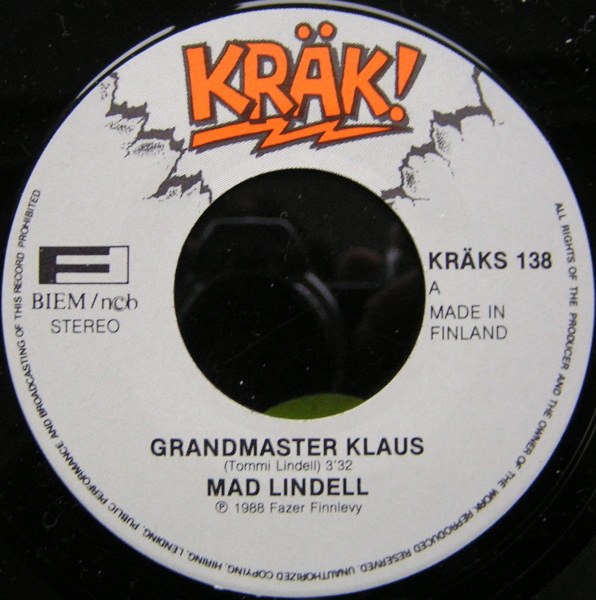
An addition to the 80s synthpop dept. of pHinnWeb... Tommi Lindell was one of Finnish electro pioneers with 'Grandmaster Klaus', a humorous electro-funk take on Klaus Järvinen, the über-critical musical educator member of TV's Levyraati (Finnish version of Jukebox Jury) in the 1980s, sampling the show's jazzy theme music to the comments of Mr. Järvinen on sundry musical performances seen at Levyraati. You can hear the track and see its video at YouTube.
Mad Lindell Grandmaster Klaus (7") KRÄKS 138 Kräk 1988 A. Grandmaster Klaus (3:32) B. Karjala (3:04)
It's pHinnWeb's Couch Potato Time again! Nelonen, Finland's channel 4, has now shown almost the entire run of The Streets of San Francisco, an American cop show made from 1972 to 1977, based on the characters in Carolyn Weston's detective novel Poor, Poor Ophelia. Starring the old potato-nose Karl Malden as a no-nonsense, hard-driving but humane old-school cop called Mike Stone, and then-a-newcomer Michael Douglas as his youthful, more hip and educated partner and apprentice Steve Keller, this generation-joining combination was a sure-fire hit for TV ratings, and only flopped when Douglas, who wanted to concentrate on his career as a movie producer and film actor, was replaced in the last season by Richard Hatch (best known these days from Battlestar Galactica).
A lot of the series' charm lies in nostalgia, of course, from the rapid-fire-edit opening credits with its groovy blaxploitation wah-wah guitar-laden jazzy theme music and the pompous voiceovers (an emphatically masculine narrator announcing "A Quinn Martin Production!" and presenting the dramatis personæ and tonight's guest stars) you just don't hear any more these days; to the Zeitgeist and styles of the post-hippie Bay Area when even the "squares" had decided to let their hair down a bit: bushy haircuts, thick sideburns, flared trousers, wide ties and tight shirts, afros, belated hippie chicks, garish colours and naturally some unforgettable ocean liner-size pre-oil crisis Yankee cars. Not to mention the memorable San Fran scenery with its steep hills (ideal for car chase scenes, as we already learned from Steve McQueen's Bullitt in 1968) and Victorian architecture.
Part of the fun was spotting in the show many familiar faces of silver screen and TV, both past or future: Leslie "The Naked Gun" Nielsen, James Woods, Nick Nolte, Mark "Star Wars" Hamill, Sam Jaffe, Stefanie Powers, Martin Sheen, Tom "Happy Days" Bosley, Tom "Magnum P.I." Selleck, Larry "Dallas" Hagman, Paul Michael "Starsky & Hutch" Glaser, Joe Spano and James B. Sikking (both Hill Street Blues), Bill "Hulk" Bixby, Meg Foster... even pre-fame Arnold Schwarzenegger.
Though the years passed might have added some unintentional humor as to the show's looks, the tone of the series was far from camp. The detective pair Stone & Keller of Patrol Car 81 solved week after week crime cases involving the whole gamut of social scene: from the derelict areas of winos, youth gangs, prostitutes, runaway kids and drug dealers to the secluded world of the well-to-do, the rich, the celebrities and your usual bunch of greedy businessmen getting rid of their rivals by way of murder. Social agenda was high on the list when several storylines (many of them quite well-written in comparison to the more fluffy cop show fare) concentrated on the hapless murderers who ended up killing not by their innate evil but by some unfortunate circumstances caused by poverty and other social injustices.
Rather than being simply happy blowing the bad guy away in the climax, Stone and Keller always understood they had to deal with far more complicated causes and effects inevitably leading to tragedy; even though in most epilogues (adding to the series' charming old-fashioned style, each episode was divided into four "acts" and an epilogue) they left for home cracking ham-fisted jokes after having solved the case; Stone probably heading afterwards for a well-deserved snack of junk food and Keller to a football match with another foxy girlfriend of his. Vintage!