Showing posts with label comic books. Show all posts

Friday, January 23, 2009

S.H.I.E.L.D. Art by Steranko


The very first issue of Nick Fury's own title with psychedelic lettering and patterns.


The "S.H.I.E.L.D. Origin Issue", with some OP art designs.


A striking science fiction cover; too bad the story inside was not by Steranko and had nothing to do with the sleeve art.


A surrealist art-inspired cover also reminiscing the films of Alfred Hitchcock (who, in fact, collaborated with Salvador Dalí for Spellbound.)

Through Facebook, I recently got hooked up again with Canadian Tony Robertson, who maintains an excellent tribute site to American comic book artist and illustrator Jim Steranko. As a fan of the artist's work, I used to host my own Steranko tribute under pHinnWeb during the late-90s, but eventually gave up the site (partly because of worrying about the copyright issues) and let Tony "adopt" for his own site the Steranko-related material I had gathered together so far (including the 1983 Amazing Heroes and 1989 Betty Pages feature stories on Steranko).

James "Jim" Steranko (b. 1938), known in the industry only as Steranko, is best known for his take on the Marvel Comics character Nick Fury -- who started his life as a WWII hero Sgt. Fury, now promoted to the rank of Colonel as the head of a spy organization S.H.I.E.L.D., wearing a futuristic jumpsuit and also rejuvenated with a mystical youth serum -- which started in 1965 through Strange Tales magazine; the character receiving his own title, Nick Fury: Agent of S.H.I.E.L.D, in 1968. S.H.I.E.L.D. (Supreme Headquarters International Espionage Law-enforcement Division) was inspired by other fictional spy organizations like U.N.C.L.E. (of the TV show Man from U.N.C.L.E.), when Marvel Comics decided to jump in to the secret agent craze popular in the mid-60s after the phenomenal success of James Bond movies.

For Nick Fury, Steranko developed a totally new flashy narrative style he called "Zap Art", based on the groundwork made by Marvel stalwart Jack Kirby and then further inspired by psychedelia, OP art and surrealism. Marvel Comics titles such as The Fantastic Four and Dr. Strange had already appealed to the hippie generation with their spectacular cosmic visions, and Steranko was consciously to apply to his own works the psychedelic visual style familiar from the rock posters and record covers of the era. Also Will Eisner's Spirit and Eisner's cinematic photomontage-like style of "consequential art" informed Steranko; furthermore, the influence of classic comic book illustrators like Hal Foster of Prince Valiant (large splash pages with long descriptive text captions) and Russ Manning's (Tarzan and Magnus, Robot Fighter) fantasy landscapes were there, also Wally Wood's striking style Wood used in his horror and sci-fi comics. As a writer Steranko ofter favoured elliptical narratives with theatrical pulp fiction style drawing inspiration from hard-boiled crime fiction, sci-fi and even Gothic horror style.

Steranko, who also had worked as a stage magician, was fascinated by all sorts of games and complicated labyrinth designs, so Nick Fury was seen adventuring in several intricate (and psychedelic) mazes the arch-villains like Hydra had set up for him. The dialogue, with Nick Fury's hard-nut war veteran/bar brawl "Brooklynese", with tough-guy expressions like "flapping one's gums" (= talking too much), sounds now often comically corny and contrived, but hey, isn't that the case, too, when reading also other Marvel titles of the era? Anyway, Steranko might be remembered as a great "postmodern" synthesist, who combined different existing styles to create his own visual narrative (and in his turn influenced other artists like French Philippe Druillet, who took Steranko's psychedelic OP art style and used it for his own byzanthine Lone Sloane in the 70s).

Steranko's hectic working schedule for Marvel took its toll and he finally left the company in 1969. After that he worked briefly for some horror and romance comics titles of other publishers, before establishing his own Supergraphics company, which published two volumes of The Steranko History of Comics in 1970 and 1972, also the magazine Comixscene, which then evolved into Mediascene and finally Prevue, lasting until 1994.

Steranko also provided illustrations for several pulp novels, some comics books and pin-ups. Chandler: Red Tide was a 1976 film noir-inspired "graphic novel" entirely created by Steranko. 1981 saw the comic book adaptation of Outland, a Peter Hyams sci-fi thriller based on the classic Western High Noon and apparently influenced by the bleak-corporate-future visual style of Ridley Scott's Alien. Steranko's Outland was serialised in the legendary Heavy Metal magazine.

Steranko also worked as a conceptual artist for the films Raiders of the Lost Ark (1981) and Bram Stoker's Dracula by Francis Ford Coppola (1992). Marvel's attempts to lure Steranko back creating Nick Fury comics were unsuccessful, though he did create some revived S.H.I.E.L.D. title mini-series cover illustrations. These days Steranko is considered an elder statesman of comic book art, still doing occasional cover art and more "femme fatale" pin-ups.


For more on Steranko, check both Wikipedia and Tony's site for countless examples of Steranko's art.


The uncensored illustration of Nick Fury's girlfriend Countess Valentina. Marvel Comics, in their infinite wisdom, blackened out in the published version the curvy details of La Contessa's buttocks, perhaps thinking they would be too much for the imaginations of the boy readers who had just entered their puberty...

Thursday, December 25, 2008

"Christmas? Bah, Humbug!"


Scrooge McDuck is a Disney character created by American comic book artist Carl Barks (1901 - 2000) for the Donald Duck story Christmas on Bear Mountain in 1947. The wealthy, nasty and misanthropic old duck, scary to the point of being Gothic, was modelled after Ebeneezer Scrooge, the Christmas-hating rich curmudgeon in A Christmas Carol (1843) by Charles Dickens. Mr. Scrooge's disapproving catchprase "Bah, humbug!" was something he used to describe the Yuletide in general.

Thus "Scrooge" has also became a common nickname for the people disliking Christmas for various reasons of their own.

Later on, for his Donald Duck comics Carl Barks softened the character of "Uncle Scrooge", who became a caricature (though one not portrayed with a too critical eye) of an extremely wealthy but overtly stingy venture capitalist, keen to literally take swims in the sea of coins he keeps in his Money Bin building. For those to whom Walt Disney's empire means American cultural imperialism at its worst, the association became all too poignant (for further studies, check out How To Read Donald Duck by Ariel Dorfman and Armand Mattelart, 1971).

Politics aside, the late 1940s is my favourite Barks era when his visual style was at its sharpest; often capturing some hues of the noir-ish post-war angst even with occasional Gothic overtones, to his otherwise comical stories meant for children. This was especially obvious with his long storylines, usually displaying a more epic scale in exotic locations around the world, in comparison to his "shorties" that were based on different "screwball"-style gags around everyday hometown situations, and other classics such as The Ghost of the Grotto and The Old Castle's Secret were born.

  • Christmas on Bear Mountain synopsis and links @ Wikipedia
  • Friday, September 19, 2008

    Mika Waltari 100 Years


    "So it has been and so it always will be."
    - The motto from The Egyptian.

    Today is the 100th anniversarsy of the birth of Mika Waltari (19 September 1908 - 26 August 1979), a Finnish writer (and national institution) best known for his extensive historical novels that are widely translated into many languages; the biggest favourite among readers continuously being Sinuhe Egyptiläinen ("The Egyptian", 1945), which is also known as less-than-successful Hollywood film version of 1954. Sinuhe was voted in April 2008 as the most loved Finnish book of all time.


    Sinuhe Egyptiläinen/The Egyptian with the famous cover illustration by Björn Landström.


    Telling something about the canonized position of Mika Waltari in Finland, even the domestic edition of Donald Duck dedicated its latest issue to the author's 100th anniversary.


    The extremely prolific Mika Waltari was also a detective novelist, his Inspector Palmu books becoming a series of four films in the 1960s, directed by Matti Kassila and starring Joel Rinne as Palmu.


    Komisario Palmu


    Leo Jokela: 'Silmät tummat kuin yö', off Komisario Palmun erehdys (1960)


    The first three films remain classics of Finnish cinema; less successful, though, was the last installment of the movie series, Vodkaa, Komisario Palmu (1969), the first to be filmed in colour and not based on any of Waltari's original books but only retaining their central characters; having as its tone campy agent comedy making fun of Finnish-Soviet relations and other phenomena of the day. An interesting curiosity, though:


    Viktor Klimenko & Inga Sulin, off Vodkaa, Komisario Palmu (1969)


    Potent Flash "commercial" from Vodkaa, Komisario Palmu (1969)

  • MikaWaltari100.net
  • Mika Waltari @ Kirjasto.sci.fi
  • Monday, November 05, 2007

    Jack Kirby's Fantastic Four


    The Jack Kirby-era Fantastic Four (1961-70) on Marvel Comics has been a big favourite of mine for a long time, though my efforts to collect these works have been somehow haphazard and mostly reliable on irregular Finnish translations. The latest of these is Ihmesarja 12 (reviving the title under which Marvel's comics were published in Finnish for the first time in the 60s) on Egmont, a compilation which features from 1969 and 1970 the last Fantastic Four adventures Kirby created for Marvel Comics before he left the company.

    Kirby's was an elegant and cinematic style of illustration (I especially love his beautiful female characters) owing a great attention to detail and vast cosmic visions, with a certain occasional touch of surrealist pop art too (some of his singular comic book panels could be works of art in their own right): Marvel Comics enjoyed a cult following among the members of the 60s psychedelic counter-culture; having a certain hipster appeal with characters like Silver Surfer (who had his first appearance in FF #48, March 1966) who was a philosophical galactic beatnik/hippie never ceasing to wonder humankind's war-like habits.

    The storylines themselves -- with pompous cosmic villains of over-theatrical lines and their universe-conquering delusions of grandeur combined with the silly comedy antics of our heroes' domestic lives -- seem quite childish these days when pop culture is inhabited with psycho serial killers and even Batman has become a dark right-wing vigilante à la Frank Miller, but obviously it's this old-fashioned naivety for which the vintage Fantastic Four holds a great appeal.

  • Comics @ pHinnWeb
  • Tuesday, April 17, 2007

    Suicide: 'Ghost Rider' (1977)


    Original album version (2:34) dubbed to the Nicolas Cage movie trailer by a fan

    Suicide is one those acts that in the annals of popular music are usually called with the clichéd epithet "seminal". A proto-electronic duo of the vocalist Alan Vega and keyboardist Martin Rev from New York City, they came into prominence when punk rock emerged in the late 1970s, though they were closer to such other pioneering electronic duos as Silver Apples of the late 60s (also from NYC) than The Ramones or Television. Taking their own cues from Elvis, Question Mark and The Mysterians, The Velvet Underground and Iggy Pop & The Stooges, they were to inspire everyone from Sigue Sigue Sputnik to Finland's own Pan sonic (who even got to record with their hero Alan Vega). 'Ghost Rider' is one of the best-known songs from their eponymous debut album of 1977.

    This year's Ghost Rider film, based on the same Marvel Comics character which inspired Suicide's song, didn't actually include their track, and got negative reviews anyway. (However, Henry Rollins' cover version was heard in 1994's The Crow.)

    The original track was also Alan Vega's comment on the Vietnam war ("America is killin' its youth"), and hasn't dated a bit in these days of Iraq. (And it was somehow ominous that I heard about the Virginia Tech shootings as I was writing this entry...)


    TV performance (2:27)


    Live performance from 1977/78 (5:12)


    Ghost Rider, motorcycle hero
    bebebebebebebe he's lookin' so cute
    sneakin' round round round in a blue jumpsuit

    Ghost Rider, motorcycle hero
    bebebebebebebe he's a-blazin' away
    Like stars stars stars in the universe

    Ghost Rider motorcycle hero
    bebebebebebebe he's a-screamin' the truth
    America America is killin' its youth

    Bebebebebebebe he's a-screamin' away
    America America is killin' its youth
    America America is killin' its youth
    Ghost Rider
    Ghost Rider


    Thursday, August 03, 2006

    Danger: Diabolik


    Diabolik is an Italian comicbook character, a super-villain created in 1962 by sisters Angela and Luciana Giussani. Diabolik's partner in crime in these amoral adventures is the ultra-cool Eva Kant (reminiscing in these comics somehow Kim Novak of Hitchcock's Vertigo). Some issues of Diabolik were published also in Finnish between 1975 and 1978.


    The acclaimed Italian horror director Mario Bava directed in 1968 a stylish movie adaptation called Danger: Diabolik -- starring John Phillip Law (of Barbarella fame) and Marisa Mell -- which has reached a cult film status.


    Teaser trailer


    Chase scene


    A damsel in distress


    Death scene


    Diabolik does his ironing

    Official Italian site
    Diabolik Club (in Italian)

    Friday, January 27, 2006

    Jack Kirby's 2001 Adaptation


    Talking about Kubrick's 2001: A Space Odyssey, here you can see some images from Marvel Comics 1976 adaptation by the legendary Jack Kirby, best known for his proto-psychedelic imagery for the 1960s Fantastic Four superhero comics.

    A Look at Jack Kirby's Controversial Adaptation

    Grafitti On The Moon: Kirby Vs. Kubrick

    A sketch for cover

    Issue 4

    Issue 5

    Issue 6

    Issue 7

    Monday, July 18, 2005

    Superdickery


    The silliest comic book covers and frames from the Golden and Silver Ages of DC Comics, Archie Comics, et. all; with Superman, Batman & co.:

    http://www.superdickery.com/

    See also:

    pHinnWeb's Comics Links

    Friday, March 18, 2005

    Kari Sipilä

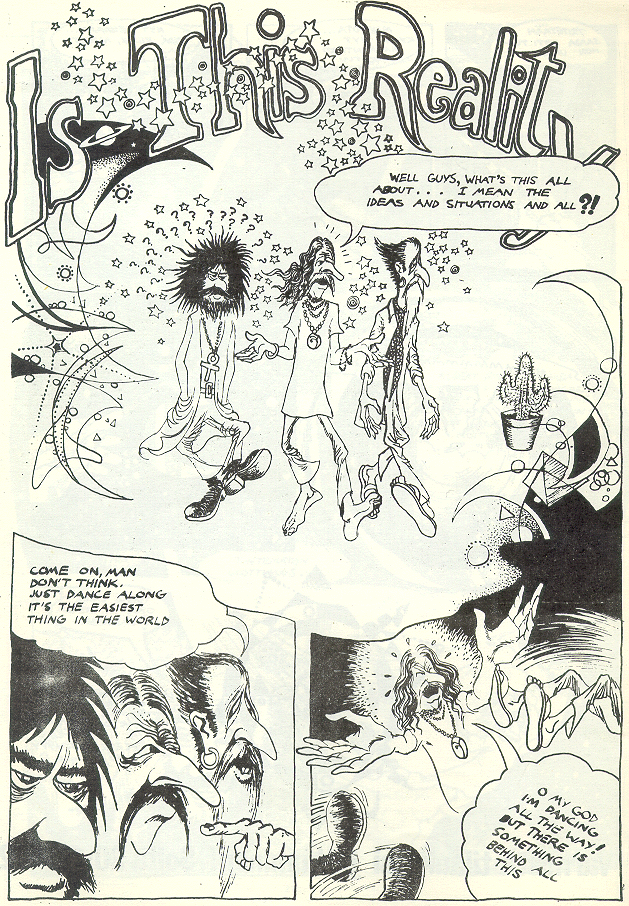
    Juri provided info on some Kari Sipilä's early 1970s hippie comic books on Mysteeni Publications. It would be interesting to find more info on Mr. Sipilä's works. Anyone? For more information, see Jorma Elovaara & The Finnish Age of Aquarius.


    Author: Kari Sipilä
    Title: Zen 1: Aika Ibizalla
    Published: Helsinki : Mysteeni r.y, 1972
    26 p : 21 cm

    Author: Kari Sipilä
    Title: Zen 2: Sarjakuvia
    Published: Helsinki: Mysteeni r.y, 1975
    25 p : 21 cm
    ("Tähti" : an occultist magazine ; 1972: 5.)


    An example of Kari Sipilä's art