Friday, February 02, 2007

Wednesday, January 31, 2007

RIP: Kirka Babitzin (1950-2007)


Kirka: 'Hengaillaan' (Eurovision Song Contest 1984)

From http://en.wikipedia.org/wiki/Kirka_Babitzin:

Kirill "Kirka" Babitzin (born September 22, 1950 in Helsinki, Finland – died January 31, 2007) was one of Finland's most famous popular musicians.

Biography

This is a heavily condensed version of Kirka Babitzin's biography at Populaarimusiikin museo.

The third son of an immigrant family, Babitzin's musical career originally began at age 5 when his grandmother gave him an accordion. He later won an accordion competition at age 10, but left the accordion for rock and roll music. His first band was The Creatures, which he joined in 1964, under his artist name Kirka.

Babitzin got his breakthrough in 1967 when he joined the band The Islanders, originally led by Ilkka "Danny" Lipsanen, as the major vocalist, and began touring all over Finland. Kirka also recorded some singles with Blues Section.

In 1978 Babitzin released a duet album with his sister Anna, and in the next year their sister Muska joined them.

Kirka represented Finland at the Eurovision Song Contest 1984, finishing a strong ninth with the song Hengaillaan.

Babitzin was awarded the Emma award for best male singer twice, first in 1981 and then in 2000. Before his death he promised he will keep on making music at least until his 60th birthday in 2010.

Kirka Babitzin died on the morning of January 31 2007 in his home.

Discography

Kirka Babitzin released 78 singles and almost 60 albums, including 15 collections. A complete discography (in Finnish) is available here. Kirka's album Surun pyyhit silmistäni (1988) is the third most sold Finnish album.

---

Kirka in The Creatures:

http://www.phinnweb.org/retro/garage/finland/

  • Listen to Kirka @ MySpace
  • More Kirka search results @ YouTube
  • Tuesday, January 30, 2007

    Nu Rave?


    Klaxons: 'Magick'


    Klaxons: 'Golden Skans'


    Klaxons, supposedly "Nu Rave" -- so how come I am not holding my breath...?


    From Wikipedia:

    New Rave (also spelt Neu Rave and Nu Rave), is a developing style of music fusing elements of electronic dance music and rock. It has similarities with US-led style Dance-punk. Music publication NME are largely responsible for popularising the term.

    Nu-Rave can also refer to the resurgent breakbeat hardcore scene.

    It can also be applied to a burgeoning fashion style, wherein 'rave' elements such as neon clothing, glow sticks, and baggy t-shirts teamed with leggings are re-appropriated.


    Electronic dance music/rock crossovers are nothing new in itself: there are such examples in the early 90s indie heroes as Primal Scream (especially their Screamadelica of 1991), EMF and their hit 'Unbelievable', Pop Will Eat Itself, Jesus Jones... but does anyone remember Carter The Unstoppable Sex Machine any more...? For the uninitiated (and someone who remembers the original Rave) the word combination (and personal fantasy concept) Nu Rave in itself just sounds great -- that silly but enchanting charm of acts like Altern-8 and early (pre-guitar) Prodigy updated for the new millennium and with new super sounds, perhaps? The return of warehouse parties in a totally fresh, smart and turbo-charged new generation version? -- but if this is just another cynical redressing for tinny-sounding NME indie guitar bands, then there's no reason to hold your breath. Maybe the problem with Nu Rave is that there is just not enough Rave in it.

  • Nu Rave @ History Is Made At Night blog

  • New Rave @ Wikipedia

    Addition, 31 January 2007

    Well, at least the Klaxons seem to have some decent reading habits: namechecking William S. Burroughs' Interzone and Thomas Pynchon's Gravity's Rainbow in their songs. Perhaps they would just desperately need a Kompleksi remix [grin]...
  • Saturday, January 27, 2007

    Privilege (1967) by Peter Watkins @ YouTube!


    Privilege Part 1 (of 14)

  • Part 2 (of 14)
  • Part 3 (of 14)
  • Part 4 (of 14)
  • Part 5 (of 14)
  • Part 6 (of 14)
  • Part 7 (of 14)
  • Part 8 (of 14)
  • Part 9 (of 14)
  • Part 10 (of 14)
  • Part 11 (of 14)
  • Part 12 (of 14)
  • Part 13 (of 14)
  • Part 14 (of 14)

    I told you last August about Peter Watkins' 1967 film Privilege, lamenting the poor distribution status of this cult sci-fi film about the connections of pop music and fascism. Now one of those friendly YouTube pirates has brought this rare film online for everyone's watching pleasure, and this is what this person writes as accompaniment to the film:

    "Privilege, a cruelly compelling, often brilliant film ... the real star ... is director Peter Watkins, only 31, who must get credit for this acidly anti-establishment film ... the quasi-documentary touches he mastered on BBC money are sharply and effectively in evidence. And in his first full-length film, he shows he can use color with startling success. No doubt about it: Watkins is on his way.' (Playboy)

    'This is a bitter, uncompromising movie, and although it isn't quite successful it is fascinating and important. Watkins made a mistake in bringing the newsreel techniques of The War Game into a narrative film, where a director should be able to make his point with his story, the performances and the photography. Still the movie isn't a failure so much as an interesting episode in the career of a director who I think will eventually be ranked with Fellini and Bergman.' (Roger Ebert, Nov 1st, 1967)

    The national cinema circuit in the UK, J. Arthur Rank, refused to show this "immoral and un-Christian picture which mocked the Church, defied authority and encouraged youth in lewd practices". Universal Pictures withdrew the film after brief screenings in a few countries, and the film has been rarely shown since - very occasionally on TV. Universal Pictures in Hollywood even refuse to let the director rent or buy a copy of this film, even on VHS.

    For more information, visit the director's website: http://www.mnsi.net/~pwatkins/privilege.htm

    For a nice essay on the film, see: http://www.brightlightsfilm.com/49/privilege.htm

    (I apologize for the godawful picture quality, it's the only version of the film I got, since Universal still refuses to give this film a PROPER DVD-release... So please see this as a chance to watch this rare film!) ..."

  • See also: Peter Watkins: The War Game (1965)
  • Friday, January 26, 2007

    Chris Marker: La Jetée (1962)


    La Jetée 1/3


    La Jetée 2/3


    La Jetée 3/3

    (Note: all subtitles here in Spanish)

    The trailer

    An excerpt dubbed in English

    La Jetée ("The Jetty", 1962) is a 28-minute post-nuclear war/time travel sci-fi film by Chris Marker (b. 1921), consisting entirely of black & white still images. La Jetée was remade in 1995 by ex-Monty Python member Terry Gilliam as Twelve Monkeys.

    Addition, 27 January 2007:

    The whole film @ Google Video (thanks for the tip: Jan/Jahsonic)

    Saturday, January 20, 2007

    More Tampere Exotica


    Tampere City Hall and Keskustori Central Plaza

    Some more YouTube footage from my hometown; this being the very area through which I stroll daily... quite exotic for you non-Finns, eh? Tee hee...

    Tampere Region Webcams

    Previous "exotic" Tampere footage

    Thursday, January 18, 2007

    Some Plagiarism and Songs Resembling Each Other Cases From Music History


    Zombie Nation: 'Kernkraft 400' (1999)

    Before the current Tempest vs. Timbaland case, claims of plagiarism go a long way back in music. Here are some (and more or less random) brief examples from the history of popular music, though these are only the proverbial tip of the iceberg of all the cases where an artist or his/her record label has claimed someone else has stolen his/her music... In the current day of "postmodern", "retro" type of pastiche pop where "ironic" references and "appropriations" (or "homages") abound everywhere, maybe it's harder to speak about plagiarism in any traditional terms, so it's interesting to see how our ideas about this will change in time.

  • The Kinks successfully sued The Doors for plagiarizing their 'All Day and All of the Night' to 'Hello, I Love You' in 1968.
  • 'Black Knight' (1970) by Deep Purple sounds very much like 'We Ain't Got Nothing Yet' by The Blues Magoos (of Nuggets) fame. Actually, Wikipedia says: "The riff to Deep Purple's 1970 'Black Night' single was closely based off the riff to Ricky Nelson's 1962 'Summertime' (Deep Purple have said this themselves). In fact, the riff is a popular one to borrow. In 1966/67 the Blue Magoos had 'We Ain't Got Nothing Yet' around the same time that Status Quo had own their version. But the riff seems to stem back to Ricky Nelson's 1962 rock version re-working of the old George Gershwin standard 'Summertime'".
  • George Harrison was sued for plagiarizing 'He's So Fine' by The Chiffons for his song 'My Sweet Lord' in a long-lasting law suit which started in 1971. Harrison was ordered to pay $587,000 to Bright Tunes Music (the owners of the song's copyright) in 1976, after a judge found him guilty of "subconscious" plagiarism. The Chiffons would later record 'My Sweet Lord' to capitalize on the publicity generated by the lawsuit.
  • Led Zeppelin used a riff from 'Taurus' by Spirit for their best-known song, 'Stairway to Heaven'. Spirit's guitarist Randy California was reportedly just happy to let Zeppelin to use the riff. Led Zeppelin was often also accused of using old blues songs uncredited as the basis of their own tracks. Also Bob Dylan has been accused along the years of "appropriating" old songs for his own tracks.
  • David Bowie's 1972 single 'Starman' has its chorus loosely based on Judy Garland's song 'Somewhere Over the Rainbow' from the 1939 film The Wizard of Oz.
  • There is said to be some resemblance between Bon Jovi's 'You Give Love A Bad Name' of 1986 and Belinda Carlisle's 1987 hit 'Heaven Is A Place On Earth'.
  • All unsold copies of 1987 (What the Fuck Is Going On?), the 1987 debut album of The Justified Ancients of Mu Mu (a.k.a. The KLF) were ordered to be destroyed by the Mechanical-Copyright Protection Society, following a complaint from ABBA; the JAMS having sampled large portions of ABBA's 'Dancing Queen' for the track 'Queen and I'.
  • De La Soul was sued by The Turtles members for featuring an uncredited sample (the intro to The Turtles' 'You Showed Me') in the song 'Transmitting Live from Mars' on De La Soul's 1989 debut album. This was one of the first court cases over sampling music.
  • Negativland issued in 1991 a single called 'U2', featuring parodies of the group U2's well-known song 'I Still Haven't Found What I'm Looking For', including kazoos and extensive sampling of the original song. U2's label Island Records sued Negativland and most copies of the single were recalled and destroyed.
  • For their 1997 track 'Bittersweet Symphony' -- using a licensed sample from the Andrew Oldham Orchestra's version of 'The Last Time' by The Rolling Stones (1965) -- The Verve (UK) was sued by ABKCO Records of Allen Klein, which owns the rights to The Stones' 60s recordings. ABCKO claimed The Verve had used "too much" of the sample. The matter was eventually settled out of court, with copyright of the song (which lyrics were written entirely by The Verve vocalist, Richard Ashcroft) reverting to ABKCO and songwriting credits to Mick Jagger and Keith Richards of The Stones.
  • Splank of Zombie Nation had to pay an undisclosed amount to David Whittaker, the programmer who wrote the original music riff to 80s Commodore-64 computer game 'Lazy Jones', which was used as the basis of Zombie Nation's 1999 hit 'Kernkraft 400'.
  • 'Älä koskaan ikinä' ("Don't You Never Ever"), the 2003 hit for Finnish band Egotrippi is said by some to bear a considerable resemblance to Procol Harum's 1975 track 'Pandora's Box'.
  • Monday, January 15, 2007

    Timbaland Accused Of Ripping Off A Finnish Musician


    "Producer Timbaland steals song from finnish musician"

    I picked this off pHinnWeb's Mailing List and Wikipedia's entry for the US producer Timbaland:

    It is now claimed that Janne Suni a.k.a. Tempest a.k.a. Damage, a Finnish demoscene musician/graphic artist (who has also done cover art for Jyväskylä's Rikos Records), has had 'Acid Jazzed Evening', one of his tracks, blatantly ripped by the well-known hip-hop/R&B producer Timbaland on Nelly Furtado's song 'Do It' for her album Loose.

    The said track is from a Commodore 64 conversion of an Amiga .mod file made by the Finnish demoscener Janne Suni. The track was entered into a music competition at Assembly 2000, a demo party held in Helsinki, Finland in the year 2000. Tempest's entry 'Acid Jazzed Evening', a 4-channel Amiga .mod won first place in the "Oldskool Music" competition. According to Scene.org the song was uploaded to their servers in 2000, long before the release of the song by Furtado. A video which claims to show proof of the theft was posted to YouTube on January 12, 2007. It's yet unknown whether Janne Suni will ever be able take the case to the court, the prospects of winning a court case against a major record label-backed international celebrity artist being very slight; not to talk about any astronomical expenses involved in losing a case like that.

    A thread @ Digg

    2007 Timbaland plagiarism controversy @ Wikipedia

    Plenty of links @ Pelamu.Net

    Related news links in Finnish:

  • Iltalehti
  • Iltasanomat
  • Stara
  • YLE

    17 January 2007 addition:

    This one reminds me of the case of UR's DJ Rolando/Aztec Mystic against Sony/BMG's cover version of his 'Knights of the Jaguar' in 2000:

    http://www.renegaderhythms.com/articles/ur/jaguar_ripoff.html

    I remember the Jaguar case caused a very angry response in dance music community towards Sony/BMG and generated lots of negative publicity, so similarly I think now only a massive media exposure and pressure from fellow musicians/music fans/journalists etc. all over the world might help Tempest/Janne Suni getting his due compensation here.

    As it was pointed out in media articles above, any court case against Timbaland and his multinational record label (with their mighty army of highly-paid corporate lawyers; just remember the OJ Simpson case...) would probably be lost (as said, not to talk about another additional injury caused by the case's expenses) by Tempest or anyone representing him. So it seems to me some sort of out-of-court settlement would be the only realistic outcome here.


  • Some plagiarism and songs resembling each other cases from music history
  • Sunday, January 14, 2007

    Yello: You Gotta Say Yes to Another Excess (1983)


    Yello: 'Lost Again' (1983)


    Yello: 'I Love You' (1983)

    I've now been listening to Yello's remastered 1983 album You Gotta Say Yes to Another Excess. Yello, the ingenious synthpop duo of Boris Blank (b. 1952) and Dieter Meier (b. 1945) (the third member, Carlos Peron, stayed with Yello until 1983) was in their 1980s heyday known for their extremely eclectic approach (being probably a bit too obvious, I shudder to use the term "postmodern" here...), combining to electronic sounds Latin rhythms and other yesteryear lounge music-type exotica (perhaps Angelo Badalamenti's jazzy moods for David Lynch's works would come close here), night club torch songs, film noir melodrama and offbeat humour with outlandish narratives, making Yello's music unlike any other synthpop act of the day's futurist/New Romantic wave; still sounding fresh today in comparison to many of their contemporaries. Yello originates from Switzerland, the country which also gave us Carl Gustav Jung, Hermann Hesse, LSD (which Albert Hoffman synthesized in Sandoz Laboratories in 1938), and H.R. Giger, the artist behind Alien designs and his hellish airbrush visions. Something odd in the water in the cuckoo-clock country...?

  • More Yello videos @ YouTube
  • Listen to Yello @ MySpace
  • Wednesday, January 10, 2007

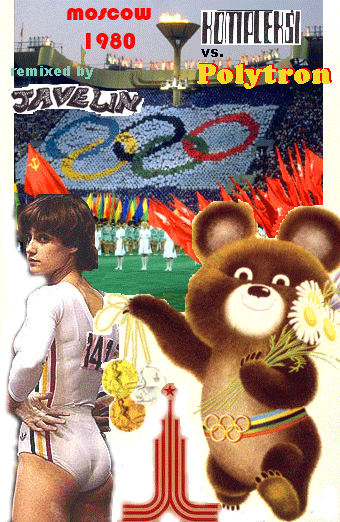
    'Moscow 1980' - Javelin Remix (feat. Larkin Grimm)


    Here's for a limited time Javelin's remix of Kompleksi vs. Polytron's 'Moscow 1980'. The vocals were sung by Larkin Grimm, Annelise Grimm and Tom Van Buskirk of Javelin "in a warm attic in Georgia". Javelin hail from Providence, RI, USA, and have released a 7" called 'Oh Centra' for Finnish Lal Lal Lal; the same label also releasing Kompleksi's first 7" '(I Ain't) No Lovechild' in 2005.

    original lyrics

    Saturday, January 06, 2007

    Caetano Veloso on Avantgarde


    Varèse/Xénakis/Le Corbusier: 'Poeme Électronique' (1958)

    Caetano Veloso -- one of the most important names behind the late-60s Brazilian musical movement Tropicalismo (a.k.a. Tropicália) -- writes in his 2002 autobiography Tropical Truth: A Story of Music & Revolution in Brazil (originally Verdade Tropical, 1997) about avantgarde and its problematic connection with popular music:


    "In 1968, Augusto [de Campos, a 'concretist' poet friend of Veloso since the 1960s] was impressed with Paul McCartney's declared enthusiasm for Stockhausen. Yet in the years that followed, as he was listening to the sweet and spineless pop produced by Paul -- music whose transgression was totally programmatic and digestible following the spectacular growth of the pop market after the Beatles -- a man like Augusto, one can only imagine, must have been filled with boredom and distaste. He must have felt the same toward pop music, MPB, and the tropicalistas. Sooner or later we, the tropicalistas, in more or less noble ways, depending on the individual case, would show signs of the essence of our chosen activity, which has always consisted in producing banal songs to compete in the market. (And in Brazil the growth of this market means an advance on the national scale.) Augusto keeps on fighting for unpopular music: Boulez, Stockhausen, Berio, Varèse, and Cage -- and also Giacinto Scelsi, Luigi Nono, Ustvolskaya, etc. The stubborn unpopularity of the most inventive contemporary music is truly a mystery. Augusto's flash of euphoria when he heard of McCartney's (ultimately undeveloped) interest in Stockhausen in 1968 represented a fleeting hope of deciphering this enigma. Produssumo, as I said earlier, was a word invented by another concretist poet, Décio Pignatari, to define a period in which avant-garde ideas had a place at the top of the pop-rock charts. One of the most stimulating problems of the avant-garde, and a problem that makes some of the most stimulating artists run from it like the Devil from the cross -- is its dubious position with regard to its intrinsic ambition to become the norm. I have recently heard Arto Lindsay say that the musicians and producers of the trendiest vogue in dance music (techno) are voracious consumers of precisely the kind of music heroically defended by Augusto. These young people are listening to Varèse and Cage, to Boulez and Berio. And, says Arto, they don't talk about anything else. What should we make of this? In the seventies, there was already an outcry of very conservative (and very useful) voices protesting 'modernism in the streets.' But will the collective ear adjust itself to postserialist or postdodecaphonic music? And what kind of world will it be, when such music sounds like music to 'everyone's' ears? I myself can't say exactly why Webern's music (especially the most radical pieces) has always seemed to me indisputably beautiful. Might the techno-dance kids be an embryonic minority? What will happen to the tonal ear as we know it if unpopular music's failure with the public at large is overcome? When I first saw MTV in New York, I wrote an article entitled 'Vendo canções' (See and Sell Things), in which I ask more or less superficial questions but still point in the same direction. The procedures of avant-garde film, which were trashed by serious and commercial cinema alike, had finally found refuge in those snippets of rock 'n' roll film, which were at once erratic illustrations of the songs and ads for the corresponding records. Now I can't stand to watch rock videos for very long: the excess of images labouring to seem bizarre bores me, especially at the speed the editing presents them. But the question remains: don't the references to Un chien andalou, to Metropolis -- and the undying kinship with Cocteau's Blood of a Poet -- appear in a rock video exactly as Mondrian's designs flash across the skirt of a prostitute? Are 'modernisms' and 'avantgardes' only now beginning to lose their right to such labels?"


  • Caetano Veloso search results @ YouTube
  • Tropicália article, info & video links @ pHinnWeb
  • Friday, January 05, 2007

    The Future Already Happened


    Kasabian: 'Shoot The Runner'

    I was just lazily channel-surfing one night when I spotted this video by a UK band called Kasabian, supposedly one of those fashionable post-Britpop acts now championed by England's indierock Bible NME.

    This song sounded to me like a sort of combination of early 70s glamrock's stomping boogie beat with the pyrotechnics guitar psychedelia of late 60s; with even some organ sounds in the middle eight reminiscing of Pink Floyd's 'One of These Days'. The Kasabian video itself could be called quite Beatle-esque, with its rotoscope animation and UV light/day-glo colours reminiscing of the 1968 cartoon film Yellow Submarine, and the singer even wearing a sort of 19th century military jacket donned by The Beatles members (and Jimi Hendrix, too) during their Sergeant Pepper era. Add to this some Jackson Pollock abstract expressionism paint splashes also favoured by The Stone Roses.

    My ongoing gripe has been for a long time that rock these days seems to be merely some retroist nostalgia pastiche trip whereas once that genre of music could even be called genuinely futuristic. Not futuristic in the science fiction sense of having such imagery as robots (the number one cliché in electro), faster-than-light spaceships and so on, but being futuristic music in the sense that it looked joyously into the future and tried to create something totally new by the very way it was conceived, arranged and produced. 'Strawberry Fields Forever' by The Beatles in 1967 or Giorgio Moroder's production for Donna Summer's 'I Feel Love' about ten years later were in this sense futuristic music for their own eras. Whereas a band or a musical act in 2007 trying to emulate the sounds of George Martin's productions for The Beatles or Moroder's proto-Italodisco would be helplessly retroist. So, even if I could enjoy a track by a current band like Kasabian as a clever and well-executed retroist pastiche of my favourite yesteryear bands, my enjoyment can't be totally and thoroughly honest and unreserved. Well, I'm totally aware that my personal quest for that genuine futurism in today's music is just completely naïve and not a little bit Quixotic.

    Could such genres currently in vogue as grime or dubstep offer me that elusive sense of being honestly "future music", then? There was a time when even the most blatant chart pop bands could at least pretend they had some sort of social agenda in their music, but these days it's very hard to find anything like that in the psychopathic drive-by shooting fantasies of hip-hop and the empty bling-bling hedonism of R&B: for example, Lethal Bizzle's grime classic 'Forward Riddim' includes such lyrical strokes of genius as: "Killa killa real deal/Niggas know the real deal/Don't care how you feel/I will be cockin' back my steel straight/Bullets bullets run run/Fire fire bun/If you don't like killa killa/Nigga you can suck your mum". But well, you can't really blame the mirror for only reflecting its environment, can you? (Probably with grime and dubstep I would be more interested in sounds and production, anyway, than whatever lyrical content they might claim to have.) Once people actually thought they can change the world with music. From a traditional leftist-Marxist point of view there seems not to be much room for any social commentary in the early 21st century music, which is rather emphasizing the instant emotional gratification than creating any uneasy questions in a listener.

    Kung Faux


    An excerpt from 'Ill Master', the first episode Kung Faux

    Kung Faux just started in Finland, being an American TV series cannibalizing old Hong Kong kung-fu movies and dubbing to them a new dialogue of typical American hip-hop vernacular and music (plus additional split screens and animated "Biff! Bang! Pow!" comic book effects of the 60s original Batman show). This sort of idea of creating comedy spoofs of existing material by adding new dialogue is nothing new in itself: Woody Allen already had that in What's Up, Tiger Lily? (1966), where a "serious" Japanese spy movie was "remixed" to some comical effects. Well, as a "postmodern" gimmick Kung Faux seems to be interesting, deriving a lot of its appeal also from the fact that American hip-hop culture (and related club music -- just see J. Saul Kane) has always been influenced by Hong Kong's kung-fu genre -- acts like Wu-Tang Clan being among some of the biggest proponents -- so the connection already exists, but I don't really know about the lasting joke value of this one...

  • More Kung Faux search results @ YouTube
  • Thursday, January 04, 2007

    Kompleksi/Polytron: 'Moscow 1980' - Javelin RMX


    Here's for a limited time Javelin's remix of Kompleksi vs. Polytron's 'Moscow 1980'. Javelin are a duo from Providence, RI, USA who have released a 7" called 'Oh Centra' for Finnish Lal Lal Lal; the same label also releasing Kompleksi's first 7" '(I Ain't) No Lovechild' in 2005.

    http://www.phinnweb.org/kompleksi/temp/moscow1980javelinremix.mp3

    Tuesday, January 02, 2007

    Sunday, December 31, 2006

    Two Double-Oh-Seven


    Exit 2006

    Enter 2007


    "I was dreaming when I wrote this, so forgive me if it goes astray..." -Prince

    2006 saw many crucial changes taking place: some dictators passing (Milosevic, Saparmurat, Pinochet, Saddam -- good riddance to all of them, though the nationalist fans of those in their respective home countries probably might disagree); more sadly, many musical & lyrical legends were gone too (Barrett, Lee, Brown, Leskinen, Laine). And not to forget the shameful murders of Anna Politkovskaya and Alexander Litvinenko, either. Global warming gave even more alarm signs with the increasingly worrying reports of polar glaciers melting and generally unsteady weather conditions all over the world (for example, here in Tampere we "enjoyed" a snowless Christmas and earlier in August a bitter stench of smoke lingering insistently in the air, caused by some Russian forest fires behind the Finnish border). As usual, trouble continued brewing in the Middle East and the big boys of global power politics kept threatening each other with nuclear missiles. Finland finally won the Eurovision Song Contest with the heavy metal monster Lordi, but very soon everyone except the most jaded media freaks and Markku got bored with the Lordi phenomenon. All in all, these twelve months felt like a much longer period of time, and it is more than probable 2007 will bring many more changes.

    As we announce a new era of integrated e(c)lectronics, here’s pHinnWeb’s little survival kit/"manipHesto" for two-double-oh-seven; with a licence to kill, thrill or make ill.

    In 2007:

    Pop-musically speaking...

    We don't need music purists and wanky little fanboys furious over the relative merits of their favourite brands of organized noise (often called also "music(k)") and ignoring the rich world of sounds beyond their style ghettoes.

    We don't need sad gothic robots wallowing in their misery: suicide is not a solution and the exaggerated cosmetics-enhanced misery is the best way only to secure some great laughs (a tip for all families, though: goths make great pets, are easy to take care of and maintain since they don't eat much, only need some cheap cider every now and then, and are totally content in their misery as long as you keep them warm and safe in their cage, appropriately covered with a black blanket, goths' eyes being very sensitive to light, let them listen to their Bauhaus CDs and remember to change their black leather pants or miniskirts often enough. The most important thing in a proper goth pet maintenance, though, is to keep any sharp objects away from them, to prevent children from witnessing their favourite cheery pastime, self-mutilation).

    We don't need middleclass white B-boys fantasizing of guns and drive-by shootings, but we need to celebrate the fact that we don't live in ghettoes (yet), we still have a (relative) freedom to choose and the (potential) power to change things (our hero, a fifteen-year old Caucasian pimply-faced pimp gangsta lying passed out on the freshly laid minefield of street pizzas, his puffy jacket, mobile phone, wallet and brand new Timbaland shoes stolen, his XXXL-size pants down on his knees and a pool of urine slowly forming under him while he snores the night away blissfully ignorant, as always).

    Also forest folkers are freely advised to search a hiding place deeper in their murky woods where they can strum away their acoustic guitars and toy instruments, and improvise to their art school student hearts' content.

    Politically & culturally speaking...

    We don't need bigoted power-hungry demagogues who tell the ignorant mobs that racial prejudice and chauvinist nationalism are an answer to society's ills, but we don't need to pretend we would be any better, either, but face our own prejudices and fears, and struggle them the best we can.

    We don't need politicians choking on their official party line, in the end of the day only meant to secure their own hard-earned turfs. We don't need any wooden-tongued bureaucrats stumbling on red tape and drowning their sacrosanct stiff bodies under their mountains of forms, files and applications.

    We may not even need traditional party politics, long ago alienated from ordinary people's lives, but we need to initiate the changes ourselves: in our immediate surroundings where we live and through our "unofficial", non-political networks around the ever-shrinking globe. For this we don't need any leaders who tell us how to get things done: no Presidents, no kings or queens, no "charismatic" reverends or "gurus", no war marshals or generals, no "trendsetters", no pop stars or Idols, no CEOs, bank managers or economy experts, no Führers.

    We don't need market researches or trend barometers to tell us how to bring joy to our shallow lives by our "choices" as consumers. We don't need any dogmatist fanatics to think for us.

    Yes, this list of "need nots" is so much defining ourselves through negation, so on a more positive note, also some things what we might actually need then for the pursuit of that ever-elusive happiness. We need to transcend the isolation and solitude of our provincial towns and the pecking orders of their petty-minded people with their little cliques. We need to break out of the tunnelvision. We need to stop whining (this very text probably included under this advice, too) and weeping to our pints, and start to seek for improvements and solutions instead.

    We need ice cream castles with gossamer wings, more moustachioed Mona Lisas and ardent eclectronauts plunging fearlessly into the Drexciyan depths. We need more Zen, Dada and Gaga and less Britney Spearses without underpants. Tiny DJ-worshipping beatmatching-anal twerps of Platinum flee in horror as Kommandomix Eclectro crushes their otaku masturbatoriums like an amok-running 500 metres tall horny Decepticon juggernaut robot on a combination of Ayahuasca, mescaline and kerosine. Idols judges escaping the town smeared in tar and feathers, running for their lives. Godzilla's farts ignited by a flamethrower and roasting a certain well-known slimeball promoter from the Fenno-Scandic Arschloch. Did the little kid already suspect the real state of Emperor's new streetwear?

    There's a God-shaped hole in your scientific rationalist-atheist worldview through which ufos and angels with their meditation crystals fly in, not to talk about poltergeists oozing stinky ectoplasm, Santa Claus in his sleigh and some other unnamed spirit entities only Danish cartoonists in their foolhardy bravery dare to give a form to. You try to arm yourself against the archaic onslaught of superstition with the collected works of Richard Dawkins, Stephen Jay Gould and Stephen Hawking, but it's too late for all your free-thinking positivism to save you, and your precise, exact clockwork-like universe crumbles like a dry cup-cake and the shadows on the walls of your Platonist cave start to close in on you as The Ontological Juggler plays around with the very foundations of your world -- where you once thought everything was in its place. Yes, rationalist boy: this is the new era. Accept chaos.

    OK, kiddoes: writing these very words, the present writer is well aware that this way he makes himself susceptible to derision from certain individuals laughing and snickering behind his back, but knowing these people's penchance to lazy, self-centred and self-absorbed passivity, he feels he's got nothing to be ashamed of in comparison.

    For the Earth is burning, the time may be running out for this planet, and even though we might be in the middle of some elaborate cosmic joke, that is on all of us -- the gist of what we may never get -- we've got no other choice than to make the best of this desperate situation. E(c)lectricity runs through our veins in the blessed but not at all holy Western night; we are not saints or supermen, but we are not doomed yet, either.

    HAPPY NEW YEAR 2007... THE COUNTDOWN HAS BEGUN.

    (With a little help from Reverend Harri Teikka.)

    And an optional soundtrack for this entry...


    Sia: 'Breathe Me' (the finale from Six Feet Under, 2005)
    (Warning for those who intend to watch the series in the future: this one contains spoilers.)

    Saturday, December 30, 2006

    The Genius of Sleepy Sleepers


    Sleepy Sleepers: 'Anarkiaa Karjalassa' ("Anarchy in Karelia", 1977)


    Sleepy Sleepers: 'Kaksi tapaa harrastaa seksiä' ("Two ways to have sex", a song and video clip for an anti-AIDS campaign in the 80s)

    Sleepy Sleepers @ pHinnWeb

    Tuesday, December 19, 2006

    Saturday, December 16, 2006

    Archigram vs. Brutalist Modernism


    Modernism prevailed in architecture since the post-First World War era, in the visions of such people as Le Corbusier, Bauhaus and Functionalists; and by the 1960s this ascetic approach had developed into the minimalist, massive and menacing -- at its worst even post-Stalinist totalitarian -- style of the slabs of concrete, in what was called "Brutalist architecture". Combined with the technocratic city-planning, often manipulated by greedy and corrupt real estate deals, this was the style that prevailed all over the world, as the architecture of earlier eras was often ruthlessly erased and demolished to give way to the box-shaped steel and concrete office buildings and suburban apartment houses of element blocks. (My own hometown Tampere can well be called another example here, when several "wars" were waged over in the 60s and 70s to save such idyllic late 19th century/early 20th buildings as the City Hall or the Old Market Hall, threatened by an impending demolition in the hands of technocratic City Fathers.)

    This autocratic dogmatism of Modernism/Brutalism was now challenged by architects who respected more the organic, evolutionary aspects of the city. Perhaps the most inventive and influential thinkers in this vein were the members of Archigram, a group of British architects that got together in the early 1960s through the Architectural Association in London; comprising Warren Chalk, Peter Cook (no relation to the era's famous British comedian of the same name), Dennis Crompton, David Green, Ron Herron and Michael Webb. Archigram's ideas were expressed in imaginative, often playful fantasy projects and colourful collages in "pop" spirit, which were published on the pages of their eponymous journal launched in 1961. Many of Archigram's designs were actually never meant to be realised as finished buildings, only as joyful simulations of what architecture could perhaps be in some possible but distant future, such as Roy Herron's "Walking City" of 1964: with an outlandish idea of a city that could be moved on its mechanical legs from one area to another!

    Archigram were influenced by science fiction, comic books and other popular culture, engineering, and generally taking ideas from outside their own medium to find new approaches for architecture. In Amazing Archigram 4 Zoom Issue of 1964 Warren Chalk wrote: "In this second half of the twentieth century, the old idols are crumbling, the old precepts strangely irrelevant, the old dogmas no longer valid. We are in pursuit of an idea, a new vernacular, something alongside the space capsules, computers, and throw-away packages of an atomic and electronic age".

    Bibliography:
  • Peter Cook (ed.): Archigram (Princeton Architectural Press, 1999, ISBN 1568981945)
  • Simon Sadler: Archigram: Architecture without Architecture (The MIT Press, 2005, ISBN 0262693224)


    click for larger image


  • Archigram Image Search @ Google
  • Archigram Gallery
  • Archigram @ DesignMuseum.org
  • Archigram @ The Bartlett: Architecture
  • Archigram @ Art Tower Mito
  • Archigram @ Wikipedia
  • Thursday, December 14, 2006

    The Music Machine: 'Talk Talk' (1966)


    The Music Machine, with Sean Bonniwell in the middle


    The Music Machine: 'Talk Talk' @ Where The Action Is, 1966

    I just got The Music Machine's 2-CD compilation The Ultimate Turn-On (Ace Records, 2006), collecting together all the works of the band's original line-up; with the 1966 album Turn On (both as mono and stereo versions), all singles and some rehearsal tapes, demos and alternate takes.

    The Music Machine, headed by Sean Bonniwell, was one of the most intriguing fuzz guitar-wielding "garage"-type bands coming into prominence in that golden year of 1966 when psychedelic music was still raw and relentless, having not yet decayed into boring, meandering, endless blues jams of San Francisco bands or boring, meandering, endless pseudo-classical jams of progressive rock acts. The biggest Music Machine hit was the fierce 'Talk Talk', truly punk rock, only about ten years before Johnny Rotten and his foul-mouthed compadres made British TV watchers spill their evening teas. Well, for me, the original "punk" of the ca. '64-'67 garage/"freakbeat" bands is always far more inspiring than the more nihilistic late 70s style, born under much bleaker, more cynical and disillusioned circumstances of the latter decade.

    The Music Machine were forerunners in other ways, too. Preceding also gothic rock by some fifteen years, the band were uniformly dressed in black, wearing black gloves too (though curiously only in the right hand for each member), and even dyeing their moppish "beat" haircuts black. This sinister look must have been quite a sight to see among all the colourful groups of the day when hippie style, with its often-garish "day-glo" colours, was already emerging in the underground.

    Some similarly gloomy overtones were also reflected in the band's music: the best psychedelic garage, more than flowers and mellow peace feelings of the hippies, always verged on the raw, gloomy feel of existential angst and even bad trip psychotic breakdown. With some extra luck and less music business shortcomings than eventually befell them, The Music Machine -- with Sean Bonniwell as their charismatic but enigmatic frontman with growling vocals and dark lyrics like Jim Morrison had, though admittedly with less "poetic" pretensions -- might finally have reached the same magnitude as The Doors did. If only...


  • Listen to The Music Machine @ MySpace
  • The Official Bonniwell Music Machine Site
  • The Music Machine @ Wikipedia


    The Music Machine: 'Talk Talk'

    I got me a complication
    And it's an only child
    Concernin' my reputation
    As something more than wild
    I know it serves me right
    But I can't sleep at night
    Have to hide my face
    Or go some other play-ay-ay-ay-ay-ace

    I won't cry out for justice
    Admit that I was wrong
    I'll stay in hibernation
    'Til the talk subsides to gone
    My social life's a dud
    My name is really mud
    I'm up to here in lies
    Guess I'm down to size
    To size

    Can't seem to talk about
    The things that bother me
    Seems to be
    What everybody has
    Against me
    Oh, oh, all right

    Here's the situation
    And how it really stands
    I'm out of circulation
    I've all but washed my hands
    My social life's a dud
    My name is really mud
    I'm up to here in lies
    Guess I'm down to size
    To size

    Talk talk Talk talk Talk talk Talk talk
  • Saturday, December 09, 2006

    Dubstep in Tampere


    Tammerforce/Bass and Beer Party club's Dubstep special last night at Yo-Talo presented Tes La Rok (a.k.a. Jani Niiranen from Helsinki) featuring MC Rogue Star from London. I checked this with some interest because I couldn't claim to have much idea what this dubstep thing -- supposedly the latest craze in UK's electronic dance music -- was all about.

    Well, it turned out to be pretty intriguing: very growling and slow bone-shaking sub-bass sounds accompanied with abstract electronic excursions circling from one speaker to another. In fact, one could say it sounded much like a jungle 45 rpm vinyl record played at death-slow 33 rpm instead. So the tempo was that of dub reggae but the aggressive heaviness -- in fact, downright scary at times -- was clearly from those darker styles of drum'n'bass.

    This sound made me somehow think of my old favourites Meat Beat Manifesto, Techno Animal (Kevin "The Bug" Martin's project with Justin Broadrick of Godflesh) or even one my all-time fave tracks, LFO's 'Tied-Up' (albeit as a slowed-down version). So I have to say I quite liked the dubstep sound: nice, dark and hard. (Heh, a comparison for the more rock-oriented people might be of grunge's slower Black Sabbath-like sounds to that of speed metal.)

    The only problem with the performance for me was that maybe the BPM/tempo there remained a bit too same-y all through the set; for my own tastes accelerating the tempo and adding more rhythmical variation every once in a while might have probably made it more interesting, but perhaps this would have also lost the idea of what this style is all about. And perhaps it might have been interesting to hear it all as purely instrumental without the Cockney chants from this Brit MC who did his best, though, to lift the audience's emotions and even trying to make them raise their cigarette lighters for Tes La Rok (as they do at UK parties to show appreciation for the DJ; it seems Finnish audiences have not adopted this habit, at least not yet). After the set, Bass and Beer head honcho Bob Ryynänen played some cool electro, the way we haven't heard in ages in this Northern Mecca of milk-white junglists, Morrissey-worshippers and forest folkers; even causing one ol' pHinn to do some rare body movements on dancefloor; a considerable feat in itself these days.

    Sakke Karipuro's photos from the event

    More on dubstep:


    Dubstep - MTV Base "About To Blow"


    Dubstep documentary of BBC Collective

    Monday, December 04, 2006

    Unidentified Sound Objects Art Will Blow Your Mind!


    valokuvia
    grafiikkaa
    veistoksia
    maalauksia


    Sampen of Unidentified Sound Objects has chockful of mind-blowing new material on the Gallery section of the official USO site at pHinnWeb: paintings, sculptures, graphics (my own favourite section here -- neo-primitive-psychedelic Id Picassoid-monsteroid alert!) and photos. Unidentified Sound Objects should be big!

    Unidentified Sound Objects 2005 interview @ pHinnWeb

    Listen to Unidentified Sound Objects @ MySpace

    Saturday, December 02, 2006

    Discosusi and Finnish DJ Hall of Fame


    click for larger images


    Diskosusi ("Disco Wolf") was a magazine (or maybe "fanzine" would be a more appropriate description for this pocket-size amateur publication) that was published in Tampere from 1979 to 1982, as its sole purpose to unite Finnish DJs, disco music fans and clubbers of the day. In its heyday Diskosusi was distributed in Finnish discos and clubs, at its best reaching an edition of 10.000 copies. The primus motor behind Discosusi was Pentti "DJ Pena" Teräväinen (b. 1956), one of the veterans of Finnish disco culture and an organiser of the union of DJs who started his record-spinning career in 1972. Diskosusi did its share in contributing to local DJ/disco culture with charts, background histories of artists, DJ interviews and naturally record reviews. The magazine covered all popular styles of disco and dance music, but also some artists performing 50s style of rock'n'roll and rockabilly revival, extremely popular in the late 70s Finland, would find their way to the pages of Diskosusi.

    The DJ culture has undergone many changes since the original disco days. Whereas today's "star" DJs mostly remain just silent and technical masters of record beatmatching, the yesteryear DJs were often hyper-talkative and flamboyant "masters of ceremony", not only spinning records but also introducing them to audiences and raising their spirits the best they could; sometimes also wearing outlandish costumes to add to the rockstar-like appearance. Finnish discotheque culture celebrates this year its 40th birthday, though the actual heyday of disco was had in the late 70s when blockbuster films like Saturday Night Fever kicked off the dancefloor mania also in these Northern latitudes.

    One of the Discosusi interviewees was Tapani "DJ Beaver" Ripatti (b. 1950), who had became a small celebrity in the late 70s by being a regular face in TV's popular "jukebox jury" show called Levyraati, and through his own radio shows -- such as Ocsid (read that backwards) -- in 80s and 90s gained a legendary position in Finland playing Hi-NRG disco and Italo, and later on even moving to rave techno. (I had an honour myself to DJ in 2004 as a warm-up to Mr. Ripatti in Helsinki's Kerma -- during my own set, punters were content to stay sitting down sipping their beers, but when Don Ripatti started to work the room with his classic 80s and 90s tracks and did his famous speaks over the records, the same people just went nuts on the dancefoor!)

    DJ Pena, still going strong these days (though playing for more mature audiences now) with his Discopress and Hitit magazine, is also instrumental in establishing the Finnish DJ Hall of Fame, the gallery of DJs who have behind them a career of at least 25 years (and now found also exhibited at Tampere's Tabu Wine Bar). There are now over 30 members in the DJ Hall of Fame, including such disc-spinning veterans as Tapani "Beaver" Ripatti, Markku "DJ Edward" Vesala, Jyrki "Jyräys" Hämäläinen, Pekka "Takku" Kotilainen, Kari "Nite" Niiranen, Pentti "Poppamies" Kemppainen, Esko "Eemu" Riihelä, and Johnny-Kai "Johnny" Forssell; many of these familiar names also in Finnish music media and radio.


    Pentti "DJ Pena" Teräväinen in 1979

    Tapani "Beaver" Ripatti, also 1979. Alongside the obligatory aviator glasses, apparently moustaches and folk-style cardigans were also "the must" those days...


    Gallery: 1979 ads for Tampere discos


    (Thanks to Juri for the copies of Discosusi!)

    Friday, December 01, 2006

    pHinnWeb Chart December 2006...


    it's boring to be hip

    ... can be found here.

    Thursday, November 30, 2006

    It's A Cosy Life in Police State (Consumer Electronics, Bling Bling and Polonium-210 for X-Mas 2006)


    [large image]

    "It's A Cosy Life in Police State (Consumer Electronics, Bling Bling and Polonium-210 for X-Mas 2006)" [30 November 2006]

    © pHinn 2006

    [pHinnMilk Comics] (not for children)

    Wednesday, November 29, 2006

    Opening Credits: Rod Serling's Night Gallery


    Rod Serling's Night Gallery


    Rod Serling's Night Gallery: "The Return of the Sorcerer"

    Night Gallery search results @ YouTube

    In another pHinnWeb Blog's ongoing but irregular series: some great yesteryear movie and TV opening credits -- this time with Rod Serling's Night Gallery. This series was shown in Finland in the 70s and early 80s as Yöjuttu.

    Serling was best known as the creator and host of the original Twilight Zone (in Finland Hämärän rajamailla) and also as the co-writer of 1968's original Planet of the Apes film.


    [Previously: Saul Bass]

    Tuesday, November 28, 2006

    Collage Art: Danny Dark Records (UK)


    [large image]

    In pHinnWeb's irregular series of interesting collage art from around the world: I spotted the one above from the ad of a British record label Danny Dark in the latest Wire magazine.

    Danny Dark Records site has more examples of their collage art: recordings section with artwork and T-shirts and posters section.

    Saturday, November 25, 2006

    Viihde-Elektroniikka: "Submit To My Regime" (12")


    After the recommendation from a fellow electro fan, DJ Autobass (check out the site for Resistanssit electro party where he will also spin records), I just purchased from Voltti Records this excellent new 12" from an act called Viihde-Elektroniikka (it translates as something like "entertainment electronics", the Finnish word for consumer electronics...).
    Don't let the "heroic" heavy metal type of sleeve deceive you, stylistically this release is quite Detroit-type of pounding, minimal electro. pHinnWeb recommends!

    Check some sound samples from Viihde-Elektroniikka site. All I know about the people behind this release (thanks for the info to Ville Sahlakari) is that its producer Raine Ruoppa runs Basso magazine (ex-Posse) these days, and he used to study graphic design.

    Viihdeelektroniikka: "Submit To My Regime" (12")

    A1. Doomsday Device (7:04)
    A2. The Excessive Use of Force (6:06)
    B1. Gora Elbrus (6:34)
    B2. Administrative Punishment (7:36)

    All tracks written, produced and performed by Raine Ruoppa. Mixed by Jukka Immonen. Mastering: Arttu Peljo. Photography: Junnu Lusa. Cover design: Sampo Hänninen. Executive Cabinet: Linda Söderholm, Pirkka Prami, AJ Savolainen, Mikko Kalso.

    Listen to Viihde-Elektroniikka @ MySpace

    In Memoriam: Juice Leskinen (1950-2006)


    The already frail-looking Juice Leskinen with his old collaborator Mikko Alatalo in 2004

    The icon of Finnish popular music has passed away. To be honest, I had been expecting this to happen for some time now, knowing Juice's well-publicised and all the time increasing health problems, caused by his decades of unhealthy living habits. The guy was a non-conformist bohemian to the bone but unfortunately that took place at the expense of his own health.

    Actually, it has to be said I've never become a big fan of his music myself -- he was a very clever lyricist (though sometimes the style was admittedly lapsing too when he tried to be too clever for his own good and when, for example, a romantic couplet was followed by some obscene rhyme) but unfortunately musically most of his stuff leaves me quite cold -- even though living in Finland you really can't avoid hearing his songs all the time. So, though I've never bothered to get any of his albums, through radio and TV I too became familiar with most popular ditties (and OK, even learned to like) that have by now gained an evergreen status, and always enjoyed his Lennon-like quick and acerbic wit of those songs and his interviews. (A lot of those songs are comical or satirical, even though there is also a lot of typical Finnish melancholy with songs like 'Syksyn sävel' or 'Viidestoista yö'). Therefore, it could well be said I found myself quite sad on hearing the news of Juice's passing. I remember a comment from someone in 2001 when film-maker and comedian Spede Pasanen (another famous Finnish humourist also hailing from Savo province) died, that it's hard to imagine the world without Spede because it feels like he has always been around. I think this is also very much the case with Juice.

    Juice Leskinen's creative output is undeniably a cornerstone in the history of all recorded Finnish music. I suppose Juice's (pronounced in Finnish way, "yoo-ee-seh") importance as a domestic Finnish institution is quite hard to explain to non-Finns because his work was based so much on the mastery and wordplays of Finnish language (he also published several volumes of prose and poetry).

    Juice Leskinen in 1974 video clip @ YLE Elävä arkisto

    Juice Leskinen performing in 1983 @ YouTube

    Official site (in Finnish)

    Obituary in English @ Helsingin Sanomat

    Juice Leskinen info in English @ Wikipedia

    Wednesday, November 22, 2006

    In Memoriam: Robert Altman (1925-2006)


    Brewster McCloud (1970): the first scene with opening credits
    2 | 3 | 4 | 5 | 6 | 7 | 8 | 9 | 10


    Nashville (1975) trailer


    3 Women (1977) excerpt


    The Player (1992): the first scene with opening credits

    More Robert Altman search results @ YouTube

    Robert Altman, the groundbreaking and sometimes also anarchistic American film director has passed away. Altman is remembered for 1970's black war comedy MASH (taking place in Korean War 1950-53 but clearly pointing to what was happening in Vietnam at the time), 1973's Raymond Chandler adaptation The Long Goodbye, relocated from the 1940s to modern Los Angeles (with Elliott Gould's memorable take on Chandler's hero Philip Marlowe as a shabby and burnt-out character, reflecting the early 70s post-hippie Zeitgeist), and the country music film Nashville (1975) where the world of show business was seen with satirical eyes -- a theme which recurred in Altman's movies. Like many of his films, Nashville also utilized Altman's trademark techniques of actor improvisation and simultaneously overlapping dialogues appearing on soundtrack. 3 Women (1977) with Shelley Duvall and Sissy Spacek is a masterful dreamlike and impressionistic study, somehow also reflecting Ingmar Bergman's Persona. Of his latest films, Altman gained most acclaim with 1992's The Player and 1993's Short Cuts, based on Raymond Carver's short stories.

  • Robert Altman @ Wikipedia
  • Robert Altman @ IMDB
  • Monday, November 20, 2006

    Saturday, November 18, 2006

    Tampere Exotica


    The first snow flakes in Keskustori, Tampere


    Blizzard in Kaleva, Tampere (music by Atomik)


    Laukontori, Hatanpäänvaltatie and the suburbs, Tampere (accompanied by some surreal music + a very un-Tampere-ish "booty" music video clip having nothing to do with the rest of it...)

    Thursday, November 16, 2006

    Roy Vedas: 'Fragments of Life'


    Roy Vedas: 'Fragments of Life'

    Another version of this song (though I prefer myself the one above)

    One of my all-time favourites is this 1998 "retro-futuristic" song from Roy Vedas (imagine a typical 1964 beat group taken through a time warp by abducting aliens into record-producing). I don't know anything else about this act except that they were two guys called Frank Di Mauro and Maxi Trusso; Trusso's vocals being manipulated here with a vocoderish effect called autotuner, which became more famous with Cher's Believe (the song which was famously parodied in South Park). Roy Vedas, apparently another act in the endless list of one-hit wonders, disappeared as soon as they emerged, but I prefer their(auto)tune to that of the queen of plastic surgery.

    ---
    The production tricks of Cher's Believe

    Saturday, November 11, 2006

    Psychedelic Phinland - Finnish Hippie & Underground Music


    Title: Psychedelic Phinland - Finnish Hippie & Underground Music 1967-1974
    Format: 2CD
    Label: LOVE RECORDS
    Date: 15 November 2006
    Cat.No: LXCD 651

    From press release notes (translation from Finnish and all ensuing errors by pHinn):

    The hippie ideals and that fiercer underground arrived to Finland in the mental turmoil of the end of the 1960s. Their blooming was cut short, but both left their permanent mark on pop culture. The 2-CD Psychedelic Phinland collects together the nation's first hippie troubadours, pioneers of psychedelic prog, vanguard warriors of anarcho rock, acoustic tribal musicians and the extreme daredevils of the arctic avantgarde. The album presents the mashers of the fringes of consciousness from Blues Section to Tylympi Kohtalo ("The Grimmer Fate"), the wanderers of stellar spheres from Pekka Streng to Jukka Kuoppamäki, the gravediggers for the Establishment from Suomen Talvisota 1939-40 ("The Finnish Winter War 1939-40") to Apollo, those who grasped the meaning of the holy simplicity from Those Lovely Hula Hands to Kruununhaan Dynamo ("Kruununhaka's Dynamo") and the midwives of sonic revolution from The Sperm to Sähkökvartetti ("The Electric Quartet"). It's a unique sound documentary of the alternative music of the turn of the 1960s and 70s. For those already familiar with Suomen Talvisota and The Sperm are offered some curiosities which amaze by their sheer existence. Everything essential concerning the topic is presented here -- from Jorma Ikävalko's no-holds-barred hippie comedy to the flute meditation reaching for the world spirit by Sikiöt ("The Foetuses"). This compilation produced by Jukka Lindfors includes 29 tracks from 20 different artists or bands, including self-releases, radio and TV performances and live recordings. The sleeve illustration is provided by Timo Aarniala, the court artist of Finnish underground. The whole it can be best described by the words of the poet Markku Into: "Everyone does their own thing. A symphony for every member of the family, for everyone their own alienation".

    CD1:

    1. Topmost: The End
    2. Hector & Oscar: Savu
    3. Jukka Kuoppamäki: Kukkasen valta
    4. Jorma Ikävalko: Hippijortsut pöhkölässä
    5. Blues Section: Cherry-Cup Cake Twist
    6. Wigwam: Must Be The Devil
    7. Baby Grandmothers: Being Is More Than Life
    8. Eero Koivistoinen: Pientä peliä urbaanissa limousinessa
    9. Charlies: Taiteen kriitikistä
    10. Apollo: Ajatuksia
    11. Suomen Talvisota 1939-40: Kasvoton kuolema ja Sirhan Sirhan
    12. Suomen Talvisota 1939-40: Tehtaan vahtimestarit
    13. Suomen Talvisota 1939-40: Flaggorna fladdrade i gentlemannens WC
    14. Tylympi Kohtalo: Näkemiin, voi hyvin ystäväni
    15. Pekka Streng: Olen erilainen
    16. Juice Leskinen & Coitus Int: Zeppeliini
    17. Hector: Meiran Laulu
    18. Jukka Kuoppamäki: Aurinkomaa
    19. Markku Into: Olen puhunut utopiaa

    CD2:

    1. Those Lovely Hula Hands: Tarzan apornas apa / Tarzan gregah / Jane Porter sivistyksen muurilla
    2. Those Lovely Hula Hands: Menevät miehet
    3. Pekka Airaksinen: Fos 2
    4. The Sperm: Heinäsirkat I
    5. Sähkökvartetti: Kaukana väijyy ystäviä
    6. Kruununhaan Dynamo: Simple Things
    7. Sikiöt: Side One
    8. Sikiöt: Trippin' Together
    9. Those Lovely Hula Hands: Missä on Marilyn?
    10. J.O. Mallander: Degnahc Ev'uoY

    Contact:

    Love Records / Siboney

    HÄMEENTIE 6 A 4 00530 HELSINKI FINLAND


    Tel. +351-(0)9 -417 66 640

    FAX +351-(0)9-417 66 650


    Psychedelic rock in 60s Finland @ pHinnWeb

    Early Years of Finnish Electronic Music & Avantgarde @ pHinnWeb